“Determining a forgery is not an aesthetic exercise, rather it is a practice of legitimation.”
Lessing opens his argument surrounding forgery with an acknowledgement that ascertaining whether a work of an art is a forgery is a “normative” judgement passed because the artwork is lacking in “value” (Lessing, 1965). The discourse under review largely works off a consensus that forgery must be studied not as a technical endeavour to prove somewhere in a painting that there is aesthetic inferiority tantamount to fraud, rather, that it is the cultural forces at play which determine if a painting in question is a legitimate body of art. Legitimation, for the purposes of this paper, refers to the identification and devaluation of forgeries within an economy of art by critics, with the corollary that there is an acceptance of valuable, authentic art that is deemed legitimate.
This paper uses three broad grounds to elucidate how diagnosing forgeries is a practice of legitimation: Lessing’s emphasis of originality in real art, Dutton’s argument about “artistic achievement” and Bowden’s analysis that novelty and culture-specific understandings of both a forgery and legitimation are based on how a society values “knowledge.”
Lessing rejects aesthetics as being the standard by which a forgery is identified or even that some aesthetic deficit is the problem with a forgery, instead proposing that a “moral offence” of “deception” occurs in passing off an inferior painting as superior, but the adjudication of what is inferior and superior in the first instance is made by a society that values art for its originality and creativity, not just technical excellence. This originality, for Lessing, has several characteristics, of which it is my belief that “individuality” and “imaginative novelty” interact to produce historical originality; individuality is a necessary condition for something to be considered creative, and imaginative novelty can only be a criterion when there exists a history of art.
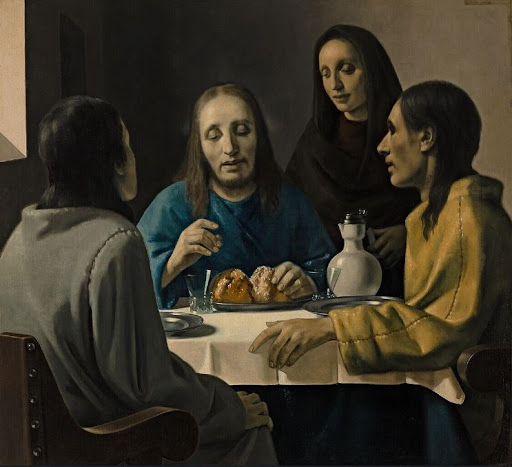
In the case study of Van Meegeren’s forged Vermeer painting, Lessing argues that Vermeer painted in a certain way at “a certain time in the history and development of art” (469). It is Van Meegeren’s manipulation of this historical originality that makes his art inferior, its value as an original work of art illegitimate, and his painting, therefore, a forgery. This assessment is not due to Meegeren’s imitation of Vermeer’s technique, which exists freely in the public domain, instead, it is Van Meegeren’s duplicitous claim that the artwork was a legitimate product of Vermeer’s historical context and imagination that is problematic.
Lessing contends that creativity relative to a context decides artistic legitimacy, but as Michael Wreen points out, this fails to account for contemporary forgery– a Picasso forger acting simultaneous to Picasso worked with the same constraints and resources (or context) as Picasso himself did, perhaps even having a more difficult task of replicating another artist’s style. Like Lessing, Dutton agrees that history is important to our consumption of art and pure aesthetics do not help identifying forgeries, although, for him, it is not originality but the methodical distortion of “artistic achievement” that makes a fraud.
Dutton explains how “reputations of artists are built on what history and taste decides is high aesthetic quality; forgery is an attempt to cash in on such established reputations” (1998). In other words, there is a tradition of valorising certain aesthetics created by certain artists or schools, and it is this trust and valorisation that is exploited by forgeries – the integrity of an artist and their achievement is compromised. Moreover, art, and its appreciation, is a “human activity” because of the “imaginative construction and association” involved in its consumption, and forgery is a betrayal, a fabricated “aesthetic experience” which, to Dutton, is unconscionable.
Lessing and Dutton argued that originality and artistic integrity are valid mechanisms to identify forgeries and legitimate art, but Bowden postulates that while art is assessed as valuable (and real) in an economy because of its creative content, this value comes from a Western belief that art is a means of expression from which novel knowledge about the world can be gleaned. Knowledge, in the European tradition, is not delivered by an unchanging, remote supernatural knowledge, but it is discovered, increases “piecemeal” over time, and is created by “creative, insightful individuals.” Great art, by extension, is something that creates something new, and the novelty of a point of view is crucial in understanding even a painting’s aesthetic components. Aesthetics are applauded for their effectiveness in conveying the novel idea, and in representing the imagination or the expansion of knowledge that they induce.
Knowledge operates within a cultural foundation, and hence for societies which do not believe knowledge is a function of human creation, (Bowden uses the example of the Kwoma society) the process of identifying a forgery is altered, but is still an exercise of legitimation rather than aesthetic scrutiny. For the Kwoma, of course originality and artistic achievement still exist, but they are not the yardsticks used to identify forgeries because the meaning of a forgery is modified in a relativistic way. Here, a legitimate work of art has to do with its “correctness” and ensuring that the art was socially sanctioned or the artist had the mandate to produce, with authority, the work of art.
The specious justification as to why a forgery is harmful is most often a highfalutin allegation of aesthetic inadequacy or visible inferiority in the work of art. Perhaps another common critique of a forgery would be on legal and economic grounds. Yet the true problemitisation of the forgery is answered only when we think about how art can be legitimatised in an economy that values it for specific qualities, and these qualities (be it originality, “correctness,” novel knowledge or human achievement) may vary, relative to the cultures in which they are constructed. For Europeans, legitimacy is accessed through the twin processes of artistic creation and historical context that renders unto a work of art its value. Nowhere, though, is pure aesthetic beauty the basis of distinction between ‘real’ and ‘fake’ art. This leaves us at a place where we recognise that art, at least in the Western tradition, is a sacred space where we can redefine our reality and cultivate an authentic diction through imaginative expression. This is a sacredness worth protecting.
Works Cited
Bowden, Ross. “What Is Wrong with an Art Forgery?: An Anthropological Perspective.” The Journal of Aesthetics and Art Criticism, vol. 57, no. 3, 1999, p. 333., doi:10.2307/432198.
Dutton, D. “Forgery and Plagiarism.” Encyclopedia of Applied Ethics, 1998, pp. 331–338., doi:10.1016/b978-0-12-373932-2.00382-3.
Lessing, Alfred. “What Is Wrong with a Forgery?” The Journal of Aesthetics and Art Criticism, vol. 23, no. 4, 1965, p. 461., doi:10.2307/427668.
 sanjana sheth
Leave a comment