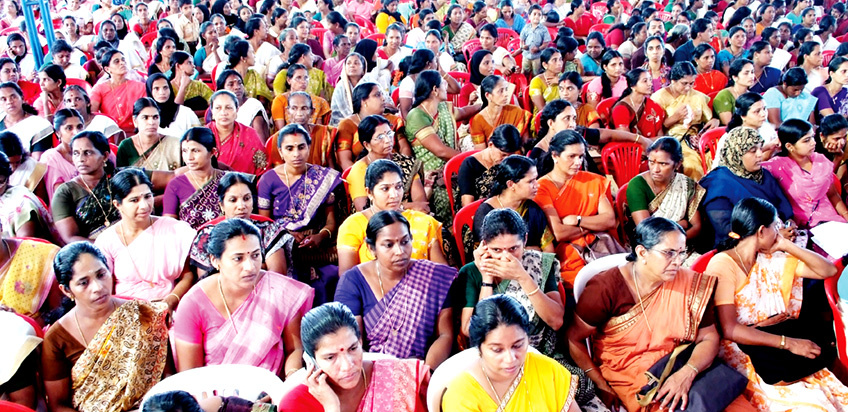
Women’s Welfare in Kerala
“Kerala women have a sense of self-worth,” declares a UNICEF worker in the Indian Express (2007). In 2018, Praveen Kumar notes, “In God’s Own Country, women are being empowered not just economically, but psychologically.” Scholars frequently rank Kerala near or at the top of all Indian states in terms of GDI, an index similar to HDI which measures women’s development (Prabhu et al, 1996; UNDP report, 2009; Panda, 2005).
Its accomplishments are well-known: it has the highest literacy rate for women, a low fertility rate, and is one of the only two states with a sex ratio that favours women (Census of India 2011). However, yoked to this utopian picture of women’s status in Kerala, there are seemingly paradoxical statistics: women’s workforce participation is abysmal, female suicide rates are soaring, there is a negative trend in women’s property rights, and domestic violence is more than just alarmingly high (Devika, 2016; Mitra and Singh, 2007).
For decades, the ‘Kerala Paradox’ was a badge of honour worn by researchers’ encomiums and politicians’ pride; the state had fantastic levels of social development despite low per capita growth. Have things changed – does Kerala now straddle a grimmer paradox – one of gender inequality? Despite the structural support recorded for women through robust healthcare, inclusive education and reserved political representation, why does recent feminist scholarship emphasise women’s distress? In other words, this paper seeks to deconstruct the indexes, structures and socio-economic changes germane to women’s well-being, in an effort to investigate how this ‘paradox’ has been established, and what its implications are.
To address these questions, I will review the relevant literature and assess four possible analyses that explore this issue: what the conventional indices of women’s well-being like literacy and fertility demonstrate; how the reporting of development and violence may have changed; the consequences of the legal reforms of the 1970s, and the workings of the “neopatriarchy” in Kerala.
Conventional Indicators of Gender and Development
Table 1 shows conventional metrics used to assess gender development like literacy, life expectancy, fertility rate and university enrolment rate. These putative indicators safely suggest that women are appreciably better off in Kerala when compared with the rest of the country; women’s literacy is over twenty five percent higher in the state, the average female age at the time of marriage is a little over two years more than the national average, and the maternal mortality rate is commendably low. Still, increasing scepticism is being cast on whether such indices serve as a reliable basis to generalise the overall level of women’s development.
Table 1
| Indicator | Kerala | India |
| Female Literacy | 91.98% | 65.5% |
| Female Life Expectancy | 76 | 62 |
| Average Age at Marriage (Female) | 22.2 | 19.8 |
| Total Fertility Rate | 1.7 | 2.9 |
| Sex Ratio | 1084 | 940 |
| University Enrolment (Female) | 56.8% | 41.5% |
| Maternal Mortality Rate | 46 per lakh | 130 per lakh |
Source: Nair (2012); Census of India (2011); GOK (2003); Hapke (2013).
Decades of scholars have presumed that success on these conventional indices would translate into the real upliftment of women, yet Kerala’s case calls for a revaluation of this fundamental assumption (Eldred, 2014). For example, university enrolment for women is distinctly high, yet this enrolment is characterised by dense concentration in traditionally feminine, “appropriate” fields such as the arts, education and social work. Polytechnic colleges and engineering courses are almost exclusively pursued by men (Hapke, 2013; State Planning Board, 2008). Additionally, the declared sex ratio favours women, but this calculation excludes the vast outmigration of people to the Middle East, of whom 80% are men (Government of Kerala, 2003). If these migrants were to be included in the sex ratio, it would then favour men (Rajan and Sreerupa, 2007). Finally, the high marriage age, particularly for economically weaker sections has been shown to be not a result of progressiveness, but increasingly exorbitant dowry demands that families take more time to raise, delaying marriages (Hapke, 2013). Thus it is safe to conclude that these frequently touted indices cannot be considered absolute indicators of liberal gender ideology, and that Kerala’s quantitative numbers conceal its qualitative conservativism.
Reporting Data – Autonomy, Violence and Suicide
In contrast with the above conventional indices that centre around women’s development where Kerala performed well, there are less popular but more direct indicators of women’s distress that imply a troubling decline in the status of women in recent years. According to the Kerala Police Crimes Record Bureau, violence against women increased by 42 per cent between 2007 and 2011 (2012). Kerala was ranked second in the country in terms of reports filed under the Protection of Women against Domestic Violence Act, 2005 (Hapke, 2013). The state has the fourth-highest suicide rate for women (National Crime Records Bureau, 2013). Fifty per cent of women interviewed by the National Family Health Survey noted that they need permission from their husband to meet their friends or go to the market (Sakhi, 2004). Although dowry deaths in the state are relatively low, dowry-induced torture is rampant, with 30% of married women experiencing some form of harassment due to dowry (Panda, 2005; Kumari, 2001).
These unsettling numbers are often attributed to the better reporting of crimes due to trust in the legal system and its organs, a literate population and general social consciousness (Shukla, 2018; The Financial Express, 2020). Defenders of the Kerala model argue that the status of women is not in decline, that it is not the incidence of crimes against women and suicides that have increased, just that these crimes are recorded more comprehensively. Prima facie, this might be true for a limited number of cases, however, even after adjusting for this unproven, supposed improvement in the reporting of crimes due to social development, the degree of violence remains substantial and underreporting continues to be seen in the state (Epean and Kodoth, 2005). There is little empirical evidence to conflate literacy with increased reporting of violence. Furthermore, Panda and Agarwal discovered that better educated and securely employed women either experience lower levels of violence or, as they contend, these women underreport violence as a result of heightened patriarchal pressures in more sophisticated social strata (2005). Lastly, in spite of high criminal charge sheets, Kerala has a disproportionately low conviction rate for crimes against women (Kumari, 2002).
Therefore, I believe that women’s distress remains unexplained by conventional indicators or the knee-jerk response that there is simply better reporting of data in the state.
Legal Reforms in the 1970s
The legal reforms of the 1970s facilitated two landmark developments in Kerala’s cultural landscape: the decline of the matriliny and the making of education accessible to marginalised groups like backward castes and women. On the first count, Kerala is famous for its matrilineal forms of family which legally recognised and socially sanctioned women’s right to inherit property. Matriliny has historically been associated with women’s relative empowerment in the state since it was often observed with forms of the matriarchy as well as matrilocal residency (Saradamoni, 1994). However, with the transformative advent of capitalism, matriliny was widely seen as antithetical both to commercial enterprise, and to the ‘natural’ authority that men ought to exercise over households and money matters. The realm of economic success was conflated with the masculine, relegating women to marriage and child-rearing (Epean and Kodoth, 2005). As cottage industries and non-mechanised agriculture were replaced by machinery and industrialisation, women’s land ownership steadily disappeared, and with it, went matriliny (Lindberg, 2001).
The prevailing antipathy towards matrilineal authority crystallised into the legal reforms of the early 20th century, which recognised patrilineal inheritance among Hindu and Muslim groups that were traditionally matrilineal (Arun, 1999). Although matrilineal groups from Kerala were not subject to the Hindu undivided family condition, the Hindu Code (1956) was made applicable to Kerala as well, effectively annihilating what little was left of Hindu matriliny (Devika, 2016). This legal ‘reform,’ is both a cause and effect of the conservative social fabric of Kerala; it ushered in “conjugal patriarchy” where the husband’s dominance over the wife was both socially and legally sanctioned (Hapke, 2006). It institutionalised a formation of family life with pre-determined structures of power, division of labour and gender identities.
Access to education is intuitively understood as a way to dismantle patriarchal institutions by spreading the philosophy of modernisation (Eldred, 2014). The reforms, as mentioned earlier, played a pivotal role in providing women with access to education, however, far from unequivocally furthering women’s liberation, the reception, narrative around and deployment of the educational reforms has been decidedly imperfect (Devika and Mukherjee, 2007; Kodoth, 2008). Education, as taught in Kerala, indoctrinated “the ideal of the public-oriented male subject and the modern domestic- oriented female subject,” by bifurcating what its end goal was for men and women (Hapke, 2013). While men’s education was a part of their journey to economic success, women’s educational experience was, and continues to be promoted as grooming for wifehood. Access to education was extended to women – at least in part – not for the sole pursuit of their individual aspirations, but to pander to an image of modernity during the context of rapid commercialisation.
In pushing forth the agenda of education and gender roles at once, an irreconcilable schism has been created for women – at one end, there is the theoretical equality promised by academic learning. At the other end, there is the sealed fate of domesticity that Kerala’s conservative culture peddles (Hapke, 2013). The incongruence between women’s ambitions, as fostered by education, set against the inhospitable workplaces or homes that they must settle for is a source of disillusionment and profound discontent (Mitra and Singh, 2007). Workplaces are plagued with discrimination, and households see domestic violence most commonly justified as a reaction to women’s “disobedience” (Pradeep, 2019).
Further evidence of this fractured reality is seen in research on female suicide rates – markedly high for graduates, and higher still for postgraduates (Epean and Kodoth 2005; Epean 1992). In 2019, MK Pradeep dissected these rates by district and Malapurram was taken up as a focussed case study to examine education’s impact on suicide. Malapurram’s population is predominantly Muslim, and only 15.2 per cent of its people has over 10 years of schooling as opposed to its neighbour Idukki, at 39.3 per cent, which is still lower than the state’s average. Women are married at a younger age, quickly falling into a life of child-rearing, and traditional domesticity. Their labour participation rates are lesser than one fourth that of neighbouring districts. Despite these regressive conditions, Malapurram, shockingly, has the lowest suicide rate in the state. This case posits that through the dialectical processes of empowerment and subjugation, Kerala’s most educated, most independent women endure some of its harshest trauma.
The Neopatriarchy – Employment and a Crisis of Masculinity
Hisham Sharabi coined the term “neopatriarchy” to describe the evolution of the patriarchy in developing countries through modernisation to re-entrench traditional values and social relations within new, capitalistic frameworks (Sharabi, 1992). Hapke (2013) proposes that the neopatriarchy emerged in Kerala as a consequence of commercial, economic transformations “that took place throughout the late nineteenth and early twentieth centuries, and sought to create the modern, governable individual.” In other words, the superstructure of the neopatriarchy is sustained by an economic base of industrialisation and competition. These capitalistic economic changes pushed women into lives of domesticity and discrimination by re-structuring the division of labour within a family in response to globalisation, the politics of women’s employment, and a crisis of masculinity.
From the 1990s onwards, globalisation, liberalisation and a ‘remittance economy’ prioritised economic growth and was accompanied by the rhetoric of masculinity being defined by the assertion of control over a household. At the same time, women were shackled by the process of “housewifeisation,” and expected to look after domestic matters (Hapke, 2013). The remittance-heavy economy valorised the creation of human capital which could be marketed globally as ‘capably raised’ for future labour (Devika, 2016). Consequently, the responsibility of attentively disciplining the “raw material” for Kerala’s “major export” was thrust onto women (Devika, 2016; Weeks, 2007). Moreover, the considerable growth that accrued from liberalising the economy materially improved the lives of several families, meaning that in prosperous households, women did not need to work anymore. Having a family with a housewife instead of a working woman was associated with wealth and sophistication, and therefore became a status symbol emulated by lower class women as well, irrespective of whether a necessity to work existed for them or not.
Next, the politics of women’s employment is a vital indicator of their welfare. The state has one of the lowest rates of female workforce participation in the country (Devika, 2016). One strand of research emphasises how the changes coterminous to the decline of matriliny – like the loss of traditional farming methods and transition to industrial capitalism – unintentionally forced women out of the workforce by rendering their strengths obsolete (Gangadharan, 2008). Alternatively, another strand that is gaining ground claims that there has been a concerted, volitional female exit from the workforce as discrimination and the ideology of housewifeisation have infiltrated society (Hapke, 2006). 51 percent of educated female unemployment in Kerala is attributed to “family problems,” suggesting that a permutation of women’s family enforcing that they stay at home in tandem with their own internalisation of the ‘women-as-home-bound’ view has wrought women out of the workforce (Mitra and Singh, 2007). The women still working are stigmatised in light of the neopatriarchy and, even today, they prefer employment in the public sector where there is less scope for differential treatment and the capacity for upward mobility is protected and relatively less gendered when compared to the private sector (Mitra and Singh, 2007).
These processes – globalisation, remittance-based economics and housewifeisation – have given immense power to the idea that women must cultivate a “balance” between their individual personalities and their domestic duties (Devika, 2016). However, in practice, it is rarely a ‘balance’ that women are expected to maintain; it is more aptly described as an expectation of subservience of the self in order to serve children, husbands, the economy. One study that focussed on how domestic violence is enabled by the neopatriarchy found that when women “disobey” this rigid prescription of gender roles in an abusive household, men and mother-in-laws rationalise violence against women by blaming them for ‘not looking after children properly’ (78 percent); ‘not attending to household’ (72 percent); and ‘not cooking properly’ (54 percent) (Panda, 2005).
Lastly, the hegemony of the neopatriarchy in the context of men’s unemployment has incited an unprecedented crisis of masculinity for Kerala’s men. The high levels of education have not seen correspondingly high job creation, leaving men unemployed while expectant of more from their lives due to the rhetoric of the neopatriarchy and dreams of capitalistic success. In other words, the prevailing gender roles demand that men economically provide for their families and allow their wives to stay at home. Their inability to do so has put crippling pressure on men, often manifesting in domestic violence (Hapke, 2013). Violence against women is also more common in households where a woman is married to a man who is less educated than her (Epean and Kodoth, 2005). Here, when the economic defects of unemployment and the tyranny of hypermasculine expectations of ‘breadwinning’ both structurally fail men, it is women’s danger and lack of agency that is exposed.
Concluding Remarks
At the outset of this paper, when women’s deteriorating state in Kerala despite structural support was termed a “paradox,” I believe a final, novel problem appears: the framing of Kerala’s gender-related discourse in academia and politics. Academic studies describing the ‘Kerala model’ frame their research to encourage the conclusion that some developmental discrepancies like different rates of literacy for men and women, high domestic violence, or low workforce participation, are “minimal and can be entirely overlooked… certain asymmetries between genders are taken for granted and glossed over as insignificant” (Sreekumar, 2007). Several scholars have resisted capturing the complete truth of women’s condition in Kerala because of the internal contradictions its model presents; there is no paradox that needs to be resolved if the existence of the paradox is itself rationalised away. This rationalisation, though, normalises a degree of oppression and praises wide reporting of crime instead of investigating why wide levels of crime exist. It is only paradoxical for women in Kerala to continue to face persecution despite high literacy rates if education is treated like a silver bullet in women’s welfare. Abstract, unquantifiable indicators like equality, justice, agency and respect are the terms in which recent feminist researchers are evaluating gender development (Devika 2016).
In the same vein, in politics and social movements, women’s oppression is again framed as minimal and subsumed under a larger fight against class oppression (Devika and Sukumar, 2006; Rey, 1998). After structural provisions for women’s political representation were made, there was little effort to cultivate a culture of real female empowerment in politics beyond the tokenistic representation itself (Hapke, 2006).
Hence the concept of a paradox is reductive inasmuch as it homogenises the two conflicting worlds of women’s status in Kerala – structural liberation and orthodox oppression – without considering that they might exist together, at times in tension with each other, but other times as mutually reinforcing systems. In summation, the idealised perception of the Kerala model of development and its much-lauded gender equality belie a darker reality of violence and oppression. High female literacy rates cannot serve as a panacea to deeply patriarchal societies, and modern structural changes, if not accompanied by an effort to dismantle the conservative social and cultural fabric, can do more harm than good.
Instead, the patriarchy must be dismantled through critically engaging with the legal, ideological and material phenomena that sustain patriarchal institutions and mindsets. Sharmila Sreekumar writes in 2007, “Modernity, it turns out, is a two‐way street stretching in opposite directions and leading to different worlds. Only, in contemporary Kerala, they are simultaneous in space and time.”
Works Cited
Arun, Shoba. (1999). Does land ownership make a difference? Women’s roles in agriculture in Kerala State, India. In C. Sweetman (Ed.), Women, land, and agriculture (pp. 19–28). London: Oxfam.
Devika, J. “The ‘Kudumbashree Woman’ and the Kerala Model Woman: Women and Politics in Contemporary Kerala.” Indian Journal of Gender Studies, vol. 23, no. 3, Oct. 2016, pp. 393–414, doi:10.1177/0971521516656077.
Devika, J. (2002). Imagining women’s social space in early modern Keralam (Working Paper 329). Trivandrum: Centre for Development Studies.
Devika, J., & Sukumar, M. (2006). Making space for feminist social critique in contemporary Kerala. Economic and Political Weekly, 41(42), 4469–4475.
Devika, J., and Mukherjee, A. (2007). Re-forming women in Malayalee modernity: A historical overview. In S. Mukhopadhyay (Ed.), The enigma of the Kerala woman (pp. 102–130). New Delhi: Social Science Press.
Eldred, Janine. Literacy and Womens Empowerment Stories of Success and Inspiration. UNESCO Inst. for Lifelong Learning, 2014.
Epean, Mridul, and Praveena Kodoth . “Looking beyond Gender Parity: Gender Inequities of Some Dimensions of Well-Being in Kerala.” Economic and Political Weekly, vol. 40, no. 30, June 2005, https://www.jstor.org/stable/4416933.
Erwer, M. (2003). Challenging the gender paradox: Women’s collective agency and the transformation of Kerala politics. Goteburg, Sweden: Department of Peace and Development Research, Goteborg University.
Government of Kerala (GOK) (2003). Women in Kerala: 2001. Directorate of Economics and Statistics. Trivandrum: The State Government Press. Retrieved May 5, 2020, from Kerala State Women’s Development Corporation website, http://www.kswdc.org/
Government of Kerala (GOK) (2012). Status of women. Official Web Portal. Retrieved May 7, 2020, from http://www.Kerala.gov.in
Hapke, H.M. (2001). Gender, work and household survival in a South Indian fishery. Professional Geographer, 53(3), 313–331.
Hapke, H.M. (2006). Gulf migration and changing patterns of gender identities in a South Indian Muslim community. Paper presented at annual meeting of the Association of American Geographers, Chicago.
Hapke, Holly M. “Theorizing Patriarchy: Development Paradoxes and the Geography of Gender in South Asia.” Gender, Technology and Development, vol. 17, no. 1, 2013, pp. 1–29., doi:10.1177/0971852412472121.
Kerala Police Crimes Record Bureau (2012). Crimes Against Women 2011. Retrieved May 5, 2020, from http://www.keralapolice.org/newsite/ crime_against_women.html
Kumar, Praveen. “Women’s Empowerment in Kerala: From Loans to Education about Laws, State Initiative Seeks to Change Lives.” Firstpost, 24 Jan. 2018, http://www.firstpost.com/india/womens-empowerment-in-kerala-from-loans-to-education-about-laws-state-initiative-seeks-to-change-lives-4317591.html.
Kumari, Anitha. “ Crimes Against Women In Kerala: What Do The Trends Reveal? .” The Journal of Family Welfare, 2001.
Lindberg, A. (2005). Modernization and effeminization in India: Kerala cashew workers since 1930. Copenhagen: NIAS Press.
Ministry of Women and Children, UNDP. “Gendering Human Development Indices: Recasting the Gender Development Index and Gender Empowerment Measure for India.” GDI, 2009, http://www.undp.org/content/dam/india/docs/gendering_human_development_indices_summary_report.pdf.
Mitra, Aparna, and Pooja Singh. “Human Capital Attainment and Gender Empowerment: The Kerala Paradox.” Social Science Quarterly, vol. 88, no. 5, 2007, pp. 1227–1242., doi:10.1111/j.1540-6237.2007.00500.x.
Nair, Preetu Venugopalan. “Enrolment of Women in Higher Education Increases – Times of India.” The Times of India, Education, 3 Sept. 2012, timesofindia.indiatimes.com/home/education/news/Enrolment-of-women-in-higher-education-increases/articleshow/16244028.cms.
Panda, Pradeep Kumar. “Domestic Violence against Women in Kerala .” Kerala Research Programme on Local Level Development, vol. 85, 2005.
Prabhu, K. Seeta, et al. “Gender-Related Development Index for Indian States: Methodological Issues.” Economic and Political Weekly, vol. 31, no. 43, 1996, pp. WS72–WS79. JSTOR, http://www.jstor.org/stable/4404711. Accessed 3 May 2020.
Pradeep, MK. “Educated Unemployment Among Women- A Study With Special Reference In Wandoor Grama Panchayath.” EPRA International Journal of Economic and Business Review, vol. 7, no. 6, June 2019, https://eprawisdom.com/jpanel/upload/articles/939pm9.Pradeep M B.pdf.]
Rajan, S.I., & Sreerupa (2007). Gender disparity in Kerala: A critical reinterpretation. In S. Mukhopadhyay (Ed.), The enigma of the Kerala woman (pp. 32–70). New Delhi: Social Science Press.
Ray, Raka. “Women’s Movements and Political Fields: A Comparison of Two Indian Cities.” Social Problems, vol. 45, no. 1, 1998, pp. 21–36., doi:10.1525/sp.1998.45.1.03x0155y.
Sakhi. (2004). A study on gender based violence in Kerala. Submitted to the Department of Health, Kerala State. Trivandrum: Sakhi Resource Center for Women.
Saradamoni, K. “Kerala Society and Politics”, International Congress on Kerala Studies. Vol. 1. Thiruvananthapuram: AKG Centre for Research Studies. 1994.
Sen, Purna. ‘Development Practice and Violence against Women’, Gender and Development, 6 (3). 1998.
Sharabi, Hisham. Neopatriarchy: a Theory of Distorted Change in Arab Society. Oxford University Press, 1992.
Sreekumar, Sharmila. “The Land of ‘Gender Paradox’? Getting Past the Commonsense of Contemporary Kerala.” Inter-Asia Cultural Studies, vol. 8, no. 1, 2007, pp. 34–54., doi:10.1080/14649370601118966.
State Planning Board (2008). Economic Review. Government of Kerala. Retrieved May 5, 2020, from http://www.spb.kerala.gov.in/old/html/eco_2008/2008_ch_8.pdf
Thapan, M. (2001). Adolescence, embodiment and gender identity in contemporary India: Elite women in a changing society. Women’s Studies International Forum, 24(3/4), 359–371.
Williams, Raymond. “Raymond Williams, Base and Superstructure in Marxist Cultural Theory, NLR I/82, November–December 1973.” New Left Review, 1973, newleftreview.org/issues/I82/articles/raymond-williams-base-and-superstructure-in-marxist-cultural-theory.
 sanjana sheth
Leave a comment