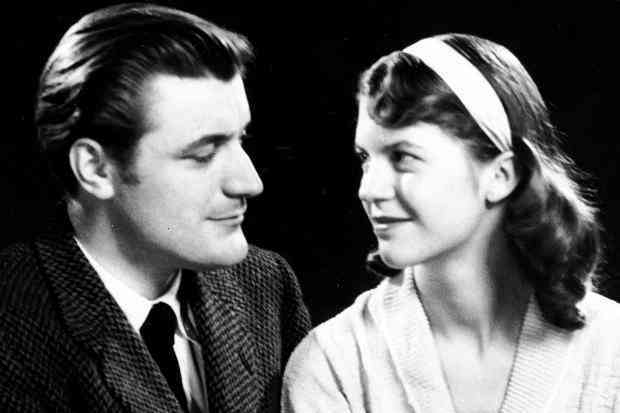
Reading ‘Stillborn’ by Sylvia Plath and ‘The Thought Fox’ by Ted Hughes with Michael Foucault and Louis Althusser
Metapoetry, or poetry about the art of writing a poem, is an idea widely explored by poets but sparsely analysed by critics. ‘Stillborn’ by Sylvia Plath and ‘The Thought Fox’ by her husband Ted Hughes are two terrific, polar metapoems which illuminate how vastly different the creative process can be. ‘Stillborn’ is an almost-epitaph for Plath’s almost-poems that are mummified through the sepulchral extended metaphor of a stillborn child. The exhaustion inherent to Plath’s experience with writing poetry is on display as she mourns the tormenting loss of the poems that failed to live and now float in preservatory pickling fluid. In ‘The Thought Fox,’ Hughes is Romantically sitting at his lonely windowsill, scouring the starless night for an ‘aha-moment’ when he has an imagined, mythologised encounter with a fox that ultimately conterminously leaves the poem’s space and becomes the poem itself.
By the end of its first line, ‘The Thought Fox,’ has made three allusions to opening lines from canonical poetry. There is Blake’s forest from ‘Tyger,’ a careful description of the scenery from Coleridge’s ‘Frost at Midnight,’ and Hopkins’ alliterative ‘m’ from ‘Windhover.’
“I imagine this midnight moment’s forest,” he says; the line stretching itself out with the assonant, confident, “I imagine,” and languidly, embossing the phrase with “midnight moment’s.” This expositional repetition of sounds moves like royalty; it is rich, loaded, and yet slow-moving, Hughes knows it has the reader’s attention. In contrast, Plath’s first lines cosh her reader with blunt force: “these poems do not live:” she states, a caesura slicing the line in half, “it’s a sad diagnosis,” she laments. Like Hughes’ opener, this line, too, has eleven syllables, but Plath’s taut abruptness reads almost like the by-line of a news report or an unfortunate medical result.
The poets’ choice of conceits is the root from which their metapoetic differences grow. Hughes offsets the lengthy opening line with an urgent realisation of something else being “alive.” Animals, crucially, are vital, breathing, dynamic organisms, which is precisely what Hughes sees his poetry as. Further, the deliberate choice of the titular fox highlights the passivity Hughes associates with the process of writing. After the first “I imagine,” his active presence in the poem is subsumed to the poetic impulse embodied by the thought fox, thereby divorcing his being from his work. The archetypal canniness of the fox is credited with culling inspiration from the dark recesses of Hughes’ unconscious[1]. For example, we are told that the fox is deftly performing “its own business” and that finally, “the page is printed,” which suggests a passive Hughes, serving only as a receptive vehicle to the thoughts that empower his art.
On both counts, Plath’s conceitof a stillborn child diverges from Hughes’. Not only is a stillborn a far cry from the animated fox, but until the penultimate line of her poem, the stillborn child is sentenced to a purgatory of being not alive, and yet, not quite dead. The fully-formed poems whose lifelessness bewilders Plath are compared with the fully-formed stillbirths who “grew their toes and fingers well enough.” Both are mechanically sound to the best of her capabilities as a poet and a mother, hence their lifelessness is difficult for her to reconcile. When Plath is eventually forced to accept their deaths, with it, she accepts her own moribund state. The metacommentary of this conceit does not resuscitate a poet from writer’s block as we see in Hughes; instead, it further unhinges her grasp on the creative process. Juxtaposing the passivity of Hughes’ poems, Plath’s conceit implies the painful involvement of a miscarriage. Her poems are not external animals, they are umbilically connected to her emotional and physical being, and she gave a part of herself to nurture, form and care for them. Their loss is elevated to the loss of a child, and running through the poem is the intensity of a histrionic mother fervently asking why.
In addition to the theme of the creative process, Hughes explores time and loneliness. He displaces his alienation onto a clock, whose agitating ‘ticks’ are suspended only when Hughes begins to write: “that now / And again now, and now, and now” suggesting that temporal constructs have dissolved until the poem is finished after which the “clock ticks” once again. Plath, on the other hand, addresses failure, her desperation to reach perfection and self-lacerating tendencies. “It wasn’t for any lack of mother-love,” she repeatedly assures us, while pleading with herself and the reader that she has done her best by manically detailing her stillborn children’s adequacy in “shape and number and every part.” For Hughes, it is the clock which mocks him. As Plath shows in a shocking image, it is the stillborn children who “smile and smile and smile” at her; the worst taunts delivered by her eerie offspring.
This theme of failure and self-deprecation is conveyed most cuttingly through her Salingerian diction: it is a diction of campy irony, dark humour and slick sarcasm. “O I cannot explain what happened to them!” sounds hyperbolic and twistedly performative, as does “They sit so nicely in the pickling fluid!” A veneer of hyperawareness of her own shortcomings and strengths coats every word: her stillborn poems “stupidly stare and do not speak of her.” Not ‘to’ her or ‘with’ her, but of her. Perhaps the children are disappointed in her, so they stay mute, or perhaps Plath believes that they do not entirely represent her – both interpretations are possible. Plath’s tone is morbidly jaunty when she, in a cutting allusion to Hughes’ penchant for animal poetry, remarks that her poem-children are neither pigs nor fish, though they do have a “piggy and a fishy air.” Plath appears to be ridiculing his motifs by trivialising them.
In ‘The Thought Fox,’ we see an extraordinary modulation of urgency and stealth, not unlike the thought fox’s actions. Hughes succeeds in resolving any tension between meditation and movement. The immediacy evoked through the present tense is heightened by his constant, secure use of enjambments that flow through the poem and are tempered by filled, majestic lexical decisions like, “widening deepening greenness” or through the slow force of, “that now / And again now, and now, and now.” Hughes’ imagery is sentient: “with a sudden sharp hot stink of fox,” we are brought stunningly close to the fox and held hostage by the sensuous language. Hughes sounds coolly self-assured: he describes “a body that is bold to come,” silently presupposing the existence of the body and of the poem.
‘Stillborn’ breaks down. At the tail-end of the poem, prosaic language and unwieldy, long lines infiltrate Plath’s last quintet. “It would be better if they were alive, and that’s what they were. / But they are dead, and their mother near-dead with distraction,” she notes. This movement towards deconstructed line breaks could be Plath’s tensely self-aware, dark humour; she offers the briefest suggestion that this, too, would be a stillborn poem, before reeling back into her usual, tighter line length. Her deadpan devastation is supported by internal rhymes that produce the jarring effect of a nursery rhyme, “And still the lungs won’t fill and the heart won’t start.”
For Hughes, poetry “Sets neat prints into the snow” after being cleanly swept into an intelligent, masterfully compiled reverie of poetic inspiration. Time stops as he manoeuvres through the layered mind of the imagination. He is composed and confident in his craft. For Plath, poetry involves failure. It means bleeding one’s very being into the body of a poem and knowing it could all go wrong. As metapoems, they share little but an acknowledgement of the interior gymnastics that are required to write poems that are “alive.” Hughes wrote of ‘The Thought Fox,’ “a long time after I am gone, as long as a copy of this poem exists, every time anyone reads it the fox will get up somewhere out of the darkness and come walking towards them.” In the case of these two poems, it is not only the fox that gets up and walks towards us or the sight of the stillborn child, but it is a palpable journey through Hughes’ and Plath’s creative process.
But this analysis is incomplete. At this point, most literary critics would introduce the fulcrum upon which the above comparison is believed to rest: context. The reason that I chose to compare the metapoems of Hughes and Plath, and not Larkin and Pound or Heaney and Atwood, is because of the biographical context which I presumed would make for a more provocative and meaningful reading of metapoetry. Their names connote much more than simply this textual work; ‘Hughes’ and ‘Plath’ carry, as part of the composition of context, the reputation of their other work, their marriage, and Plath’s gender[2]. Their marriage makes these metapoems piquant counterpoints to show how, despite a matrimonial unity which tinted the couple’s personas in the popular literary imagination, their experiences of creative writing were fascinatingly different. Never mind if there are other poems which better show contrast within the form of metapoetry, these have the irresistible additive of buzz, of gossip, of living mythology. It is rare (and I am tempted to say impossible) to find an analysis of Hughes or Plath’s poetry devoid of any reference to their marriage. What I refer to as additives are more serious than their name implies; the urge to assign meaning based on the context of authorship is a resilient habit of the literary sphere, but inevitably, much of this exercise of furnishing a poet’s ‘context,’ goes beyond inconsequential biographical fact and bleeds into the lens with which the text is read. In order to illustrate why this is necessarily deleterious, we must refer to Foucault’s 1969 lecture, ‘What is An Author?’.
The author’s name, (which can be read in our case as the poet’s name) is certainly the designation of a particular sign to an individual. In addition, it serves as a description of biographical information about the author, which includes their identities, their other works, and the personal context in which they wrote them in. Their name delineates the particular boundaries of a specific kind of discourse within which the poet operates. It prescribes and attests for the existence of a prevailing treatment of a strand of discourse. In other words, we may consider there to be a topographical economy of discourses which is made possible by the existence of and in comprehensive control of the assorted works produced by a culture. The relationship between an author, their work, and the discourses concerned with them is negotiated through an extensive, complex set of operations that create a subjective position for the text and its author to occupy within the arrangement of the economy. These discourses circulate in society and are mediated by cultural forces which determine how a literary text is rated, appraised and received, which is to say that, as members of a cultural climate, the manner in which we read texts is ordered by the nature of the discourse that the text is derived from and composed of.
Foucault would, rather disparagingly I imagine, describe the metapoetic comparative analysis that has been supplied above as a mere response to the question, what have Plath and Hughes revealed of their “most profound” selves in their language (Foucault, 1969)? He is much more concerned with questions such as “‘What are the modes of existence of this discourse?’ ‘Where does it come from; how is it circulated; who controls it?’” Essentially, through the Foucauldian mould of criticism, a work should be interrogated as a multifarious and variable form of discourse. What follows is that authors are not reduced to functions of their life’s trajectories which they express in their work, and works are not reduced to functions of an author’s biography. Instead, the ‘author-function’ posits that authors and their works are conduits of discourse, capable of founding schools of discursivity and reconfiguring what a rule is or what is possible in their respective realms of discourse.
Returning to the analysis of ‘The Thought Fox’ and ‘Stillborn,’ I seek to demonstrate how biographical (matrimonial, gendered) or formalist approaches to literary analyses elide the alternative, vascular interpretations of the poems which could examine the conditions, rules and positions of discourse. Foucault notes that “the ‘author-function’ could reveal the manner in which discourse is articulated on the basis of social relationships.” Social relationships can be understood as stratifications in society on the grounds of gender, class, race and so on, which determine the methods of circulation of discourse. Foucault posits that “the comparisons we make, the traits we extract as pertinent, the continuities we assign, or the exclusions we practice,” are all “projections” of “of our way of handling texts,” that is, are all governed by the social relationships of the culture in which the texts are critiqued. This capacity of the ‘author-function’ to illuminate the maze of social relationships is enabled not only through the discursive implications of literary decisions in a text, but also its valorisation and positioning in the economy of a given culture. Larger, holistic readings of both poems are prevented by the social relationships in the microcosm of literary circles, no different than the social relationships of the larger macrocosm.
Literary gatekeeping can be thought of as a layered framework of these social relations: Hughes and Plath are often yoked to each other through matrimonial readings of their poetry which prevent a more nuanced take on their works. For example, in ‘Stillborn,’ Plath notes that “they are not pigs, they are not even fish,” and this is marked as a ‘matrimonial’ allusion to Hughes’ animal poetry, which she seems to scorn due to their private conflicts at the time. In making this link, which may well have been Plath’s intention, we ignore that she may have chosen ‘unpoetical’ childish epithets to build the mise en scène of a nursery which could also be a revolt against domestic life and the erudition of modern poetry. In ‘The Thought Fox,’ Hughes’ work is allowed to be inducted into the hall of metapoets because when there is an overarching poetic tradition at stake, his marriage is not considered as important to his work as the purposive choice to write a metapoem. ‘Stillborn,’ however, cannot overcome the constraints imposed by Plath’s status as a ‘confessional’ poet, a wife, and a mother in order to be read as a metapoem because these designations are asymmetrically applied to a woman. Her being a wife or a mother carries greater force than Hughes being a husband or a father because of how the patriarchy is projected by us onto their work.
The very act of writing metapoetry is an attempt to cast distance into the sequestering of her work as exclusively ‘women’s writing’ or ‘confessional’; in ‘Stillborn’ she insists that she is not just a woman confessing her woes of motherhood. Along with that, she is also a writer describing the creative process. As established, the culture of the patriarchy that infests the male-dominated modernist tradition of literary gatekeeping denies her entry into larger metapoetic commentary. Her conceit of a stillbirth evidences how women perceive poetry and their art as children. Plath would go on to have a miscarriage of her own the year after the poem was written, but this temporal fact matters little in how the poem is repeatedly analysed by multiple critics as a representation of her own struggle with bearing children (Mahoney, 2013; Scutter, 2019). Plath is generally deemed a ‘confessional’ poet and a ‘women’s poet,’ both categorisations which fuel the expectation that this poem would document her innermost account of and emotions regarding motherhood and domesticity. The theme of failure and self-deprecation is unsurprising, given the patriarchal culture where women’s art was devalued to the point that women commonly internalised fears of inadequacy. In contrast, Hughes’ boldness and confidence in his imaginative powers display an easy platforming of men’s writing, or as it is better known, writing, in that discursive economy. At the time of the poem’s conception, he was not the poetic luminary he is now, yet there is little trace of hesitation and uncertainty in his creative process as we see it in ‘The Thought Fox.’
So far, I have explored the creative contents of the poems and how our readings are informed by discourses that prohibit and prescribe frameworks to read poems. However, both the poets themselves and readers such as myself are complicit in these restrictive readings due to the internal, eternal invasion of “ideology” in our schemas as detailed in Louis Althusser’s essay, ‘Ideology and Ideological State Apparatuses’ (1970).
According to Althusser, ideology comprises the imaginary relations that represent the real conditions in which people live; it refers to modes of thinking constructed by the distortion of reality through individual perception and the agents of socialisation. The function and necessity of all ideology is to perform the task of “subjection,” that is, to transpose discrete individuals into subjects of an ideology by means of what Althusser terms, “interpellation.” Ideological State Apparatuses (ISAs) are systems that enforce ideology and “recruit” subjects primarily through modern education, but also by way of other institutions like the family and the media. While ideologies can be plural[3], the segment of the ISA that applies to this paper is an apparatus which indoctrinates gendered relations of thought, interaction and behaviour. This has manifested in the behemoth that is the patriarchy.
The interpellation of individuals as subjects is not always subliminal or unconsciously achieved, they are generally aware of their subjection to ideology in some way or the other, but this does not preclude the interpellation itself. The cognisance of one’s subjection is termed “recognition” and poetry, being an art of representation, takes on the implicit initiative to portray ideology. Whether the portrayal of ideology is approached through direct illustration, subversion, or resistance against representation is immaterial – poetry, like everything else, is inescapably bound by the omnipresence of ideology. The act of engaging in ‘meta’ poetry is an effort to recognise not just ideological subjection on the first level, which is the level of the representation of imaginary relations, but a recognition of the interpellation of subjects that occurs on the level of the processes that produce the representation of ideology.
‘The Thought Fox’ can be used to clearly understand this sort of ‘double recognition’ which poets believe they have accomplished. The primary representation of the distorted reality refers to the depiction of an encounter with a fox in a forest. By choosing to write a metapoem, Hughes charts out how this process of representation has happened at all. He exhibits recognition in that there is a concerted distortion of reality which is taking place in his ‘poeticisation’ of a fox, and he then proceeds to dissect how he, as a subject[4], represents this distortion and others like it in his poetry. Of course it is not the details of the fox’s appearance which are reflective of the imaginary relations in society, but the author’s treatment of them and critic’s reception of them that expose social relations that rule over discourse. Foucauldian criticism demands that stylistic devices, choices of metaphors, and so on are all scrutinised not in terms of what they tell us about Hughes’ state of mine or his marriage with Plath, but in terms of what discourse they relate to, their thematic significance and discursive innovation or subjugation. Per the aforementioned analysis of the variable nature of discourse, the poem is in conversation with the metapoetic tradition and the mechanics of the creative process, but it is also a text which exposes the selective platforming of individuals on the basis of their gender and how matrimonial relations shift the perspective with which a culture consumes literature. These inferences are not immediately visible to readers, and despite the meta-ness of Hughes’ poem, neither are they immediately visible to Hughes. Hence, while Hughes might appear to be self-aware of how ideology shapes his writing on the primary level (in that it is representative), this recognition in no way liberates him from the prescriptions of ISAs.
Plath, on the other hand, is what Althusser would call a “bad” subject. ‘Stillborn’ shows “cynicism, contempt, arrogance, confidence, self-importance, even smooth talk and cunning” against the ISAs of the patriarchy and misogynistic literary gatekeeping that restricts the way her poetry is consumed. Despite her rebellion against these ISAs, she is nevertheless their subject and beholden to them. Her treatment of the experience of giving birth to a stillborn is brash, disturbing and defiant to what is expected of women writers, but it continues to be part of the patriarchal framework inasmuch as in it, motherhood is given credence by being the object of her poetry at all. Irrespective of the separation she writes into her lines by subverting domesticity with dark humour, her firmament is indubitably a part of an oppressive ideology.
Similarly, as a reader, when I used Hughes’ boldness as an indication of masculine platforming and culturally-sanctioned confidence, or Plath’s conceit of stillbirth as evidence of her enduring, internalised conviction that women’s metaphors are restricted to those of motherhood and domestic life, I am also liable to the critique that it is my own subjection to the patriarchal order that motivates such observations. The point is that individuals consider themselves exempt from ideology through stabs at self-awareness, despite the irrefutable logic of ideological subjection as a continuous, inescapable process.
The idea that context is crucial to the way a literary text ought to be read is a salvageable claim if our conception of context is expanded to a discursive and structural concept, and not just a biographical one. Althusser comments in passing that “every individual is called by their name, in the passive sense, it is never they who provide their own name.” In conclusion, there are numerous systems and structures which produce a text, never just an individual author, but always ideological subjects. No matter how ‘meta’ their writing or our critique, the work is still a vessel of ideology, bound by its topographical location in an economy of discourse.
This paper began as a critical comparison of poetry and went on to comment on the ‘meta’ creative processes involved in their production. Next, it expanded its scope to questing the nature and positioning of even those discourses which were hidden by cultural forces and social relationships. In turn, the pursuit of discursivity disclosed the prevalence of ideology in framing not only how we read or write, but also think. The power of a singular text in reshaping, representing or understanding cultural landscapes is mired in a host of other discursive and structural operations. Distilling into simple biography the extensive networks that produce literature is not only a futile exercise, it misses the point of literature at all.
Works Cited
Hughes, Ted. “The Thought-Fox.” Thom Gunn and Ted Hughes: Selected Poems. London: Faber, 1962. 35. Print.
Summerfield, Geoffrey, ed. Worlds: Seven Modern Poets. Harmondsworth: Penguin Books, 1974. Print.
Mahoney, Blair. Poetry Remastered: a Practical Guide for Senior Students. Cambridge University Press, 2013.
Scutter, Richard. “Stillborn – Sylvia Plath – Analysis.” My Word in Your Ear, 26 Oct. 2019, mywordinyourear.com/2019/10/27/stillborn-sylvia-plath-analysis/.
“A Close Reading of ‘The Thought-Fox’.” The British Library, The British Library, 23 Dec. 2015, www.bl.uk/20th-century-literature/articles/a-close-reading-of-the-thought-fox
Foucault, Michael. “What Is an Author?” 1969, doi:10.4324/9781912453238.
[1] This is an idea that takes full form in ‘Pike’ where Hughes confronts his fears of darkness within people’s hearts that might surface during creative processes.
[2] This is, of course, a non-exhaustive selection of the connotational baggage most relevant to their biography. It is only for the analytical purposes of this essay that segments of their identity can be regarded more or less defining.
[3] This is only one example of an ideology. In his essay, Althusser focuses on how ISAs are repressive tools deployed by the ruling class and its organs in order to maintain the oppressive systems of capitalism. Here, what is relevant is the gendered oppression which arises from social relationships that are constructed and maintained by ISAs.
[4] Hughes’ recognition of his interpellation is not equally applied across different ideologies. While he may be aware of certain aspects of how he performs the process of writing a poem, he might not be aware of other aspects like how his class or gender is also a part of that process.
 sanjana sheth
Leave a comment