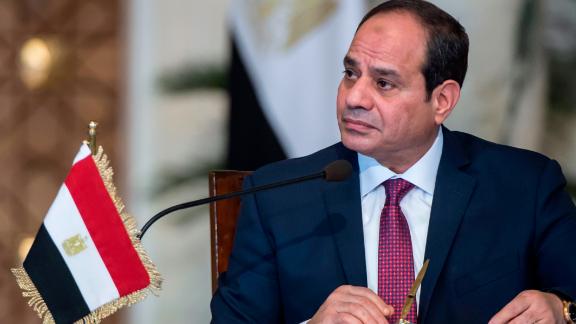
The Middle East’s experiences with sustaining democratic states or backsliding into authoritarianism are of unique theoretical significance. In these post-revolution states, there is much analytical scope to assess the efficiency and vulnerabilities of democratic transitions contemporary to an age where the West has naturalised democracy both as ideal, and the only acceptable pis aller.[1] In particular, Egypt’s tumultuous path under Al-Sisi has been shaped by inveterate militarism, struggling secularism, and brutal repression.[2]
Beyond Egypt, the modern world’s relationship with democracy is complicated by a lack of transparency and the fusillade of contradictory stories regarding democratic developments and regressions. I contend that Egypt, under Al-Sisi, cannot be termed a democracy. Using a procedural conception of democracy and the Democracy-Dictatorship Index, I show how Al-Sisi’s failure to transfer power to another political party and manipulation of electoral rules costs Egypt its democratic status.
Scope and Egypt’s Political Context
This paper’s focus is restricted to Egypt under the presidential rule of Abdel Fattah Al-Sisi – from May 2014 to the present day. It was against the backdrop of political insecurity in 2013 that Al-Sisi rose to eminence. He branded himself as the only leader reliable, visionary, and capable enough to lead an Egypt unstable and discontented in the wake of the Arab Spring’s failure to bring peace and prosperity to the country.[3] Catalysing the Arab Spring in Egypt, the Muslim Brotherhood was an Islamic group instrumental in toppling Hosni Mubarak’s regime by promising Egypt a revival of Islam’s relevance in a new, modern, democratic state. [4] Mohammed Morsi, of the Brotherhood, was elected president in Egypt’s first free and fair elections. However, the brief spell of revolutionary hope for Egypt’s fledgling democracy was quickly marred by the Brotherhood’s bald attempts to impose Islamic fundamentalism on its citizens. Morsi ruled for just a year before civilian unrest created an opening for then-Commander-in-Chief of the army and Defence Minister Al-Sisi to orchestrate a coup d’état with the Supreme Military Council on 3rd July, 2013.[5]
Despite the progress and democratisation Al-Sisi promised voters in 2014, after just one year in power, Human Rights Watch described this year as a “year of abuses.”[6] In 2019 The Times referred to him as “one of the most authoritarian leaders in the Middle East.”[7] In 2020 Foreign Policy asserted that Al-Sisi was “worse than Mubarak,” who had turned Egypt into “a personalist dictatorship.”[8] This paper evaluates whether such allegations of Egypt’s dictatorial status can be confirmed through an objective measurement of democracy.
Conceptualising Democracy
The paper employs Robert Dahl’s procedural conception of democracy, “which classifies political regimes only in regard to their institutions and procedures.”[9] This minimalist conceptualisation stands in contrast to substantive definitions of democracy which evaluate and classify states not only on the basis of their institutional and electoral frameworks, but also on the specific outcomes they produce, such as economic and civil justice, internet freedom, and other descriptive rights. Dahl argued that finding a ‘real’ state which met the expansive ideals of a substantive conception of democracy was a tall order – if not entirely impossible. Hence, not only would Egypt easily fail to meet the demanding requirements of a substantive democracy, nearly every other country would fail too, making such a metric unhelpful for this paper’s investigative and classificatory aim.
Dahl records two axes that comprise his procedural democracy. First, there is contestation, or assessing the degree of competition permitted by the ruling party – it asks whether citizens can form political parties, compete in elections, advocate for policies, and express their opinions. Secondly, Dahl emphasises the importance of measuring the level of inclusion in a democratic system. This examines whether there are barriers to participation for certain groups. This axis’ relevance has declined as most countries adopted universal adult franchise; Egypt has allowed universal suffrage for adults since 1956.[10] Working off of Dahl’s procedural conceptualisation, the Democracy-Dictatorship Index’s (hereafter “DD”) framework of classification understandably sidelines inclusion and expands upon the relevance of contestation for a democracy.
Democracy-Dictatorship Index
Dahl’s conceptualisation of democracy operates on a continuum where countries can be more or less democratic per the degree to which they uphold contestation and inclusion. The DD replaces this with a dichotomous approach; countries either are democracies or they are not.[11] This clear, binarist classification benefits this paper’s analysis inasmuch as we are concerned with Egypt’s status as a democracy at a given period of 2014-2021. Perhaps for a report contrasting its democratic character under different leaders, or differentiating between countries’ levels of democracy other measures like Polity IV or Freedom House’s continuous scale would be more suitable.[12] Further, DD has a set of four cut-and-dry rules, all of which must be followed if a country is to be a democracy – unlike the more subjective and descriptive indices other measures rely on. Thus, DD’s metric is easier to replicate (and verify or standardise) than those premised on substantive analyses of freedom and rights. While Al-Sisi’s Egypt passes the first three rules, it fails on the fourth count, and is therefore not a democracy.
The first rule posits that the head of state must be chosen by the people either directly, or indirectly through a body that was elected by popular vote.[13] In the 2014 elections, Al-Sisi secured 96.91% of the vote, which was 80% of the electorate given the low 47% turnout.[14] There were reports of large-scale rigging that allegedly inflated Al-Sisi’s vote share and Freedom House maintains that Al-Sisi “has never been elected in a fair contest.”[15] Theorists of DD Przeworski et al write, “Screaming “Fraud!” is just part of the standard repertoire of democratic competition,” making this an unreliable reason to discount an election.[16] The 2014 election did satisfy the first rule of the index and its strictly procedural requirements.[17] In 2018, Al-Sisi won 97% of the vote with 41% turnout.[18] Again, there were rampant reports of intimidation, voter suppression, and bribery.[19] It is impossible to empirically verify the veracity of accusations of fraud, hence no standardised metric can be created for the same. While subjective negative inferences can be made about dubious particulars of election results, it remains incontestable that empirically, elections did result in the selection of the president. The 2018 election satisfied the first rule of the index.
The second rule stipulates that the legislature must be elected. Both in the 2015 and 2020 legislative elections, the same allegations of voter suppression, fraud and corrupt electoral commissions plagued parliament elections.[20] Al-Sisi’s loyalists and fellow party members monopolised both elected seats and nominations. Much like presidential elections, while not entirely “free and fair,” the legislature was elected and this rule was upheld.
The third rule states that there must be more than one party contesting elections. This rule was fulfilled by Egypt’s multi-stage elections both in 2015 and 2020, as multiple parties and a significant number of independents organised, contested, and secured seats in the House of Representatives.[21] A detailed report by Dunne and Humzawy on political parties in Egypt proposes three categories into which they fall.[22] Their categorisation excludes Islamic parties such as the Muslim Brotherhood which were systematically outlawed and crippled by strategic anti-Terrorist legislation, extrajudicial repression, and exile to foreign countries – all designed to trounce the threats of a strong religious opposition to Al-Sisi’s governance. The first category includes nascent parties formed post-2014 that are structured to supplement and work within the framework acceptable to Al-Sisi. The Nation’s Future won 53 seats in 2015 and is an example of such a pro-state organisation.[23] The second category refers to parties that toe the line of compliance with the state and retaining kernels of agency; their efforts rarely spell political danger for the ruling government, and if they ever overstep, the government responds with swift repression. Lastly, confessed anti-government parties are rare and weakened by constant intimidation and clampdowns from Al-Sisi. Therefore, albeit far from strong oppositions, Al-Sisi’s Egypt satisfied rule three.
The fourth and final rule, introduced only after a country has succeeded on the first three counts, submits that “alternation” must take place. That is, a transfer of power from the incumbent to another political entity under identical electoral conditions must occur for a country to be considered democratic.[24] Al -Sisi is in his second term as president, which, under the established rules would end in 2022. He has not yet lost an election, and while there is no data on whether he would hypothetically relinquish power, I argue that this rule has been flouted because of Al-Sisi’s recent constitutional amendments.Al-Sisi ‘changed the rules of the game,’ by increasing the term of presidency from 4 to 6 years and the maximum number of terms from 2 to 3.[25] These are clear indications that the institutional design of democracy is being subverted for his personal political survival. The constitutional changes were ‘ratified’ by a referendum boycotted and repudiated by the National Election Authority Chairman (who claimed the ‘illegitimate’ referendum would “destroy the democratic atmosphere”) and opposition parties alike.[26] This crucial facet of democracy under the DD measure has been breached by Egypt, conclusively rendering it a dictatorship.
Beyond these four rules, DD also highlights three principles of contestation: ex-ante uncertainty as to who will win the election; ex-post irreversibility in the formal winner of the election is given authority; and repeatability, or the assurance that elections are regularly conducted in accordance with the first two principles of contestation.[27] The frequent debilitation of opposition parties, the potentially comprised nature of election results, and the suppression of dissent all contribute in some way to the destruction of the first principle – ex ante uncertainty about election results. In a qualitative sense, Egypt’s dictatorial status is re-affirmed by these technologies of political survival.
Some might argue that Al-Sisi could hand over the reins after his extended tenure is complete, but this is highly improbable because of the pattern of suppression he has displayed. To predict the direction of Al-Sisi’s policies, qualitative reports and subjective analyses cannot be ignored. Hence, DD’s limitations are twofold. First, its retrospective gaze restricts its scope; it cannot be applied to regimes whose leaders are yet to cross their term limits. Narendra Modi’s India, for example, cannot be tested under DD’s rules despite several early semaphores of dictatorship surfacing. Relatedly, the same objectivity that makes DD’s clarity and Dahl’s procedural conception of democracy convenient, opens them up to critiques of being overly simplistic and blind to substantive political interrogations such as the treatment of minorities, the state of internet freedom, or the lack of economic justice. Egypt’s backsliding into dictatorship provides insight into the trends of authoritarianism and the stakes of electoral manipulation as seen in his undemocratic amendments. At this juncture, research into how to develop a robust system for recognising election fraud is imperative. Lastly, supplementing empirical indices of democracy, explorations into the political culture and psychosociology enabling Egypt’s dictatorship would facilitate richer, more attuned theoretical conclusions.
Works Cited
Acconcia, Giuseppe. (2014). L Egitto di al-Sisi. 4. 10.1402/77360.
Amy Hawthorne, Andrew Miller. “Worse Than Mubarak.” Foreign Policy, 27 Feb. 2019, foreignpolicy.com/2019/02/27/worse-than-mubarak/.
Board, The Editorial. “Enabling Egypt’s President Sisi, an Enemy of Human Rights.” The New York Times, The New York Times, 4 Apr. 2017, http://www.nytimes.com/2017/04/04/opinion/enabling-egypts-president-sisi-an-enemy-of-human-rights.html.
Clark, William R, Matt Golder, and Sona N. Golder. Principles of Comparative Politics. Washington, D.C: CQ Press, 2009.
“Egypt President Abdul Fattah Al-Sisi: Ruler with an Iron Grip.” BBC News, BBC, 1 Dec. 2020, http://www.bbc.com/news/world-middle-east-19256730.
“Egypt President Could Rule until 2030 as Constitutional Changes Backed.” BBC News, BBC, 24 Apr. 2019, http://www.bbc.com/news/world-middle-east-48035512.
“Egypt: Freedom in the World 2021 Country Report.” Freedom House, freedomhouse.org/country/egypt/freedom-world/2021.
“Egypt: Year of Abuses Under Al-Sisi.” Human Rights Watch, 28 Oct. 2020, http://www.hrw.org/news/2015/06/08/egypt-year-abuses-under-al-sisi.
Kirkpatrik, David. “General Who Led Takeover of Egypt to Run for President.” The New York Times, The New York Times, 26 Mar. 2014, www.nytimes.com/2014/03/27/world/middleeast/general-el-sisi-egypt.html.
Michaelson, Ruth. “Sisi Wins Landslide Victory in Egypt Election.” The Guardian, Guardian News and Media, 2 Apr. 2018, http://www.theguardian.com/world/2018/apr/02/sisi-poised-to-declare-landslide-victory-in-egypt-election.
Michele Dunne, Amr Hamzawy. “Egypt’s Secular Political Parties: A Struggle for Identity and Independence.” Carnegie Endowment for International Peace, 2017, carnegieendowment.org/2017/03/31/egypt-s-secular-political-parties-struggle-for-identity-and-independence-pub-68482.
Pardo, Ignazio, and Translated by Rebecca Wenmoth. “The El-Sisi Regime: The History and Protagonists of Contemporary Egypt.” The New Federalist, The New Federalist, 9 Apr. 2021, http://www.thenewfederalist.eu/the-el-sisi-regime-the-history-and-protagonists-of-contemporary-egypt?lang=fr.
Saleh, Yasmine, and Stephen Kalin. “Sisi Won 96.91 Percent in Egypt’s Presidential Vote-Commission.” Reuters, Thomson Reuters, 3 June 2014, http://www.reuters.com/article/us-egypt-election-results-idUSKBN0EE1UO20140603.
Sanyal, Paulami. “Egypt: Presidential Elections, 2014.” Contemporary Review of the Middle East, vol. 2, no. 3, 2015, pp. 289–307., doi:10.1177/2347798915604923.
Democracy and Development: Political Institutions and Well-Being in the World, 1950-1990, by Adam Przeworski, Cambridge University Press, 2006.
[1] Clark et al, Principles of Comparative Politics.
[2] Kirkpatrik, “General Who Led Takeover of Egypt to Run for President.”
[3] Pardo, “The El-Sisi Regime: The History and Protagonists of Contemporary Egypt.”
[4] Acconcia, “Egypt by Al-Sisi.”
[5] Pardo, “The El-Sisi Regime: The History and Protagonists of Contemporary Egypt.”
[6] Human Rights Watch, “Egypt: Year of Abuses Under Al-Sisi.”
[7] New York Times, “Enabling Egypt’s President Sisi, an Enemy of Human Rights”
[8] Hawthorne and Miller, “Worse Than Mubarak.”
[9] Clark et al, Principles of Comparative Politics, 150.
[10] Sanyal, “Egypt: Presidential Elections, 2014.”
[11] Przeworski et al, Democracies and Dictatorships.
[12] Clark et al, Principles of Comparative Politics.
[13] Przeworski et al, Democracies and Dictatorships, 19.
[14] Saleh and Kahlin, “Sisi won 96.91 percent in Egypt’s presidential vote-commission.”
[15] Freedom House, “Egypt: Freedom in the World 2021.”
[16] Przeworski et al, Democracies and Dictatorships, 55-6.
[17] Przeworski et al, Democracies and Dictatorships.
[18] Michaelson, “Sisi Wins Landslide Victory in Egypt Election.”
[19] Ibid.
[20] Ibid.
[21] The Tahrir Institute for Middle East Policy, “Parliamentary Elections Monitor.”
[22] Dunne and Hamzawy, “Egypt’s Secular Political Parties: A Struggle for Identity and Independence.”
[23] Ibid.
[24] Przeworski et al, Democracies and Dictatorships.
[25] BBC News, “Egypt President Could Rule until 2030 as Constitutional Changes Backed.”
[26] BBC News, “Egypt President Could Rule until 2030 as Constitutional Changes Backed.”
[27] Clark et al, Principles of Comparative Politics.
 sanjana sheth
Leave a comment