A critical reading of ‘The Betrothal in Santa Domingo’
Set during the Haitian revolution, Heinrich Von Kleist’s The Betrothal in Santa Domingo examines racial politics as vengeful, chaotic, and brutally gendered. Each character is wrought with suspicion of the racial ‘other,’ but the boundaries of race themselves welter into a bloodied confusion, ultimately costing a young women her life. The novella opens “at the time when the blacks were murdering the whites” (Kleist 231) and its intensely tenuous world – where murder or war is possible at every point in time – is mired in this anxiety about violence. In this novella, while race and gender are treated as monolithic identities and categorically ranked by both the characters and the narrative voice, the detriments of pigeon-holing complex humans into a totalising identity’s confines steadily play out with intricate psychological nuance. Additionally, the spatial presentation of characters and ideas at crucial junctures of the text serves as a metaphorical structure to depict and rupture said rigid, binaristic hierarchies of identity.
The story unfolds in the plantation which the rebel leader Congo Hoango seized from his former white ‘master’ by killing him and his family. While Hoango is away, his wife Babaken and her racially mixed daughter Toni are enlisted to entice White people into their home with assurances of food and shelter so that Hoango may return, murder them, and continue his bloodied crusade against his oppressors. The ruse is effective because White travellers would assume that they are safe in a White family’s plantation. When those seeking refuge learn that a Black family resides there, it is unlikely that they would enter or spend the night. This is where Toni’s racially ambiguous yellowed complexion and womanly seductive powers are required to lure the travellers into a sense of temporary security.
Betrothal deploys an heterodiegetic narrator which laces the description of events with a diction of authority and judgement. This diction reads as noticeably White; much effort is spent detailing how the reactionary Black violence championed by people like Hoango is morally inexcusable, irrespective of the trauma of slavery. The revolutionary urge is characterised as a “general frenzy of vindictive rage” produced by “reckless actions,” (Kleist 242). Hoango is adjudged irredeemably cruel – his failure to show gratitude at his master’s patronising acts of kindness is proof that Hoango is a “ferocious man” (Kleist 242). However, it is this moralising, intrusive diction which speaks in absolutes of black-and-white that pushes the reader to question whether the normative picture of morality crafted by White people is just or merely expedient. By setting up the novella with self-assured clarity about who and what is right or wrong, when the story is plunged into dereifying ambiguity, not only is the reader left questioning novelistic particulars such as when ill-intentioned racially motivated seduction turned to genuine love, but the reader is also left contemplating whether there can be choate identarian categories or universal morality at all.
Throughout Betrothal, as the Black community commits retaliatory violence against White people indiscriminately, the White community protests that it is disproportionate and indefensible under the laws of what they see as universal morality. Gustav, the Swiss traveller whose arrival and subsequent love affair with Toni forms the heart of the plot, maintains that “no tyranny of the whites could ever justify a treachery of such abominable vileness” (Kleist 242). White people systematically inflicted the Black community to blanket, horrific persecution merely on the grounds of their self-proclaimed ‘racial superiority.’ As the text’s Black community is vilified for their reactionary violence, the text’s Europeans conveniently abstract themselves from their race’s collective culpability in committing slavery. The communitarian memory of trauma causes the Black fury against any and all White people, and the burden of that oppression weighs heavily on the everyday lives of Haitians in Betrothal. The European oppressors demand holistic racial exoneration under their conception of humanity and morality (one that was previously never extended to the Black community), the Black denial of such civility paints them as inhumane brutes.
In this context of starkly polarised races, Toni, the illegitimate daughter of a European and Haitian, muddies what it means to belong to either community. Her European father denied paternity and condemned her to a live of enslavement, yet she cannot wholly integrate into her Black family and is afflicted with compunctions about their ruse. As stated earlier, her lighter skin allows her to be bait for the wary White travellers, but her Blackness means that she is expected to abet the travellers’ destruction for she shares her family’s traumatisms. Each conversation with Gustav or her mother alters Toni’s performance of race and loyalty to the point where it is not apparent whose side she is on. Furthermore, Toni’s womanhood leaves exceptionally vulnerable; she starts off as a devoted daughter ready to aid her mother’s machinations, but after falling in love with Gustav, she desperately tries to peel off her Blackness and goes so far as to proclaim herself white to her mother. Toni’s oscillation between these two races lays bare the schisms and inconsistencies of the supposedly seamless binary – it cannot predict her intentions, affection, or loyalty.
Toni’s vulnerability is visually represented through her vertically lowered spatial occupation. Her bodily lowness is both physically significant and a metonym for the hierarchies that shape gendered and racialised interactions. As a person of mixed race, she is subordinate to both White colonisers and her Black family. As a woman, she is subordinate to the men who enter her home and to her adoptive father. Before Gustav’s affection for Toni may begin, he must ensure that she is not the caricatured ‘Black seductress’ plaguing men to their death as in an anecdote he relates to drive home his disgust at the femme fatale’s immorality. Toni promises that is not the villain he fears by physically cowering into the subservient position of woman. When Gustav inquires, “‘Could you ever do a thing like that?’” we are told “‘No!” said Toni, casting her eyes down in confusion” (Kleist 242). Her ever-downcast eyes signal submission to him. Just as the patriarchy fixes women below men in the gender hierarchy, Toni’s gaze never dares to meet Gustav’s heights. Gustav’s attraction to Toni becomes clear to him only when “the girl, crouching before him on her knees, continued the little preparations that were needed for his bath” (Kleist 243). These highly feminised acts of service she performs are the archetype of deference, and are constantly reiterated as their relationship progresses. There is ambiguity in pinning down if Toni deliberately manipulates her occupation of space to present herself more as ‘demure woman’ than ‘Black seductress’ as part of her pre-planned seduction, or if it is Toni’s blossoming love for him that leads to her gravitationally-bound modesty.
The second story Gustav shares is a direct counterpoint to the first one. Gustav recounts the story of his dead fiancée Mariane, who died to save Gustav’s life by valiantly lying to an angry mob and claiming that she was not engaged to him. Guvtav refers to her exclusively as the “faithful” Mariane. By reducing Mariane’s life and legacy to her martyrdom, “faithfulness” is elevated as not only the single, defining requirement of a lovable wife, but also as a defining requirement of a White woman. Where the first anecdote of the ‘Black seductress’ crystallises what Gustav did not want Toni to be, this second story lays down who he does want her to be. This is achieved by his mythologised descriptions of Mariane: “‘it was her death alone that taught me [Gustav] the very essence of all goodness and nobility”’ (Kleist 246). His words are interconvertible – they portray death for one’s beloved as the highest form of morality and the greatest evidence of pure, ‘noble,’ ‘White’ love. By his own characterisation, Mariane’s death was the truest love language Gustav knew, and this foreshadows Toni’s determination to speak it. To Toni, sacrifice becomes a sure-fire model to both capture Gustav’s eternal affection, and to reach Whiteness itself. She “exulted in the prospect of dying in this enterprise designed to save his life” (Kleist 262). Her inevitable death is alluded to through the recurrent imagery of her smallness and her collapse. As Gustav narrates the mournful tale of Mariane, Toni is “lowering her great black eyes with a sweet air of modesty” and “murmer[s]” “without raising her eyes to him” (Kleist 246). She is so close to the ground through her mannerisms and countenance, her eventual burial is inscribed into the text all through the novella. Most vividly, when he lifts her, she is simply “hanging over his shoulder like a lifeless thing” (Kleist 248). The imagery seems to suggest that despite his commitments to rescuing her from what he (wrongly) sees as a ‘dishonourable’ Black life in Haiti, Gustav cannot or will not lift Toni to vertical heights of mobility or Whiteness. Instead, he can only hold her falling body when she is drooped down like a corpse.
Even with her mother, Toni’s initial wave of rebellion fuelled by her enchantment with Gustav gives way to the same self-effacement and shrinking by her mother’s side at the sight of her mother’s displeasure. Toni is “embracing the old woman’s knees” and “stooping down quickly to kiss the old woman’s hand” (Keist 250-1). She is never standing tall, she must bend to the frames those with more authority – either by way of Blackness or Masculinity. Toni’s racial and gender identity has trapped her in the bottom rungs of the hierarchical ladder of power.
This restrictive ladder is not, however, without its conflicts. From her place of oppression and deference, Toni wrestles with what it would mean to transcend the identities which put her down. When she encounters the sleeping Gustav, we can see the spatial politics of Toni’s bowing by his side contrasted with her bold thoughts about what escape from her the ‘racial limbo’ would look like. Kleist writes:
She was overcome by a feeling of indescribable sadness, and could not bring herself to drag him down from the heights of enchanting fantasy into the depths of base and miserable reality; and sure in any case that he would wake of his own accord, she knelt down by his bed and covered his dear hand with kisses. (Kleist 256)
Toni idealises her hypothetical married life with Gustav as a “height.” If their fantasy was realised, she would be able to overcome her past enslavement and routine seduction of White travellers by betraying her family. To her mind, she would finally rise to colonialist standards of ‘dignity’ and ‘nobility,’ having been appropriated into a White-passing wife by her European husband. The portrayal of Blackness as cruel, based, and unforgiving is one that she, in the light of Gustav’s racist love, has accepted to some extent. The collective memory of her community – of which she does not fully feel a part – is an ugly, inconvenient obstacle dragging her down from the euphoric, all-encompassing love she feels for Gustav. The Black characters’ insistence on vengeance, even on those Europeans not directly responsible for trauma, is now dead weight on Toni’s buckling shoulders. Weight that she wants to be rid of. The architecture of her metaphor elevates this white-washed future of marriage with Gustav to the highest heights, which is exactly where Whiteness had forced its way to on the political ladder as well.
On the other hand, “reality” is a plummeting “depth” which one would have to be dragged down to, to reach. If eloping with Gustav is the zenith, remaining in Haiti with her family is the nadir. Without Gustav, she would continue to be shackled by her race and gender, at least with Gustav she would be able to erase one part of her identity – namely, her race – that was a source of oppression. Knowing that, in all likelihood, she will remain trapped in reality, her final kneeling by Gustav is a resignation and submission to the misery that was sure to follow.
Which is to say that reality, for Toni, is a world of race relations that cannot be trumped by sheer love or devotion. By admitting there is a fantastical haze hanging around her love affair and betrothal, we are invited to contemplate how her pipe dream of elopement reflects both an emotionally and politically distorted view of the world. Emotionally, while she welcomes this distortion because of the intensity of her love, she still knows the danger she will be in because of her betrayal and the social taboos prohibiting interracial marriages. The White vantage point she has come to adopt is both fallacious and self-serving: it is convenient to subscribe to white morality after the fact of slavery, and impossible to draw false equivalences between the degrees of harm perpetrated by slavery as opposed to a reactionary uprising. Moreover, politically, the unshakeable histories of oppression cannot be redacted from Toni’s past, or, as she quickly learns, her future.
The ensuing chaos forces the faithful Toni to betray her family to save her beloved. In the throes of conflict between Hoango and Gustav along with his family, Gustav is debilitated and “on the verge of collapsing” (265). Despite being wounded, when Gustav believes that Toni has deceived him into his deathbed, “he stood up” (Kleist 265). The emphasis in the text on Gustav’s ability to stand up despite the searing physical pain he was in alludes to the enduring political power he enjoyed both as a White man, and in terms of his capacity to do harm to Toni who he perceived as beneath him. His occupation of space and vertical alignment wades past coincidental posturing, and in fact mirrors the privilege and strength his identity confers onto him; we can metaphorically read this as an account of injustice originating from those at the summit of the hierarchy subjecting those below them to immense suffering.
Next, “Gritting his teeth with rage, [Gustav] fired a shot straight at Toni” (265). On the surface of it, Gustav’s murderous bullet appears as a consequence of a Shakespearean miscommunication. I contend that the roots of Gustav’s anger are far more grim. In almost no time, reading the situation as best his biased reflexes and education had prepared him to, Toni reverted back to the ‘Black seductress’ he first saw her as. The Whiteness that she craved was denied to her when she needed it the most. This gunshot was not in self-defence against some threat Toni posed, it was motivated by the same incomprehensible, irrational rage that White morality condemned and separated itself from. It was an urge to tower over the vulnerable Toni and exact revenge.
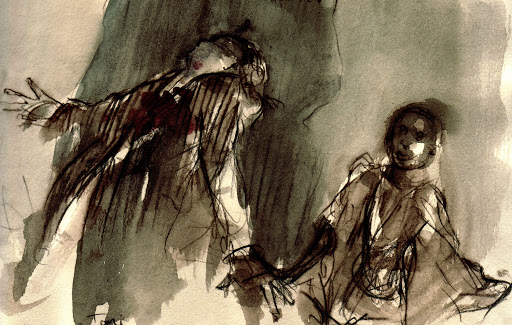
Once again, Kleist jarringly exposes Toni’s devastation through her involuntary coercion – the bullet “went right through her breast…she sank down at his feet; but he hurled the pistol over her to the ground, kicked her away from him” (265). This jarring imagery finishes what has been hinted to throughout the novella: Toni is bludgeoned to the ground, collapsed in the depths she had been confined to her entire life. The shot to the breast exhibits how her feminine sacrifice is complete, and the fall to the floor nails her degradation at the hands of her flighty White lover. Toni “could not speak, nor even reach him with her hand” because she was laying helpless on the ground” (265). Whatever mobility or upliftment she fantasised Gustav would give her is politically, and quite literally, beyond her prostrated reach. She would never experience freedom from the suffocation of her identity in any real sense. By believing that Gustav might save her from her from the uncomfortable realities of her mixed race, she was blindsided by his betrayal. His brutish treatment of her is nowhere warranted nor proportionate, it is a senseless slaughter. Gustav was far more powerful than Toni, and the briefest possibility that she – whom he saw as ‘racially inferior’ and a ‘lowly’ woman – had duped him into falling in love elicited tremendous fury. She is slaughtered by her race, unable to be more than the ‘Black temptress’ to Gustav, unable to belong wholly to her family.
But she is also slaughtered by her womanhood, this is her predetermined, spousal immolation. The moment Gustav gave her Mariane’s locket to seal their engagement, Toni was doomed to follow in Mariane’s martyred footsteps. It can be argued that Toni’s desire to be the wife Gustav wanted meant buying into the self-sacrificial mythology of Mariane’s mould and risking it all for him because even if she was killed, that would mean she died for White love. The difference is that Toni did not explicitly choose to die.
It is only when Gustav realises his fatal mistake that he is finally “kneeling down beside her” and shoots himself in the mouth out of horror (Kleist 267). This ultimate felling of the white man to the ground – a spatial position he has never occupied in this novella – suggests some recognition on Gustav’s part that he made a hasty conclusion in believing that Toni would betray him as the ‘Black seductress.’ The patriarchal ideology incarcerates women in the binary of either being unfaithful whores or sacrificial wives. It is this rationale that Gustav defaults to in panic.
However, when the two are buried and “lowered” together as lovers, their story is rewritten (Kleist 268). Their burial together glosses over the ghastly uxoricide that occurred because of the scathing differences in their race and gender positions. In the erection of their monument far away from Haiti, Toni’s struggles are erased. She is remembered tall and white, a martyr who is recast as one who died for her love, when in fact she died at the hands of her love. The irony here is cutting. Toni, whose life was spent in political and physical lowness, in death is made standing upright.
Kleist’s gratuitous use of destruction holds readers hostage, staring straight at Toni’s kicked corpse, compelled to reckon with the unspeakable fate of the most defenceless victims of gender and race systems. Toni’s nubile subordination makes her the defenceless target of patriarchal demands for bowing lowliness and self-immolation. Being a mixed child, caught in the crossfire of race identities that claim to be irreconcilable, she is denied the ‘natural’ identification and belonging race claims to provide. Betrothal highlights the tendencies of power systems to shoehorn individuals into identity groups for political purposes. After the bloodshed of the novella, overwritten by a duplicitous monument, the lofty rhetoric of self-righteous enslavers is brought down to the ground. There is no black-and-white answer as to which character can be blamed for the wreckage, nor an answer to whose actions were morally justified. However, in a larger sense, the binds of race and gender are responsible for fracturing its individuals into hostile, mistrustful, and violent groups, wrapped up in rage that explodes in its own contradictions.
 sanjana sheth
Leave a comment