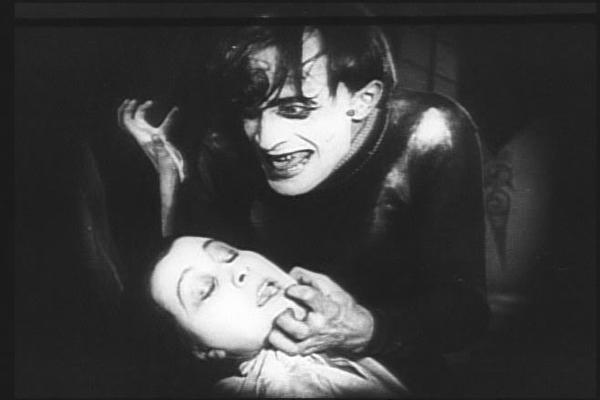
Perhaps the most striking frame of the 1919 classic, The Cabinet of Dr. Caligari, is where an unhinged Cesare, powdered to a spectral pallor and streaked with tar black liner, madly clutches a still-sleeping, luminescent Jane. It is a frame charged with electrifying dramatic tension. Both the macabre horror and the psychological derangement which agitate the entire film are distilled into this juxtaposition of Cabinet’s killer, Cesare, with its primary love interest, Jane, in scotopic moonlight.
The maniacal contortion of Cesare’s face is the most animated we have seen him yet – but this frenzy is not a conviction of Cesare’s murderous intent. Rather, the film suggests that what we see here is a moment of unhinged, yet human hesitation; he has fallen in love with Jane. Like much of the film, this frame and the monster-falls-in-love-with-victim dynamic has become archetypal in the genre of horror. Universal’s Dracula and Frankenstein borrow from Cabinet’s iconoclastic cinematic design. However, what makes Cabinet so peerless, andmore than just a blueprint or inaugurator of future remakes, is that it so wholly gives itself up to the melodrama of madness through its cinematography, set design, lighting, and narrative. The line between the sane and the insane welters like a madman on the loose, and there are no neat boxes that things fall into after the chaos has taken over.
The Cabinet of Dr. Caligari, directed by Robert Weine, written by Carl Mayer and Hans Janowits, opens with Francis (Friedrich Fehér) describing one Dr. Caligari’s (Werner Krauss) hypnosis of a somnambulist, Cesare (Conrad Veidt) to commit acts of murder on unsuspecting people who ask for their future to be told by Cesare at fairs, where Caligari showcases his coffin-bound companion. A New Yorker review called Cabinet “the most complete essay in the décor of delirium.” Roger Ebert positioned it as the “ne plus ultra of German Expressionism.” While German Expressionism was already a popular theatrical movement at the time of the film’s production, Cabinet masterfully typifies the movement’s investment in externalising the terror and psychological instability of subjective individuals on the screen through formal, stylistic, and narrative techniques. Karl Heinz Martin’s From Morn To Midnight (1920), Paul Wegener and Carl Boese’s The Golem: How He Came into the World (1920) and Fritz Lang’s M (1931)are similar explorations of the tormented inner psyche in the German Expressionistic style that came in the wake of Cabinet.
Cabinet marries romantic horror with psychiatric authoritarianism to produce a cinematic experience which is stylistically innovative, constructs an architecture of insanity, and raises its own stakes by grappling with tyranny and the banality of evil. Each of these feats is achieved through a fractured cinematic structure where nothing and no one is anodyne or edulcorated. Visually, the much-discussed sets of the film are terribly disjointed and disorienting. Buildings teeter like inebriated diagonals, trees are sharpened to razors, windows defy geometry and widen into nothingness. Siegfried Kracauer writes that, “the settings amounted to a perfect transformation of material objects into emotional ornaments.” When Cesare tries to kidnap Jane and run away from the townspeople chasing him, his hands coagulate into the craggy branches of the surrounding trees. Cesare’s barrenness and crazed desire are cathected in the set and the silent scene.
The spatial politics of this film create a firmament of schizophrenia for the action and paranoia to exist within. It is a firmament where horizons of sanity and insanity bleed into one another, and subjectivity reigns supreme. The frame story, which Erich Pommer, Fritz Lang, and Robert Wiene insisted on introducing, opens with a naturalistic mise en scène that is never fully recovered, even at the end of the framing scene. Although the last scene implicates Francis as a lunatic concocting stories in a state of derangement which requires institutionalisation, the final shot lingers on ‘Dr. Caligari’ (or the director of the asylum) for a second too long. And therefore, we must ask: was Francis really mad? Or is Dr. Caligari the serial killing director? Cabinet does not clarify, and that is precisely the point. The film feels like a post-truth opera of psychological terror, part of which comes from the inconclusivity about what is real and what is imagined. This trope of unlacing the fabric of reality in the last shot of the film can be seen in contemporary cinema like Christopher Nolan’s Inception (2010).
Beyond the aesthetic force of Cabinet’s meandering sets and topsy-turvy plot lines, it has been termed as portentous for the rise of Hitler and fascism and Germany through its anatomisation of the workings of tyranny. Whether it was a forecast or merely a product of post-World War I German alienation cannot be pinned down. Still, what is clear is that the film takes up authoritarianism both stylistically and thematically. Officials with power are expressionistically staged on looming swivel chairs that totter precariously in the air. The political climate of Germany at the time of the film’s release saw discontentment with the state’s long, harsh arm and its policies of mandatory conscription. Cesare’s relationship with Dr Caligari is wrought with paternalistic tension, capitalistic transaction, and instrumentalised evil. Dr Caligari delights in the splendour of his somnambulist the way a father might show off a son, yet at the same time, he exploits Cesare to make a living off Cesare’s freakish state of sleep. Moreover, Dr. Caligari wields Cesare like a weapon to fulfil his twisted ends, and this can be read as a critique of how the German state enlisted citizens to commit crimes in WWI. Still, the uncertainty that hangs in the air as to whether Francis has fabricated the story of Dr. Caligari in his head replicates the anamorphic effect produced by a state’s abrasive prescriptions and its pathologisation of resistance. The film concludes with not a contrarian critique of power, but instead with a depiction of the inner turmoil and shifting moral calculus of civilians in a society deracinated from their cultural and ethical compass.
Reality, sanity, and symmetry all lie out of reach for the mangled characters and distorted cinematic structure of the film. Cabinet succeeds because it is neither a linear political critique nor a condemnation of fantasy. It is chaosmos captured in shades of off-kilter horror, micro-subjectivity, and abdication to the serrations of insanity.
Works Cited
“Goings on about Town.” The New Yorker, 1965, https://www.newyorker.com/goings-on-about-town/movies/cabinet-dr-caligari.
Interiors. “The Cabinet of Dr. Caligari (1920) – Interiors : An Online Publication about Architecture and Film.” Interiors, 2013, https://www.intjournal.com/0813/the-cabinet-of-dr-caligari.
Kracauer, Siegfried. “Caligari.” From Caligari to Hitler, 1947, pp. 61–76., https://doi.org/10.2307/j.ctvc77cxj.12.
The Take. “How Does ‘the Cabinet of Dr. Caligari’ Utilize Point of View and Perception of Reality?: Read: The Take.” How Does “The Cabinet of Dr. Caligari” Utilize Point of View and Perception of Reality? | Read | The Take, 27 May 2020, https://the-take.com/read/how-does-the-cabinet-of-dr-caligari-utilize-point-of-view-and-perception-of-reality#:~:text=madness%20and%20betrayal.-,The%20Cabinet%20of%20Dr.,patient%20in%20a%20mental%20institution.
Vognar, Chris. “Lasting Fright: The Staying Power of the Cabinet of Dr. Caligari: Features: Roger Ebert.” Features | Roger Ebert, https://www.rogerebert.com/features/lasting-fright-the-staying-power-of-the-cabinet-of-dr-caligari.
 sanjana sheth
Leave a comment