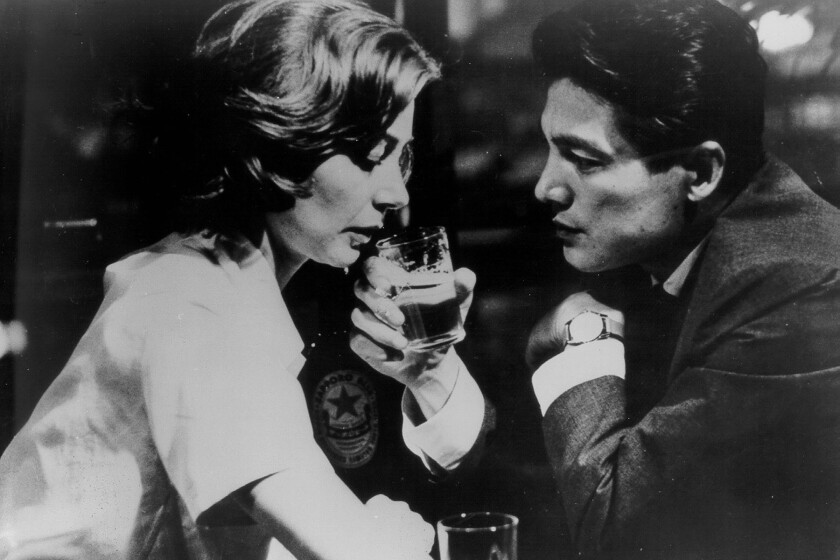
The indelible first 16-minutes of Alain Resnais’1959 film Hiromshina mon amour tells its audience precisely everything it will do for the next hour-and-a-half. The film opens with the unbreaking, aggressive intimacy of entangled lovers pushing into each other’s skin like historians examining precious artefacts, as an unsettling, plaintive score wrings the scene in an aesthetic of anxiety. “You saw nothing in Hiroshima. Nothing,” the man utters calmly. The woman responds with controlled but unmistakable anguish, “I saw everything. Everything.” (Duras 15). The shot of the woman gripping the man’s shoulders dissolves into footage of a hospital, a museum, a mutilated body, a scalded scalp, a town square – as her voiceover continues to document all that she has seen in the bombing of Hiroshima (See Fig. 1).
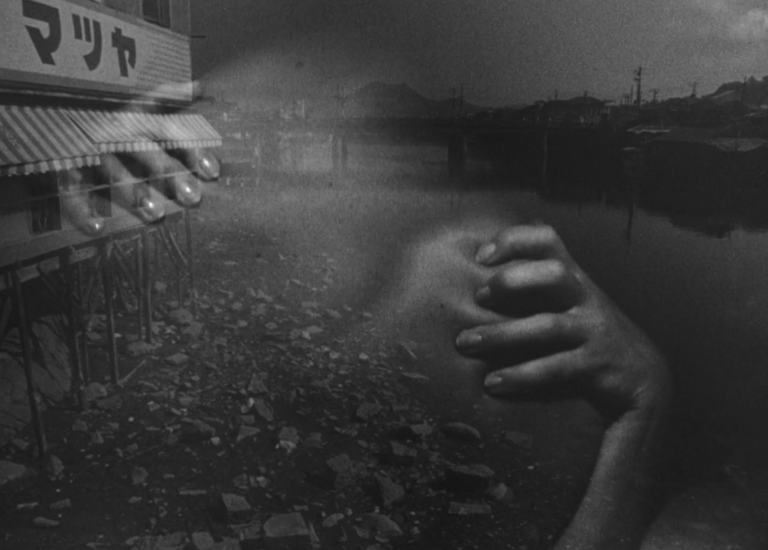
The woman asserts that she has felt the hot nuclear sun burn her. He tells her she has made it all up in her head. With the metronomic poetry of the traumatised, her voice paces through how she cried with the trapped mothers, smelt the uprising gladiolas, and mourned the animals who would never again emerge from the ground. The man continues to interrupt her – negating that she was there, negating that she knows, and negating that she feels. She says as much as she knows the remembering, she also knows the forgetting. Footage of mushrooming clouds of terror and carnage are interspersed with their glistening bodies. “I remember you. Who are you?” she says, both statements measured with equal conviction (Duras 25). “You destroy me. You’re so good for me,” she goes on. Just as it takes the eye a second to even begin to comprehend that the glittering dust or sweat or silver is actually nuclear ash caught in the horrid light of the present, it takes the rest of the film to comprehend what it means to know, what it means to feel, what it means to remember, and what it means to forget.

This essay explores the thematic construction of ‘knowing’ as a necessarily dialectical process, whose central aesthetic and philosophic logic in the film comes from the oppositions and reversals it contains within it. Through the contradictory movements of assertion and resolution, Resnais breathes life into the cinematic stakes of knowing and temporality. These movements conterminously occur on the plane of the meta, as Hiroshima mon amour invites reflection on the polysemic effects of the act of representation.
About the opening montage, Cathy Caruth writes, “[s]et against the pictures of the wounded, and directed at the repeated recitations of “I saw,” the man’s denial suggests that the act of seeing, in the very establishment of a bodily referent, erases, like an empty grammar, the reality of an event” (29). Caruth is suggesting that for Resnais, the enormity of a moment is reduced, and paradoxically unappreciated, when its reality is contingent on a voyeur being physically present to see what is taking place. Sight, and any other sensory cues are usually regarded as authoritative empirical sources of information, but here they become misnomers for what it means to truly know. The dialectic of knowing can be understood as a rejection of empiricism that comes from the pursuit of Truth and corporeality, because epistemologies are ever-evolving, specific, and inseparable from empathy.
Later on in the film, the French woman admits to not being able to prescind the exact moment when her ex-lover died as she lay by his side for hours, knowing that the one defining moment could occur at any time.[1] What is emphasised here, however, is that her visceral proximity to the body does not make her estimation of the binarist life-or-death any clearer from an empirical perspective. Instead, it is this corporeality that prevents her from differentiating between his body and his hers, his death and hers, thus allowing her – on a deeper and more granular level – to know, to see, to feel. It is the experience of this dialectical movement of knowing that emboldens her to tell her Japanese lover that she can empathise with his existential pain.
When the Japanese man negates the French woman’s statement that she knows, he is not merely claiming that she was not there for the explosion and hence there is no way for her to have known. He was not in Hiroshima during the bombing either. His negation is, in fact, an affirmation of the paradoxes within the process of knowing itself in that he is able to know about Hiroshima better than some people who were physically present because he has lived through its consequences. Yet with this, he is also tortured by his ability to know Hiroshima, because knowing is inextricably linked with the weltering skeins of forgetting and remembering as mediated by time. As the woman says:
She: Like you, I know what it is to forget. . . .
Like you, I have a memory. I know what it is to forget. . . . Like you, I too have tried with all my might not to forget.
Like you, I forgot…
Why deny the obvious necessity for memory? (Duras 22–23)
Knowing is inalienable from the passage of time. Time is constantly acting on it. Resnais’ work succeeds because he is able to take what is supposed to be a unifying, objective cinematic and structural element, and totally dereify it. One of the film’s producers told Resnais that he had seen other films reversing the flow of time, playing with time through flashbacks, and manipulating the verisimilitude of a film through time. To this Resnais responded, “Yes, but in my film, time is shattered” (Jones). For Hiroshima mon amour, there is no objectivity to time, it is a psychologically scattered device whose inchoate representation ends up much more faithful to the way people tend to experience time. In a sense, the present-tense plotline of the two lovers travelling around Hiroshima is the only temporal reality that is allowed to exist, but Resnais overwhelms its linearity with epistemically uncertain afterimages from the breathing past. So, in another sense, the past is the only temporal reality that is allowed to exist – even though it is always already gone.
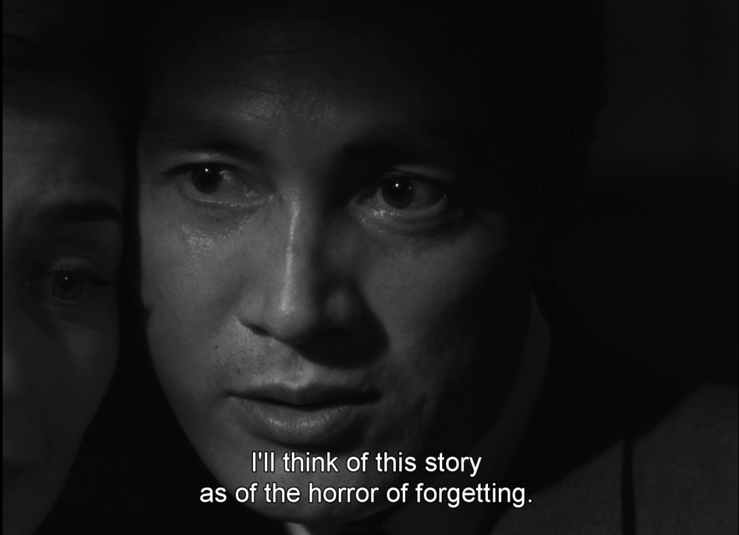
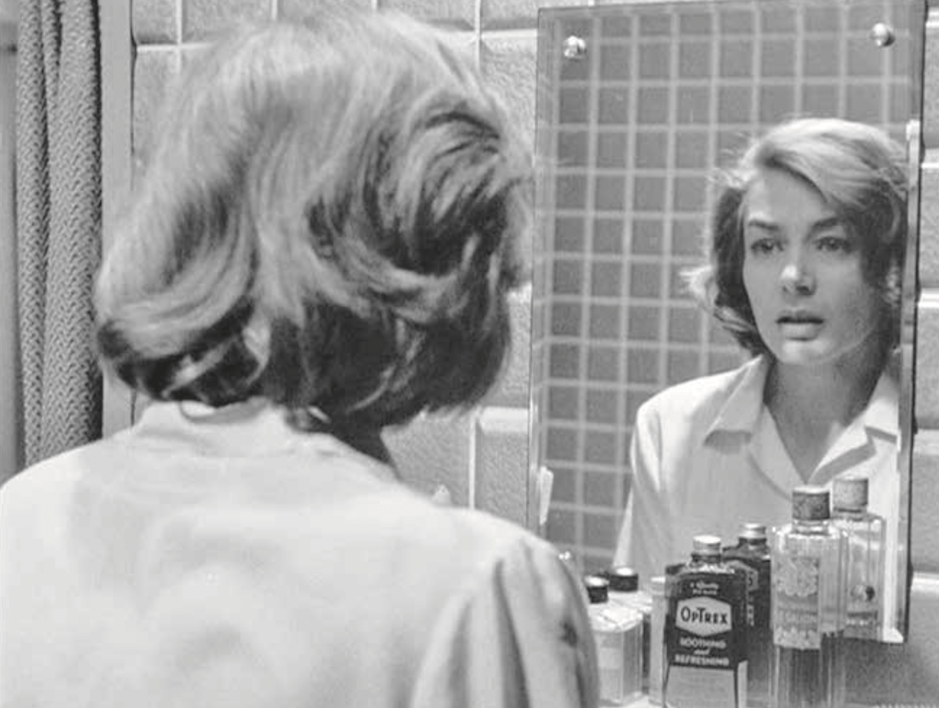
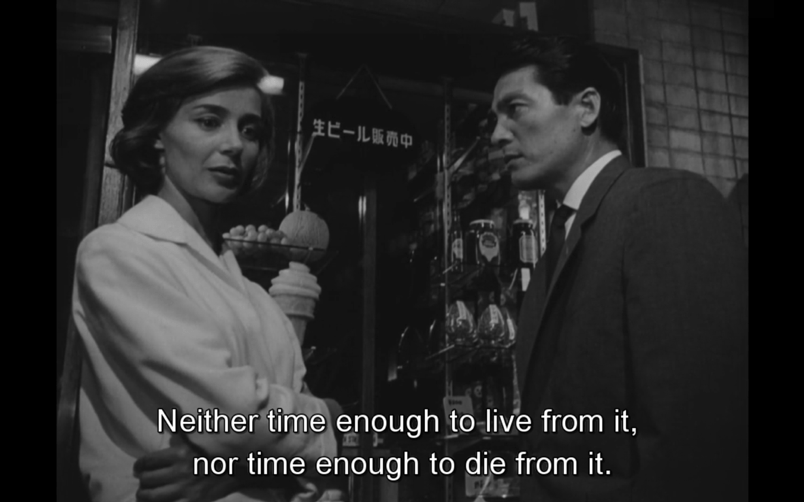
We have no choice as spectators of cinema but to follow the present story and invest our hopes in the narrative that is the most trustworthy. But it is the past’s disruptive power – formally and narratively – that exerts the strongest influence on the film and its cinematic effect on what it means to know, experience, and represent life. As Hunter Vaughn theorises, “the state of narrative limbo is fundamentally a breakdown in the formal codification of speech and image” (122). Time, therefore, is a schizophrenic stimulus, that produces multiple selves that are diachronic, splintered, and exponential. See, for example, Fig.3, where the woman’s voiceover loses its authority – as does the video itself – as multiple versions of the woman from the past invade her consciousness, effectively destroying her ability to know or experience in the present, without losing her knowledge of the past. The weight of these multiple lost selves contained in memories hangs over her immanent now.
Resnais was originally commissioned to make a documentary on the aftermath of the Hiroshima bombing, however, he eventually elected to make this film instead. His archival footage pieced together over the first few months when he was still making a documentary are included in the opening montage, albeit spliced with the couple’s conversation. In declining to present Hiroshima’s story in a documentary style, Resnais inaugurates and typifies the subjectivity, vanguardism, and non-linearity of French New Wave cinema that privileged the auteur’s particular vision above a clear narrative. By choosing to not talk about Hiroshima, everything that needs to be said about Hiroshima is said – truth through the illusions of fiction. Hiroshima’s repudiates empiricism as the highest form of acquiring knowledge, instead investing in the subjectivity of its characters and on a meta-representational level, its director. In doing so, it is able to tell universal truths about the piercing guilt of surviving, and the disappointing vitiations that time causes in remembering the sacred emotional past. Resnais communicates experiences that are at once private and public, of the present and of the past, and collective and individual. He chooses not to name the characters until the very end of the film, when they are named for the memories that defined them, traumatised them, and are slipping away from them – ‘Nevers’ and ‘Hiroshima.’ In doing so, Resnais is able to deliver a final and characteristically oblique declaration that there is no knowledge, no logic, no imagined community without the knowing by a person, with an imagination, resisting the structures of logic.
Works Cited
Cathy Caruth, “Literature and the enactment of memory (Duras, Resnais, Hiroshima mon amour)” in Cathy Caruth, Unclaimed Experience: Trauma, Narrative, and History (Baltimore: The John Hopkins University Press, 1996).
Hunter Vaughan, “Alain Resnais and the code of subjectivity” in Hunter Vaughan, Where Film Meets Philosophy: Godard, Resnais and Experiments in Cinematic Thinking (New York: Columbia University Press, 2013).
Jones, Kent. “Hiroshima Mon Amour: Time Indefinite.” The Criterion Collection, 2001, https://www.criterion.com/current/posts/291-hiroshima-mon-amour-time-indefinite.
Resnais, A. (1959). Hiroshima Mon Amour. Zenith International Films.
[1] Duras writes: “I stayed near his body all that day and then all the next night. The next morning they came to pick him up and they put him in a truck. It was that night Nevers was liberated. The bells of St. Etienne were ringing, ringing. Little by little he grew cold beneath me. Oh! how long it took him to die! When? I’m not quite sure. I was lying on top of him…yes…the moment of his death actually escaped me, because…because even at that very moment, and even afterward, yes, even afterward, I can say that I couldn’t feel the slightest difference between this dead body and mine. All I could find between this body and mine were obvi- ous similarities, do you understand?” (66-67)
 sanjana sheth
Leave a comment