Lipless Mouths and Fallen Mangoes
In the poem ‘The Glass Essay,’ Anne Carson writes, “She stands into the wind. / It is a hard wind slanting from the north. / Long flaps and shreds of flesh rip off the woman’s body and lift / and blow away on the wind, leaving / an exposed column of nerve and blood and muscle / calling mutely through lipless mouth.”[1] The winded girls of Sonia Faleiro’s third book blow, bleed, and burst through the sticky pages of this ethnographic-true-crime work of nonfiction.[2]
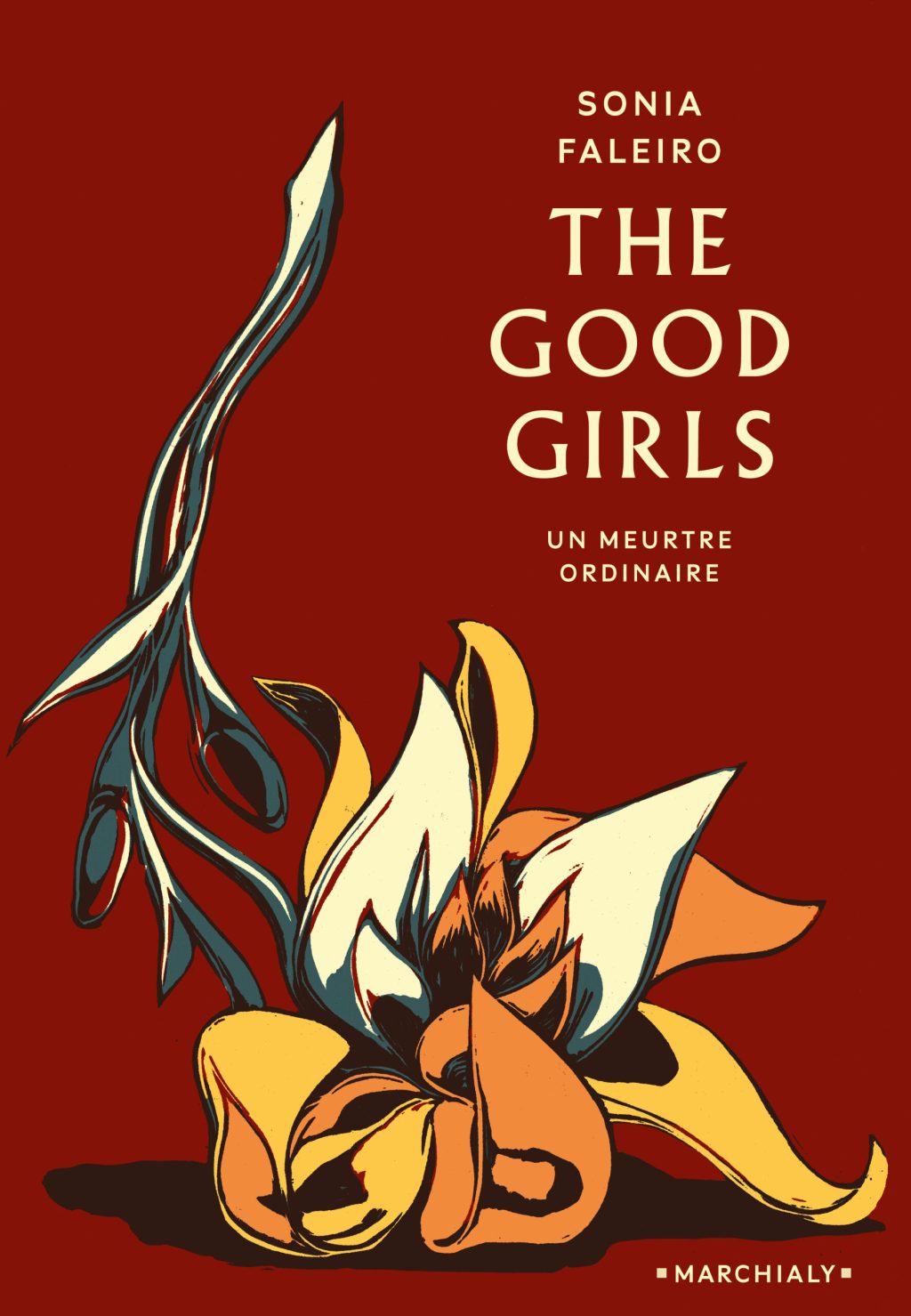
Good Girls is a focused yet vascular reconstruction of the Budaun killing where two teenage girls, Padma and Lalli Shakya, were killed in Uttar Pradesh days after Prime Minister Narendra Modi came to power in 2014. In an instantly indelible image, their bodies were found dangling from a mango tree, stirring in the northern air, their bangles and slippers meticulously preserved – perhaps a flash of agency at the hour of death. Their lipless mouths were forever suspended in the secret solidarity of girlhood. Good Girls commits to unspooling this single narrative, and the text weaves itself together with the skeins of relevant political and historical context, rich, indulgent descriptions, and the excavations of an ex-journalist determined to tell the whole story, however embroiled it may be.
The prologue is darkly titled ‘Good Days Are Coming Soon,’ and the book opens uncomplicatedly just before the girls’ disappearance – before truth evaporates into noxious chatter, and justice flattens into a farce. The incident takes place in an “eye-blink of a village,” Katra, where we meet cousins Padma and Lalli Shakya, 16 and 14 years old respectively.[3] The young girls are generally hailed as a unit: ‘Padma Lalli.’[4] Padma had left school with marriage looming imminent, and her maturity relative to Lalli feels like a kind of loss due to its coercive, parochial origins in systems of caste and patriarchy. On the other hand, Lalli is described with delicate tragedy: “[r]ound-shouldered and baby-faced, she was the quiet romantic who read poems out loud.” [5] These tender details are gutting, yet they render unto Good Girls a kind of closeness not just to ‘the victims,’ but more importantly, to who they were before they became victims, and who they could have someday become. Their names have been changed per a law that prohibits the disclosure of victims’ names for crimes of a certain nature; this is a provision that either guards against privacy violations, or, more likely, does not wish to compromise the victim’s “marriage prospects” or cause “degradation of respect,” the first of many social mechanisms borne out of Indian society’s instinct to protect women’s ‘honour’ over the women themselves.[6] Faleiro refuses to let these girls slink into being just another statistic from a state saturated with stories like this one, and through the particularities of this case, she depicts the broader landscape of everyday injustices against women.
Padma and Lalli disappeared on 27th May, 2016, last seen relieving themselves in an open field. When their bodies were found the next morning, immediate, inveterate gossip shrouded the bloodied orchard. The first suspicion, supported by the victims’ family, was that they had been gang-raped and consequently killed by Pappu Yadav and his brothers – members of a backward but dominant caste from a neighbouring area. Villagers offer convoluted accounts of what they had seen that night which are both internally and externally contradictory. Some say they had seen the girls enter the fields, others claim they had also seen the 19-year old Yadav at the field with them on the night in question. The Shakyas refused to let the bodies be taken down. They recognised that justice is rarely delivered to their caste, much less girls of their caste. But the visual force of the girls’ hanging bodies proved to be a lightning rod for media attention – which, in turn, attracted the Central Bureau of Investigation, and “rockstar” politicians to Katra.[7] Faleiro documents the wild variations in the number of suspected rapists by the police, conjecture that the family or the local police were responsible, witness and evidence tampering, and post-mortems obfuscated by media pressure and institutional incompetence. There is no tidy resolution at the close.
Good Girls is a sprawling methodological endeavour, explicating details of the case alongside their interconnectedness with police misconduct, casteism, political peacocking, and gendered violence. Its thick descriptions furnish the narrative with suspense but never sensationalism, and simple observations tend to echo broader cultural truths about the site: “[i]f the men settled on the charpoy, the wives made do on the floor,”[8] Faleiro writes plainly, or elsewhere, “Girls huddled.”[9] With sensitive participant observation and thorough interviews, Katra comes alive as a site of naturalised hierarchies encountered by both oppressors and victims with infallible realism. In particular, Faleiro’s tactile conversations with the officials of the law capture their fractured modus operandi in a way that is urgently persuasive. Good Girls is also uniquely comfortable with letting rumours float untethered by empirical facticity, and the cartography of violence in rural India Faleiro manages to map out would never have been possible through an exclusively quantitative approach. Faleiro spent 4 years at the site, visiting frequently even after the incident itself had been documented in order to monitor its long-term implications on the social lives (or lack thereof) of backward caste women in Uttar Pradesh. We are shown that Padma and Lalli’s deaths did not inspire Katra to interrogate the cultural practices that enabled these deaths in order to prevent further cases – such as honour killings, or equating women’s freedom with their moral degeneration. Instead, Katra’s society concluded that to prevent such deaths, they ought to entirely deny women private lives. Hence, unlike similar terrifying state and social failures, (such as the Bhanwari Devi or Nirbhaya case) there is no reactionary progressive impulse to round out the gruesome arc of the narrative.
Stylistically, Good Girls deals in facts – all alternative versions of them and their sources are diligently presented for the reader’s edification. Chapter titles are stark and telling: ‘A Mother Goes ‘Mad,’’ or ‘‘Girls Are Honour of Family.’’ Information unravels and gets entangled in real-time for the reader, who develops their own speculations with the concrete evidence supplied such as phone calls and text messages. As a result, not only is the reader invited to participate in the book as a researcher, but it also implicates the reader in the dialogical web of rumours. It forces acknowledgement of fact that we, too, are susceptible to the melodrama of murder, and therefore, it forces critical engagement with how proximate these incidents are to anyone living in India – despite physical or purported sociological distance from Katra. Additionally, Faleiro’s narrative is heavily scaffolded by statistics about crime and caste, and characterisations of the political context in which this incident took place. For instance, we are told about pollutants in the Ganga affecting decisions of what to do with the bodies. Or, crucially, how the Shakya girls’ OBC identity and the alleged rapists’ Yadav identity introduced the possibility that the Yadav Chief Minister was protecting his kind. At times, the generous contextualisation might read as repetitious or detracting from the pulse of the narrative, but it is necessary for two reasons. First, it reels the reader back into the realm of research by reminding us that this is not fiction. Second, it places readers in the informed position to evenly formulate their own perspectives on crime without the author’s normative intervention.
For that is Good Girls’ intention. It is not a story with a conclusive whodunnit. Faleiro is not interested in lazy binaries of villains and victims. She is much more interested in indicating which superstructures interact to produce a pattern of injustice and trauma, how electoral politics intervene in justice, and what creates a social propensity for deaths such as these. If – as investigations suggest – Padma and Lalli died by suicide out of fear that they would become victims of honour killings because they were seen with a Yadav, the culprit is really the systemic shaming of desire, outmoded conceptions of female consent, and the damning inventions of the caste system. Yet on this point, Faleiro seems reluctant to theorise the contemporary sociological stakes of these superstructures and mores beyond flagging them as relevant and deleterious. In her project to remain objective, she misses the opportunity to drive home a substantive argument that engages with the changing conditions of rural life. The girls’ use of a mobile phone becomes a leitmotiv for the slow but perceptible influence of technology on Katra’s ancient ways of living, but Good Girls does not indicate what the likely outcome of this impending modernisation will be.
Nonetheless, Good Girls is a book about many extraordinary things – media frenzy, political flexing, caste-conflict, the rot of ‘honour,’ and the startling ineptitude of the police. But neither the singularly horrific aesthetics of these deaths, the level of political celebrity they attracted, nor the media’s obsessive invasions should detract from the reality that this is, very much, ‘an ordinary killing.’ Good Days are not coming anytime soon for a society that responds to female death with increased policing of their behaviour. Good Days are not coming soon for a society whose clogged legal and law enforcement system has little capacity (or as it would seem, inclination) to deliver justice to its most vulnerable stakeholders – poor, backward caste, young women. For now, it is clear that no matter how good a girl is, that alone will not be enough to protect her.
Works Cited
Carson, Anne. “The Glass Essay by Anne Carson.” Poetry Foundation, Poetry Foundation, https://www.poetryfoundation.org/poems/48636/the-glass-essay.
Faleiro, Sonia. Good Girls: An Ordinary Killing. BLOOMSBURY PUBLISHING, 2022.
Singh, Shreya, and Apoorv Pandey. “Remembrance: The Dilemma of Identity.” India Law Journal, https://www.indialawjournal.org/the-identity-dilemma.php.
[1] Carson, “The Glass Essay.”
[2] Faleiro, Good Girls: An Ordinary Killing.
[3] Faleiro, Good Girls: An Ordinary Killing, 19.
[4] Faleiro, Good Girls: An Ordinary Killing, 18.
[5] Ibid, 18.
[6] Singh and Pandey, “The Identity Dilemma.”
[7] Faleiro, Good Girls: An Ordinary Killing, 170.
[8] Faleiro, Good Girls: An Ordinary Killing, 31.
[9] Faleiro, Good Girls: An Ordinary Killing, 20.
 sanjana sheth
Leave a comment