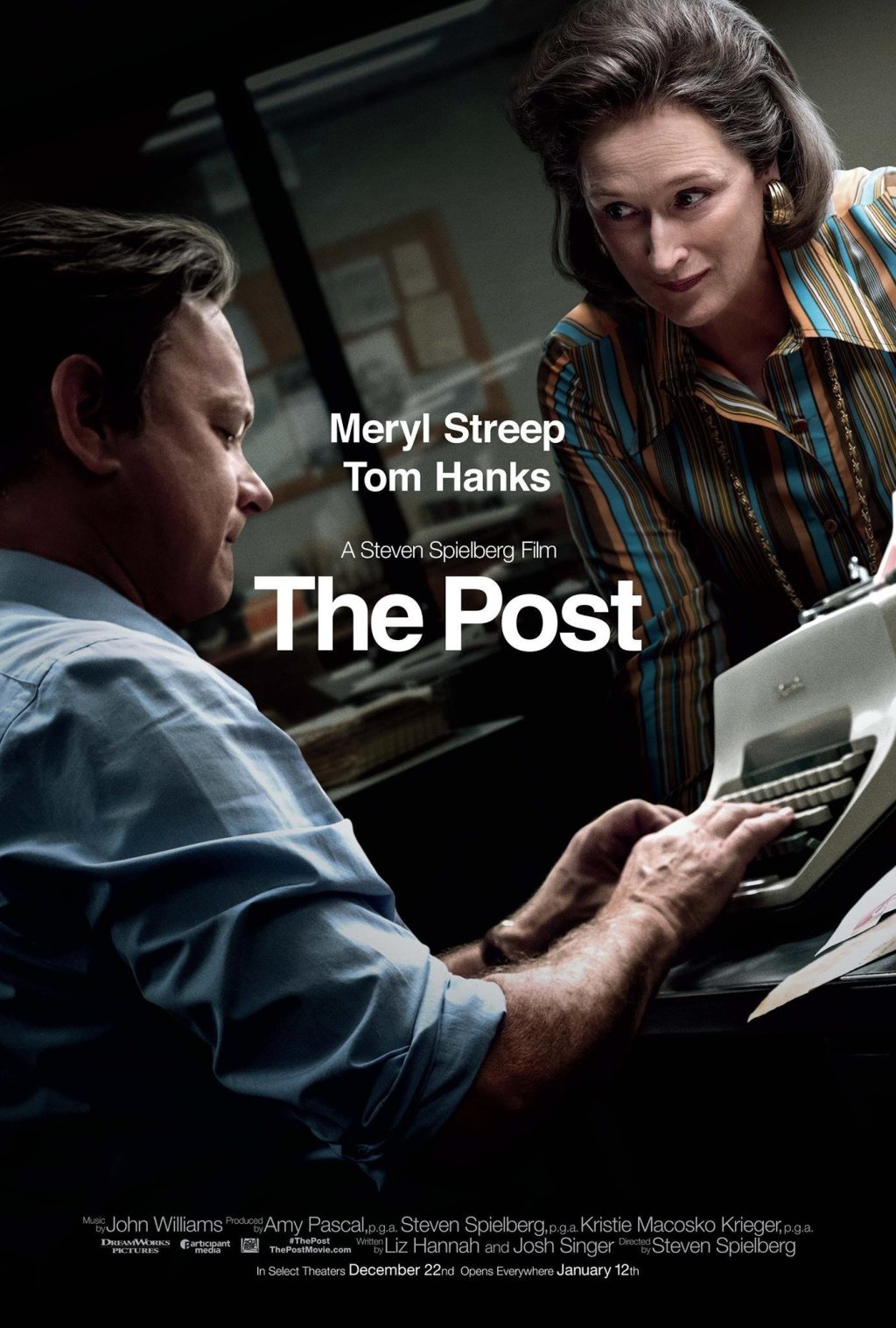
Muddying Masses, Machines, and Meryl
The Post opens in 1971 Vietnam, to American soldiers smoking cigarettes and streaking tar-black muck on each other’s faces. Seconds later, percussive mechanised weapons rattle through the jungle while smog drenches the lush, muddied shot. The soldiers dive into trenches and trees, while both dodging and delivering showers of shimmering bullets. In ‘The Work of Art in Its Age of Technological Reproducibility,’ Benjamin invokes Marinetti to show the enmeshment of destruction, machines, nature, and imagery: “war is beautiful because it combines gunfire, barrages, cease-fires, scents, and the fragrance of putrefaction into a symphony.”[1]
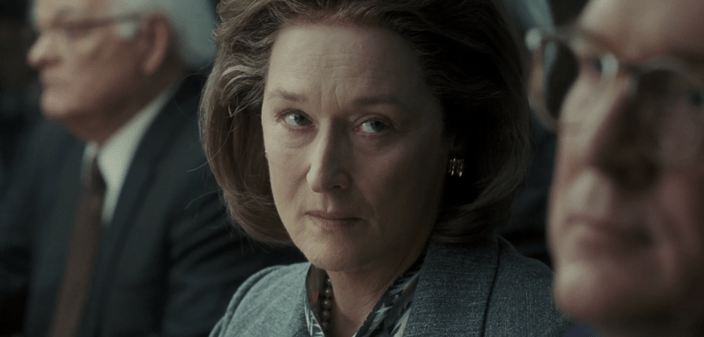
In the five minutes that follow The Post’s opening scene, the film relocates to Washington’s world of scratchy pantsuits and affected journalistic chatter, where the publisher of Washington Post, Katharine Graham (Meryl Streep) is wrought with the anguish of being the only woman in a room. Tactile close-ups of Graham show her stutter, shrink, and shiver through a board meeting (see figure 1) – foreshadowing the reversed final scene where Graham emerges from the Supreme Court, embraced by hordes of admiring women. The war scene teases the kind of film The Post could have been – one directly invested in the fate of the victims of mass violence – but the transition to a white woman in a boardroom introduces its true stakeholders; that is, a newspaper, its widowed leader, and the fraught decision-making of its operation.
Benjamin distinguishes between the fascist impulse to aestheticise politics, and the revolutionary impulse to create political art. The former “sees its salvation in granting expression to the masses,” [italics added] whereas the latter agitates for the right to change the status quo.[2] This essay asks to what extent The Post succeeds in problematising the status quo’s structures of technology, democracy, and gender. To unspool the broader stakes of film as a medium for political art, it is necessary to analyse the aforementioned structures as they are substantively presented within the film.
The Post spans the two-months between May and July of 1971, culminating in the Supreme Court’s adjudication on the notorious Pentagon Papers in favour of The New York Times and the then-local-now-behemoth Washington Post. The confidential papers documented not only American war crimes in Vietnam, but also that the US knew they were losing but did not withdraw troops. Graham spars with her editor, Ben Bradlee (Tom Hanks) over whether or not to publish more of the papers after The Times is served with an injunction for leaking sections. The 2017 Spielberg historical drama is littered with too many Hollywood luminaries to list here. Unlike his usual investment in spectacular action, here Spielberg attempts to create tension through dialogical ingenuity, delicate performances, and a panoply of coeval cultural references.
Benjamin singles out period pieces as formally potent for in them, “[a]ll legends…await their celluloid resurrection, and the heroes are pressing at the gates.”[3] Historical dramas have the potential to, in some ways, revive the aura of art by reconstructing the past and speaking to the present. The Post was released at the height of liberal moral panic in American democracy following Trump’s election, when Hollywood could not comprehend how the leader-of-the-free-world had elected an overt bigot.[4] The Post is a soaring liberal effort in helping the masses “get closer” to political life, both for its characters who have come to reject America’s invasion of Vietnam (although this is mainly because they were not winning), and its audience, who have been forced into political participation because of Trump’s distasteful articulation of what America stands for.[5] The (neo)liberal Academy, who nominated The Post for 6 Oscars including Best Picture and Actress, is clearly addressed in the film through its didactic celebration of democratic morality as manifested in the freedom of the press.
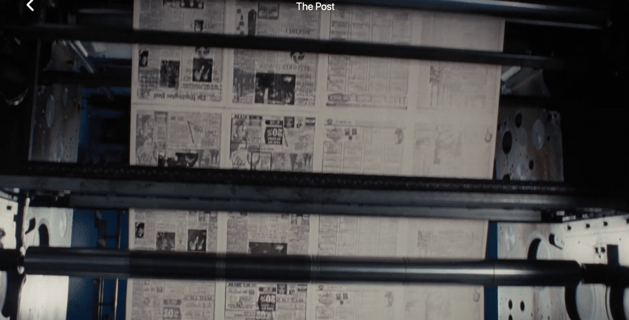
Benjamin described a kind of film which could inspire “the progressive attitude,” one “characterised by an immediate, intimate fusion of pleasure – pleasure in seeing and experiencing – with an attitude of expert appraisal,” where uncritical consumption was impossible, and spectators would grapple with reality while being entertained.[6] There are two fronts on which The Post earns its progressive sensibility. First, The Post takes for granted – and therefore elegantly sacralises – the tremendous power of mass consumption of newspapers. The ostensive question consuming the plot is whether or not Graham will decide to print, but this is a foregone conclusion to the audience who know how history has played out, and who can also easily recognise that the cultic superstars Hanks and Streep will make the morally courageous decision to do so. Nevertheless, the technology of the printing press enjoys a weighty, uninterrupted montage where an antecedent printing factory exults on the screen, churning and huffing out pages of truth. This dramatises the pivotal role of technology in resistance (see figure 2). As Benjamin writes, such scenes “train human beings in the apperceptions…needed to deal with a vast apparatus whose role in their lives is expanding almost daily.”[7] The attention The Post pays to media literacy in the wake of technological advancements resounds in the post-truth Trump era by confronting the conflict between government and the people through affirming The Truth’s centrality to a constitutional democracy – where the government deliberated denied the population honesty with ‘fake news.’
Secondly, there is the feminist question of Graham’s leadership, to which most of the film is dedicated. Her decision-making calculus straddles her friendship with war criminals, her familial and marital legacy, and her professional ambition for The Post. Yet here, the film is consciously insular, and occupied by the tender struggles of a woman trying to take ownership of her decisions. The individual, interior feminism of Graham eclipses the collective pursuit of truth, and structural considerations of gender. This flaw captures the neoliberal capitalist logic undercutting the film’s political stakes. It has a relatively myopic focus on American constitutionalism which ignores the evils of American hegemony on an international front[abir5] . The Post is much more interested in Washington Post garnering a reputation akin to The Times than in theorising who the worst victims of war and government egotism really are. There is a self-congratulatory ease which naturalises polarised ideas of good and bad within the film, a far cry from Dadaist shock effect, wherein art can be “turned into a missile.”[8] Each impassioned speech, impeccably delivered by legendary actors, is caught in an echo chamber of acceptable resistance that fails to push the envelope beyond well-established liberal standards. The Post is an intentional blockbuster that has decidedly not “liberated itself from the fetters of capitalist exploitation,” for its penultimate scene suggests the most valuable outcome of the ordeal was in Washington Post’s elevation to the level of popularity of The Times.
Still, The Post is political art inasmuch as it does provide metacommentary on the role of mass technology in delivering justice and truth to the American population, and it offers a nuanced depiction of a woman steadily coming into her own as a businessperson and journalist. After the opening scene, it is honest about these limited stakes – restricted to the journalistic world – which is both disappointing and understandable. Its political edifications about American righteousness are presented as truisms, and they are scaffolded by a big budget and evocative cinematography. Thus, they run the risk of being accepted before they are interrogated. However, as students of film and of the present political moment, as Bradlee indelibly preaches, “we have to be the check on their power. If we don’t hold them accountable, I mean my god, who will?”[9]
Works Cited
Benjamin, W. (2008). The work of art in the age of technological reproducibility (J. A. Underwood, Trans.). Penguin Books.
Dargis, Manohla. “Review: In ‘the Post,’ Democracy Survives the Darkness.” The New York Times, The New York Times, 21 Dec. 2017, https://www.nytimes.com/2017/12/21/movies/the-post-review-steven-spielberg-tom-hanks-meryl-streep.html.
Staff, Harper’s Bazaar. “50 Celebrities Who Spoke out against President Trump.” Harper’s BAZAAR, Harper’s BAZAAR, 10 Oct. 2017, https://www.harpersbazaar.com/culture/politics/g12502906/donald-trump-celebrity-statements/.
Spielberg, Steven. 2017. The Post. United States: Twentieth Century Fox
[1] Benjamin, ‘The Work of Art in the Age of Its Technological Reproducibility,’ 121.
[2] Benjamin, ‘The Work of Art in the Age of Its Technological Reproducibility,’ 121
[3] Benjamin, ‘The Work of Art in the Age of Its Technological Reproducibility,’ 104, quoting Abel Gance
[4] Harper’s Bazaar, “50 Celebrities Who Spoke out against President Trump.”
[5] Benjamin, ‘The Work of Art in the Age of Its Technological Reproducibility,’ 105.
[6] Benjamin, ‘The Work of Art in the Age of Its Technological Reproducibility,’116.
[7] Benjamin, ‘The Work of Art in the Age of Its Technological Reproducibility,’108.
[8] Benjamin, ‘The Work of Art in the Age of Its Technological Reproducibility,’ 119.
[9] Singer, The Post.
 sanjana sheth
Leave a comment