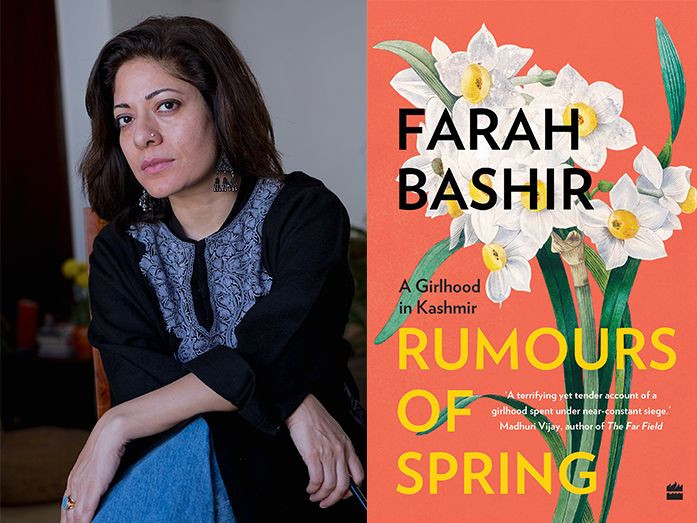
Farah Bashir’s Rumours of Spring is Shocking, Soft, and Sick with Anxiety
Girlhood, in our popular imagination, usually invokes imagery of a young woman fulfilling the rites of feminine passage with the messiness of a bursting dawn. We tend to think of girlhood as a flurry of emotions at once obsessive and trivial, as hair braided with bildungsroman flowers, as dreams tethered to an ever-expanding sense of possibility, as pinked skin learning how to bleed for the first time, as piping tantrums over parents and schoolwork. Indeed, girlhood is most of these things. But as Farah Bashir draws out in Rumours of Spring, self-described as an account of ‘Girlhood in Kashmir,’ for young women living under siege and occupation, it is also infected with terror: “I hate curfews. I want to pick the petals of a flower…I could pick petals and play that stupid game they show in films – he loves me, he loves me not. I could change that to – will they impose curfew: maybe, maybe not.”
Ex-Reuters photojournalist Farah Bashir’s 2021 debut work is a gentle, startling account of her adolescence in Srinagar through the 80s and 90s. The Indian occupation of Kashmir is not simply the backdrop for her coming-of-age memoir; violence is wedged into its stern spine. Bashir’s memoir is smart. It is stitched together by the day of and after her grandmother’s (Bobeh) death, whose hours (‘Evening,’ ‘Night,’ ‘Early morning,’ up to ‘Afterlife’) form the tapestries of her book. Each hour weaves in different strands of her memories not chronologically, but as they are triggered through the events of the day. This structure holds together the weltering remembrances of several years, and renders unto the book a sense of immediacy despite its historical timeframe. Mirroring this tight organisation of material, Bashir’s language is accordingly stark, honest, and deft. Her chapters are casually titled “Period Pangs and a Stray Bullet,” “I Miss Walking,” and “Cinemas? No Scope!” There is little tortured subtext, and little oblique circuity to these names. This was her reality. Her voice soars in its simplicity. Further, the book slips in and out of Koshur, Urdu, Hindi, dreams, poems, and parables – sometimes supplying a translation right there, and sometimes asking readers to turn to the addendum of notes to understand. In doing so, it becomes clear that there are parts of the book that will forever remain untranslatable for those who have never lived in Kashmir, those who have never heard army announcements which, “in Urdu and in sometimes Kashmiri, sounded more like a threat: ‘apke gharoon se baahar nikaliyey. Koi aadmi ghar pen a paaya jaaye.’”
The period during which Bashir grew up saw intense militarisation by the army, conflagrations at the Line of Control, and the rumblings of an organised Kashmiri resistance. For its residents, this meant life punctuated – and eventually colonised – by curfews, army raids, disappearances, and overwhelmingly, inexorably – anxiety. Even when she is excited or content, anxiety hovers nearby. Rumours of Spring is a chronicle of the destruction unleashed by anxiety onto both culture and girlhood. An instantly indelible quote from the book comes from Bashir’s friend, Mir, who jokes that PTSD in Kashmir ought to be expanded to “Perennially Traumatic Stress Disorder.” The book opens in medias res to commotion outside Bashir’s house, which immediately sets her off wondering whether someone was hit by a bullet, and who it could possibly be. The anxiety of her life is shared by the reader through the stream of conscious narration that follows Bashir on several spells of tenebrous intrusions.
The fertile traditions of Kashmir are steadily eroded by the ever-present, growing threat of the army, curfews, and violence. Bashir’s family is forced to choose between saving lives and preserving their centuries-old traditions. For instance, they must decide whether to store enough grain to survive protracted lockdowns, or to minimise the havoc they would have to clean up when the army inevitably and very rationally assaulted bags of grains in search of hiding militants. Humour is bastardised and blackens into tar. Festivals turn into days remembered for the trauma that accompanied them, and the geography of the city is redrawn based on places’ proximity to bunkers. Old, light-hearted childhood games of hide-and-seek fall out of favour as faux-kidnappings and army simulations make up the fabric of children’s experiences. Walking becomes a monopoly of the marchers – “why are people okay with not walking? / These are not built for walking / left, right, left.”
There are parts of this book that force you to put it down and take a deep breath. But these do not come from gratuitous descriptions of violence, nor from diatribes against the Indian state (while both remain extremely justified). Instead, these moments come through the brutal, matter-of-fact tone Bashir employs when discussing her delicate, impressionable psychology. By naturalising her lived reality and state of mind within the logic of the book, she defamiliarises it for us. It is not only the fact that she must live through constant threat and inexplicable horrors lurking behind any movement past curfew, but it is also the way she must adapt and adjust to these new conditions, and the way they infiltrate her young mind.
This is most heart-wrenchingly felt as we see Bashir grow into a woman. Each stereotypical aspect of adolescent girlhood – already a tempestuous period of life – is devasted by the fury of ever-imminent harm. When suffering a wretched bout of period cramps, she cannot get her medicine because she cannot risk being shot in her own house. Her notebooks for school are usually wrapped with brown paper, but when this is inaccessible, she must use newspapers – beautiful, but full of “unending deaths, killings, arrests, and protests.” Her ambition to do well in her exams is mercilessly interrupted by the curfews announced in the wake of Babri Masjid’s demolition. The obstacles she faces of being young and in love are hardly hormonal or immature. She writes to her first love, “I am sorry, I am out of letter-pads. I do not know when we will get them again.” Bashir lets her childlike diction tell us her story, which only sharpens its gutting blow.
Young women must reckon with the politics of their beauty and visibility. Bashir’s mother, when wrought with tension, looks as if “retracting into her own womb.” Quotidian wishes such as wanting to visit the salon incur tremendous consequences, and set Bashir into a spiral of self-blame and hatred. Girlhood generally involves a torturous desire to be seen and chosen, however, for her own protection, Bashir tries to make herself as ugly and undesirable as possible, which she rationalises heartbreakingly as: “I didn’t want to look attractive in any way, lest it invited undue attention and that indescribable guilt. I wanted to somehow become invisible…not be thrown acid at like Nuzhat, not to be stared at by the troops.” Her nights are spent yanking hair out of her scalp as a gateway to avoid the anxiety of the treacherous nights. Shame plagues vanity. Danger robs innocence. Imagination becomes a monster.
Reading Rumours of Spring right now, when most Kashmiris have been subject to internet shutdowns, stripped of their constitutional rights, and plunged into political darkness is neither easy nor comforting. Reading Rumours of Spring as our notifications buzz insensitively with updates on Russia’s invasion of Ukraine is neither easy nor comforting. But there is a messy, bursting dawn for Rumours of Spring’s girl. It leaps out of moments of cruel absurdity. Bashir is unpretentious, elegant, and articulate. She describes a “steely cacophony of resistance” created by her neighbourhood, warning each other of a violent steel-clad militant through banging kitchen utensils (which cannot help but assume tragically ironic significance in light of the current government’s pandemic response). She describes a friend who repeatedly graffities “QK. qk. QK. ” wherever he can: QUIT KASHMIR. quit kashmir. Quit Kashmir. She describes dreams of photographs and funeral flowers and the anguish of not owning her own dreams. The power of this book is in its existence: a Kashmiri woman, endangered by the Indian state, deprived of normalcy and girlhood, denied a voice, is telling it like it is. Reading this book is neither easy, nor comforting. Resistance – the kind this book has the potential to inspire – was never supposed to be, though.
 sanjana sheth
Leave a comment