Loose Narratives and Institutionalised Riot Systems
Salman Rushdie is invariably invoked in conversations about the sprawling, fecund imaginary of old Bombay as a site of dreams and syncretism, where fanatical Hindu militant violence was but the stuff of magical realism. He described how, “[t]he Bombay that I grew up in, in the ’50s, ’60s and ’70s, was famous as a city in which the communal tensions of the rest of India didn’t happen,”[1] but as he admits, “Bombay is not that Bombay anymore.”[2] In 1992, that imaginary of Bombay as the ‘first city’ of India, cosmopolitan, and in some ways, ‘above’ the ignominy of intolerance, died.[3] 900 people lost their lives between December 1992 and March 1993 during two phases of violence, followed by India’s first encounter with terrorist attacks in the form of serial bomb blasts.[4] In this essay, I will analyse “the two types of struggles that take place when riots occur,” using Bombay as a case study that complicates and clarifies Paul Brass’ theory of riot production.[5]
The first type of struggle that Brass identifies is the actual riot between Hindu and Muslim civilians, the police, and participating political entities. On this point, I will qualitatively examine the nature of the violence and interactions between groups, through which it becomes possible to spatially map the riot, detail its instruments, and assess the destruction left in its wake. Secondly, there is the struggle of a riot’s interpretation – in the case of Bombay this can be observed both between phases of rioting, and after its eventual cessation. I will pay attention to how electoral, judicial, and civic institutions were involved in shaping the multiple narratives which exist in their historiography. The two distinct phases of Bombay’s riots expose how literal and interpretive struggles are imbricated in each other. Thus, while the Bombay riots’ retrospective excavation might be an exercise in theoretical reconstruction, such an exercise is not without tremendous emotional and political stakes. In other words, this exercise addresses the relationship between narrative and violence, between ideas and action.
Context warning: this essay contains descriptions of graphic violence, sexual and communal. Please use your discretion before reading further.
Context and Approach
‘Riot,’ as a classificatory term, is “a noun with the force of a verb.”[6] In the Indian public consciousness, riots definitionally erupt along the lines of the binarist Hindu-Muslim identification. The term conjures images of hysterical mobs comprising people who have at once supposedly ‘forgotten themselves’ in the chaos of the crowd, but also who have succumbed to primordial prejudices which are purportedly inalienable from their being. To counter these fallacious representations, progressive academics, victims of the violence, the (diminishing) secular elite, and several English-language media tend to locate causality in different places, but most commonly in precariat economic conditions, incendiary rumours, or other specific socio-political circumstances. In the case of the Bombay riots, conventional explanations centre five causes: economic conflict in the urban slums; relatedly, liberalisation; the watershed Shah Bano dispute; the Shiv Sena; the demolition of the Babri Masjid; and finally, historical Hindu-Muslim antagonism.[7]
In The Production of Hindu-Muslim Violence in Contemporary India, Brass posits that a causation-driven approach to riots cannot comprehend “the intermediate space in which riotous activity actually takes place” – where boundaries separating collective civilian action from state intervention implode, “‘objective’” variables of “demography, economics, and electoral competition” are infiltrated by intentionality that is abstract, volatile and agential, and where chaos collides with careful planning.[8] Accordingly, Brass suggests that riots are the weltering outcome of several micro and macrosociological conditions, which can be prescinded from the furore of the riot, studied, and used as a conceptual framework for understanding the conditions which could culminate in riot. The five aforementioned objective variables were involved in the process of Bombay’s riot production. However, this involvement neither took the form of linear causality nor spontaneous, directionless precipitation. Brass terms this conceptual framework for understanding complex riot incidence as the “Institutionalised Riot System” (hereafter ‘IRS’). [9] In the forthcoming discussion, I will theorise its relevance in the case of the Bombay riots.
1.1 Phase One: The Struggle of Violence
In 1990, L.K. Advani of the BJP embarked on the ram rath yatra from Somnath, Gujarat to Ayodhya, Uttar Pradesh, collecting hordes of right-wing Hindus on his journey, and leaving behind 564 casualties through their itinerant rioting.[10] Their aim was to reclaim the alleged birthplace of the god Ram, which was located where a 16th Century mosque – the Babri Masjid - stood. On 6th December, 1992, the Babri Masjid was destroyed by Hindu kar sevaks. Disgruntled Muslims all over the country spilled out onto the streets, as celebrating Hindus did the same, rubbing salt in the wound by organising victory rallies that passed through Muslim-dominated neighbourhoods. Muslim anger was further inflamed on the morning of 7th December, after the BBC broadcasted news of the razing and its accompanying death toll.[11] In Bombay’s Bhendi Bazar, Muslim protesters looted, stoned, and destroyed Hindu shops and public property, while in Null Bazar, they looted the market and subsequently burnt it to the ground.[12] Temples in Kherwadi and Kalbadevi were attacked by Muslims, and Muslim houses were stoned and set on fire.[13] On 8th December, the economically impoverished region, Govandi, was engulfed in violence, primarily at the hands of the police, who were seen wrenching out civilians from slums to shoot them. Between the 6th and the 12th, the police repressed demonstrations and petty violence with brutal force. During this period, around 200 civilians were killed – the overwhelming majority of whom were Muslim, and died at the hands of the police.[14]
Meanwhile, Maharashtra’s Chief Minister from the Congress Party, Sudhakarrao Naik, “took more than 45 hours to return from Nagpur to Bombay after the demolition of the Babri Masjid and it was in those 45 hours that more than 200 people had lost their lives in Bombay’s streets, without a Chief Minister.”[15] The local Shiv Sena’s leader Bal Thackerary aggravated his supporters by declaring – falsely – that hundreds of the party’s foot soldiers had spearheaded the destruction of the Masjid.[16]
To rupture the perception of riots as improvisation, Brass uses an extended dramatic metaphor to instantiate the triphasic theatre of riot production: rehearsal; enactment; interpretation.[17] What he calls ‘rehearsal’ denotes the sustained priming of a group or population to the potentiality of violent outbreak which occurs constantly at sites with a propensity for communalism. During the tenebrous years of the ram yath yatra, this preparatory phase was always in motion even in relatively peaceful parts of the country like Bombay. Bal Thackeray’s Saamna, a newspaperinaugurated in 1989, was nothing but a repetitious script teaching its readers the language of bigotry and fanaticism; it stated that Muslims inhabited “mohallas in which flowed streams of poison and treason.”[18]
Brass’ second phase, enactment, refers to the triggering of violence that takes place in a context of electoral competition or when there are perceived or real threats to one community and their culture by a vilified Other. In Bombay’s case, the Masjid demolition was a situation which could be leveraged – both in the interest of Shiv Sena’s political expansion, and in the interest of so-called Hindutva preservation. Therefore, the executive stakeholders (Shiv Sena leaders, the Chief Minister, high-level police personnel) aided by the strategically poised masses (men, doctors, children, women, low-ranking officers) “activated” the riot for which they had been preparing.[19]
Crucially, Brass yokes riot production to the existence of an IRS, which is a system that employs divided, specialised labour to actuate each of the three phases.[20] The two roles he highlights as integral to an IRS are that of the “fire tender,” and “conversion specialist.”[21] On paper, it is reasonable to suggest that both were performed by the Shiv Sena and specifically, by Bal Thackeray. The ‘fire tender’ is responsible for the rehearsal stage (which we see in Thackeray’s public proclamations and Saamna), while the ‘conversion specialist’ is an agent responsible for the second phase, enactment. The conversion specialist explodes a circumstance into a riot for their political purposes – as we see with the Shiv Sena, which while increasingly influential for Bombay’s many Marathas, had not yet dominated elections.
Speaking more broadly however, neither role could ever be performed by individuals acting in a vacuum; these two actors can only be identified within the firmament of cultural structures of knowledge-production, self-mobilising functionaries of violence, and secular, quotidian disputes.[22] That is not to say that culture consumes (and is consumed by) all violent activity, nor that indoctrinating communalism is enough to birth mad combatants – even Ashis Nandy agrees that “[i]t is not easy to convert ordinary citizens into fanatics or killers; they may not be epitomes of virtue, but neither are they given to bloodcurdling satanism.”[23] As we see in the Bombay riots, there are substantive interventions in the cultural sphere which had direct (although mercurial) effects on the IRS. This is the third phase of Brass’ schematic, or the ‘second struggle’ created by riots: that of narrative.
1.2 Phase One: The Struggle of Interpretation
The interpretation phase comprises a dynamic, discursive battle to get control of the dominant way in which the public comes to think about the violence. The Human Rights Commission Report assessing the first phase of the riots, concluded that “[t]he Muslim reaction in Bombay to the demolition of the mosque was violent and vociferous but unchannelised and unmeaningful,” which rather than being anti-Hindu, was anti-state, giving expression to “a sense of despair coupled with humiliation.”[24] Moreover, this violence neither had the mass murderous intent as was seen in the demolition of the Masjid, nor was it infrastructurally scaffolded by the state’s policing machinery – and hence in all likelihood, it was less potent. The Srikrishna Commission, which was published years later explicitly maintains that “no known Muslim individuals or organizations were responsible for the riots,” which cannot be said about the Hindu activity which had some degree of state sanction, and provocative grounds to begin with (the Masjid demolition).[25] Contrarily – or rather, contrapuntal to this perspective, Shreekant Bapat, the police commissioner who presided over the riots testified that “the larger number of minority community casualties during December 1992 can be explained on the basis of the much greater aggression of the minority community mobs.”[26]
Brass would call these conflicting narratives evidence of classic blame displacement. For both Muslim and Hindu actors (including the police), ‘spontaneity’ and ‘emotional intensity’ is used as a defence against culpability. Under this narrative, since both sides’ actions are charred by the same ‘internecine’ rhetoric, a false equivalence of moral tit-for-tat is created, despite clear indications of institutional support on one side, causing disproportionate harm to the other side. In Bapat’s rationalisation, there is an implicit concession of the police’s illegitimate, asymmetric violence against Muslims, which he attempts to justify with the logic that, “the aggressor community [Hindus, the police] was not aggressing, but was acting only in desperation in defense against the attacks of the other.”[27] The police abdicated their institutional identity as upholders of the law and assumed an identity of victimhood as a deliberate tactic to appropriate “a discourse of public good and evil” that would absolve individual wrongdoing in light of utilitarian necessity.[28] Therefore, the Hindu-Shiv Sena exceeded Brass’ expectations of the perpetrators of riots since they fluidly profess not only that their illegitimate violence was proportionate, but also that they were the David-esque underdogs, who must be both heroized and victimised for ‘managing’ to defeat Goliath. Losses are overstated, and cruelty is wielded as a kind of rectitude.
The Hindu nationalist side was successful in conquering the interpretation of the first phase of riots. The Shiv Sena was loud and belligerent in their celebration of the mosque’s destruction, they were insulated from central disciplining because the Congress was hesitant to incur Hindu backlash, and they showed shrewdness in the political embodiment of their rhetorical narrative.[29] They built a memorial for the Hindus who died in the riots, and fabricated an entirely new form of public prayer called maha aartis. Maha aartis, having no religious history, were unabashed political performances of strength and symbolic posturing – they were synchronised with Muslim namaaz, turned extremist mobilisation into a mediatic spectacle, and seemed to be begging for Muslim retaliation that might justify further violence.[30]
Bal Thackeray, ever prescient, continued to make inflammatory remarks about the December riots: “[i]f our people should not retaliate then they should really wear bangles.”[31] In January 1993, Saamna published an editorial titled, “Hindunni Akramak Vhayala,” which translates as a direct call of action to Shiv Sainiks to take up arms to protect Hindus.[32] Through Shiv Sena’s bulletins in their offices, affiliated newspapers, and informal networks of communication, the clarion call was amplified, disseminated, and soon fulfilled.
2.1 Phase Two: The Struggle of Violence
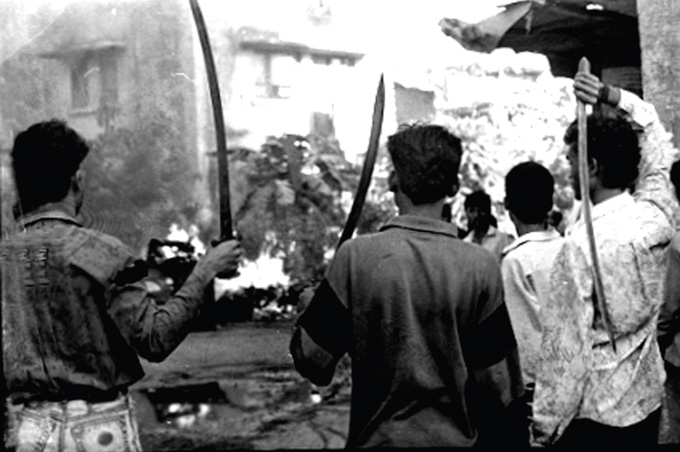
In early January 1993, after a Hindu family was attacked by unidentified arsonists, Shiv Sainaks and Hindus sympathetic to their cause ravaged Bombay’s Muslims.[33] Houses, shops, vehicles, and offices were destroyed, burnt, and robbed with or without the Muslims inside them. Shiv Sena’s disciplined and trained young boys (posing as MHADA officials) had assiduously demarcated Muslim-owned homes or workplaces beforehand, ensuring that the violence would be efficient, and unambiguously imminent as a deterrent that would send Muslims fleeing even prior to the riot’s formal enactment.[34] Upper middle-class building complexes took down Muslim names from their directories to minimise casualties. During this second phase of violence, approximately 250,000 people were displaced either within the city or seeking refuge outside its bounds.[35] Under these conditions of horrific violence, rumours darted around the city. As Radhika Subramaniam writes of the constant phases of riot rehearsal and enactment, “in this culture, a riot seems to remain only as a rumour because there always has been the rumour of a riot.”[36] The rioting was spread across the city – from Chembur, Mahim, and Nagpada, to Tardeo, Gamdevi, and Byculla. Hindu women were reported to be assisting in the rape of Muslim women.[37] The police either turned a blind eye, encouraged riotous behaviour, or actively participated in it – officers were even seen wielding swords.[38] Police communication lines were tapped and officers were heard dropping slurs, and giving orders to “let the Muslims be roasted.”[39] Acid bulbs were burst, soda bombs were hurled, violence was inflicted on the differently-abled, police commissioners, bakeries, slums, and eventually, the army had to be called in to contain the riot.[40]
At the cessation of violence, just prior to Prime Minister Rao’s tight-lipped visit to Bombay, the tally counted 900 dead, of which 575 were Muslims, with 356 killed by police firing, followed by 347 due to stabbing, with the remainder attributed to arson, stampedes, and unclassified causes.[41]
2.2 Phase Two: The Struggle of Interpretation
Per Brass’ triadic formulation, the interpretative phase of the December riots proved to be the preparatory phase of the January riots. Since the Shiv Sena controlled the popular understanding of the first riot, they were able to manufacture a corrective, retributive second riot. Due to the short gestation period of the next riot (or second phase of the same riots, depending on the perspective) Shiv Sainik violence had established itself as a systemic pre-condition to the survival of Hinduism. Hinduism, in turn, needed to survive because of its unimpeachable ethical force as an organisational principle of society, whose cultural fate was being increasingly compromised by caricatured hooligans who were utterly brainwashed by Islamic thought.
Certain masterful Hindutva machinations such as their maha aartis, collated electoral and residential information to locate Muslims,or Saamna’s editorials indicate a degree of deliberation consistent with Brass’ account of the self-serving, politically expedient IRS. Conversion specialists of the Shiv Sena mutated the relatively small amount of Hindu death in the previous riots into martyrdom in need of avenging as the party would directly benefit from increased communal solidarity against perceived threats to Hindus when elections came around. In this manner, the IRS was rendered cyclical in Bombay, a cyclical game rigged against minorities who lacked systems of machinery which allowed for sophisticated organisation of riotous action.
At the same time, the Shiv Sena’s unique brand of ‘goondaism’ (careless, mob criminality) also manifested in their method of interacting with the IRS. A Hindu journalist affectionately remarked, “[t]hey are bastards, but they are our bastards.”[42] For a political party as self-confessedly roguish and anti-elite as the Shiv Sena, electoral stratagems were always conceived and deployed simultaneous to their media circuses, their self-mythologizing bad behaviour, and their sensationalised radicalism for radicalism’s sake. As animosity disinterred the city into a communal pressure-cooker, Bal Thackeray was “the most interviewed man in Bombay.”[43] To conquer the all-important narrative, one needed to be a celebrity, a cultic figure and craft it.
The city’s IRS, fuelled largely by the Shiv Sena’s machinery and logic, was also genuinely capricious – simply because the political leaders of the party were not following some final solution vade mecum in the daily revisions of their propaganda, preparation, and rehearsal.[44] When the riots were, in fact, activated, the Shiv Sena’s division of labour did not have the political and practical capacity to control the violence – that is, neither did they want to de-escalate the situation, nor did they have the ability to.[45] Private and local conflicts infiltrated the broader communal fight, inter-mafia agendas surfaced, and the lawlessness of an unfettered purge emboldened the air. Therefore, in the case of the second phase of the Bombay riots, it is significant to recognise that the existence of an IRS does not imply control – a riot’s production and process can find its footing in systems and institutions without these systems and institutions being capable of directing the riot’s movements. It is important to preserve some dimensions of critical and political volatility in our conceptions of riots, despite being able to situate its moving parts.
This critical tension between organisation and unpredictability is captured in the differential classification of this phase of violence as either a ‘riot’ or a ‘pogrom.’ The former tends to be deployed not only by those who seek to undermine its devastation (although that is true for segments of its proponents), but also by those who, like Brass, acknowledge a level of incomprehensibility embedded in riots as a form of political violence.[46] In other words, the use of ‘pogrom’ or genocide would privilege the organisational design of the Hindu memorial, or marking of Muslim houses, or perhaps the extreme political and physical vulnerability of the Muslim community. However, the conceptual framework of the IRS does not presume that prior planning ‘caused’ the violence. Its theoretical fulcrum rejects causality and embraces gradations. In the case of Bombay’s IRS, intent, agency, time, and circumstance together produced a violent event structurally and experientially greater than the sum of its parts.
Deliverance, Documentation, and Dawood Ibrahim
In March 1993, a series of deadly bomb blasts exploded across the city, killing hundreds.[47] Powerful underground criminal organisations, primarily composed of Muslims, were responsible for their detonation, and Hindutva groups suggested that these criminals were abetted by Pakistani intelligence. Dawood Ibrahim, the iconic gangster, was considered to have been symbolically settling the score by warning Hindus and the Indian state against massacring Muslims.[48] These blasts deepened Muslim marginalisation in India for they fed into the narrative Hindutva groups had been peddling since the demolition of the mosque. With speed the Indian legal system has scarcely seen, the TADA Act was invoked to level 188 people with the charge of “waging war against the state,” an allegation redacted much later by the attorney-general.[49] This prosecutorial celerity, however, was wholly forgotten when it came to the slow ‘recommendatory’ findings of the erudite, secular Srikrishna Commission.
The Srikrishna Commission was constituted in 1993 to evaluate the events of the riots, determine liability, and provide a framework to deliver justice to aggrieved individuals and organisations.[50] It is part of what Brass calls the “institutionalised system of riot documentation” (‘ISRD’) through which India’s secular elite remember and “create a body of truth” which resist the hegemonic narrative of Hindu nationalists who displace blame onto their victims.[51] The Commission, in no uncertain terms, castigated Bal Thackeray’s involvement and evasion of prosecution, police brutality, the Shiv Sena’s incendiary character – if not legal remedy, it did facilitate a “public catharsis.”[52]
A similar reconciliatory (or edulcorating) effort took the form of the police’s Moholla Committees, where ‘respectable’ Muslims were encouraged to restore their faith in the system in an apolitical context; the police hoped for meetings without mobilisation.[53] However, these conventions quickly turned into platforms for political posturing and pandering on the part of the members invited. For the police, they became surveillance of Muslim-dominated neighbourhoods, negotiations with Muslim stakeholders deemed useful – under the guise of conciliation.[54]
Despite, and perhaps because of the IRS’ riots, the consequent bomb blasts, peace committees, and the Commission, the Shiv Sena did spectacularly well for themselves in the 1995 elections (and again in 1997). Until the IRSD gains the kind of popular and institutional support that is currently enjoyed by IRSes dominated by Hindu nationalists, it is difficult to imagine a situation where one riot’s narrative does not lay the groundwork for a future riot. Rushdie’s Bombay will never exist anymore – neither in name, nor in essence. The task at hand, then, is to create bodies of truth powerful enough to produce a new political imaginary – a new narrative – that resists the cycle of communalism.
Disclaimer: The information and accounts of the violence presented here do not reflect or claim to be facts. They are merely the reflection of the works cited and the research process. I do not intend this as an authoritative account of the violence and acknowledge the web of rumours and misinformation within which all riots occur. The purpose of this essay is not to pass moral judgements, but to prescind from the chaos a theoretical framework.
Bibliography
Brass, Paul R. Production of Hindu-Muslim Violence in Contemporary India. Univ Of Washington Press, 2015.
Chatterji, R., & Mehta, D. (2007). Living with Violence: An Anthropology of Events and Everyday Life (1st ed.). Routledge India. https://doi.org/10.4324/9780367817640
Daud, S.M. and Hosbet Suresh, 1993 The People’s Verdict. Bombay: The Indian People’s Human Rights Commission.
Jim Masselos (1994) The Bombay riots of January 1993: The politics of urban conflagration, South Asia: Journal of South Asian Studies, 17:s1, 79-95, DOI: 10.1080/00856409408723217
Nandy, Ashis. “The Twilight of Certitudes: Secularism, Hindu Nationalism, and Other Masks of Deculturation.” Alternatives: Global, Local, Political 22, no. 2 (1997): 157–76. http://www.jstor.org/stable/40644885.
Panikkar, K. N. “Religious Symbols and Political Mobilization: The Agitation for a Mandir at Ayodhya.” Social Scientist, vol. 21, no. 7/8, 1993, p. 63., https://doi.org/10.2307/3520346.
Punwani, Jyoti. “25 Years on, Children of the Bombay Riots Have Forgiven the Culprits – but They Haven’t Forgotten.” Scroll.in, Scroll.in, 7 Dec. 2017, https://scroll.in/article/860413/25-years-on-children-of-the-bombay-riots-have-forgiven-the-culprits-but-they-havent-forgotten.
PUNWANI, JYOTI. “Bal Thackeray: A Politics of Violence.” Economic and Political Weekly 47, no. 47/48 (2012): 12–15. http://www.jstor.org/stable/41720399.
Srijana Mitra Das / TNN / Jan 23, 2013. “I Don’t Mind ‘Rediscovering’ Bombay, Salman Rushdie Says: India News – Times of India.” The Times of India, TOI, 2013.
“Salman Rushdie on Bombay Becoming Mumbai.” CUNY Podcasts, 30 Sept. 2014, https://www1.cuny.edu/mu/podcasts/2014/09/30/salman-rushdie-on-bombay-becoming-mumbai/#:~:text=%E2%80%9CThe%20Bombay%20that%20I%20grew,Lecture%20Serie
Subramaniam, Radhika. “Culture of Suspicion: Riots and Rumor in Bombay, 1992-1993.” Transforming Anthropology, vol. 8, no. 1-2, 1999, pp. 97–110., https://doi.org/10.1525/tran.1999.8.1-2.97.
Staff, CJP. “Bombay Riots Timeline.” CJP, 13 Jan. 2018, https://cjp.org.in/bombay-riots-timeline/.
Thakkar, Usha. “Mohalla Committees of Mumbai: Candles in Ominous Darkness.” Economic and Political Weekly 39, no. 6 (2004): 580–86. http://www.jstor.org/stable/4414609.
[1] Rushdie, “Salman Rushdie on Bombay Becoming Mumbai.”
[2] Das, quoting Rushdie, “I don’t mind re-discovering Bombay.”
[3] While there have been documented communal riots in Bombay stretching all the way back to late 19th Century (most notably the 1984 riots), the scale and nature of the 92-3 riots have frequently been identified as a point of rupture, where the ‘myth’ of secular Bombay – and indeed the name of ‘Bombay’ itself, was shattered. For a detailed account of precolonial riot documentation, see Mehta and Chatterji’s Living with Violence, 30-42.
[4] Punwani, “Bombay Riots Revisited.”
[5] Brass, Production of Hindu-Muslim Violence in Contemporary India, 31. Given restrictions of time and space, the scope of this paper is restricted to the biphasic riots, and cannot adequately address the 1993 bomb blasts, the Srikrishna Commission, and the Moholla Committees beyond making a mention of their relevance in the big picture.
[6] Mehta and Chatterji, Living with Violence: An Anthropology of Events and Everyday Life, 28.
[7] These five reasons are articulated in this order by a Muslim journalist, Anwar, in Radhika Subramaniam’s essay, “Culture of Suspicion: Riots and Rumor in Bombay, 1992-1993,” 97. However, similar explanations can be found in several academic and mediatic accounts such as in the influential Bombay Shames India by Asghar Ali Engineer, and P. Sainath’s report in Communalism in India: Challenges and Response, p. 97 onwards.
[8] Brass, Production of Hindu-Muslim Violence in Contemporary India, 20-32.
[9] Brass, Production of Hindu-Muslim Violence in Contemporary India, 32.
[10] Panikkar, “Religious Symbols and Political Mobilisation: The Agitation for a Mandir at Ayodhya”
[11] Engineer, Bombay’s Shame, 4.
[12] Engineer, Bombay’s Shame, 4-5.
[13] CJP Team, “Bombay Riots: Timeline.”
[14] Hansen, “Riots, Policing, and Truth Telling in Bombay,”121. The group ‘Ekta’ reports the number of dead as 400, although the police put the figure at 202, of which 70% are confirmed to have been killed by the police themselves.
[15] Sainath, “Bombay Riots of 1992,”197.
[16] Hansen, Wages of Violence, 122.
[17] Brass, Production of Hindu-Muslim Violence in Contemporary India, 15.
[18] Punwani, “Bal Thackerary: A Politics of Violence,” 13.
[19] Brass, Production of Hindu-Muslim Violence in Contemporary India, 15.
[20] Brass, Production of Hindu-Muslim Violence in Contemporary India, 32.
[21] Brass, Production of Hindu-Muslim Violence in Contemporary India, 33.
[22] Around 1992, there was a whole economy of what P. Sainath calls “investing in communalism,” evidenced by Larson and Tubro’s – an engineering company – advertisement in a Shiv Sena publication which depicted a squirrel “blessed by Lord Ram because, like an engineer, it helped him construct the bridge to Sri Lanka.”[22] Larson and Tubro’s factories were populated by Shiv Sena’s men, and so their advertising budgets propagated Shiv Sena’s messages.
[23] Nandy, The Twilight of Certitudes, 160.
[24] Daud and Suresh, “The People’s Verdict,” 98, as quoted in Subramaniam.
[25] Hansen, “Riots, Policing, and Truth Telling in Bombay,” 144.
[26] Hansen, “Riots, Policing, and Truth Telling in Bombay,” 139.
[27] Brass, Production of Hindu-Muslim Violence in Contemporary India, 14.
[28] Brass, Production of Hindu-Muslim Violence in Contemporary India, 17.
[29] Hansen, “Riots, Policing, and Truth Telling in Bombay,” 139.
[30] Hansen, “Riots, Policing, and Truth Telling in Bombay,” 121. As Shruti Kapila writes, “Hindutva is a theory of violence in search of a history.”
[31] Hansen, “Riots, Policing, and Truth Telling in Bombay,” 122.
[32] CJP Team, “Bombay Riots: Timeline.”
[33] Hansen, “Riots, Policing, and Truth Telling in Bombay,” 121.
[34] Hansen, “Riots, Policing, and Truth Telling in Bombay,” 122.
[35] Hansen, “Riots, Policing, and Truth Telling in Bombay,” 122.
[36] Subramaiam, “Culture of Suspicion: Riots and Rumor in Bombay, 1992-1993,” 99. For instance, rumours circled that Muslims from around the region were arriving by sea to exact their revenge, and so groups of Hindu men, “driven by guilt and fear,” parked their cars on the beach and left their headlights on while keeping watch all night, and when day broke and no Muslim sea-faring terrorists had come, the men pushed their battery-dead cars back home.
[37] Hansen, “Riots, Policing, and Truth Telling in Bombay,” 123.
[38] CJP Team, “Bombay Riots: Timeline.”
[39] Hansen, “Riots, Policing, and Truth Telling in Bombay,” 122
[40] CJP Team, “Bombay Riots: Timeline.”
[41] CJP Team, “Bombay Riots: Timeline.”
[42] Hansen, “Riots, Policing, and Truth Telling in Bombay,” 125.
[43] Hansen, “Riots, Policing, and Truth Telling in Bombay,” 124.
[44] Hansen, “Riots, Policing, and Truth Telling in Bombay,” 124.
[45] Ibid, 126.
[46] Brass, Production of Hindu-Muslim Violence in Contemporary India, 386.
[47] Rao, “How to Read a Bomb: Scenes from Bombay’s Black Friday,” 567.
[48] Hansen, “Riots, Policing, and Truth Telling in Bombay,” 125. TADA refers to the Terrorist and Disruptive Activities Act, an understandably harsh piece of legislation.
[49] Hansen, “Riots, Policing, and Truth Telling in Bombay,” 142.
[50] Hansen, “Riots, Policing, and Truth Telling in Bombay,” 133.
[51] Brass, “Meerut,” 10.
[52] Hansen, “Riots, Policing, and Truth Telling in Bombay,” 144.
[53] Thakkar, “Mohalla Committees of Mumbai: Candles in Ominous Darkness,” 582.
[54] Hansen, “Riots, Policing, and Truth Telling in Bombay,” 157-8.
 sanjana sheth
Leave a comment