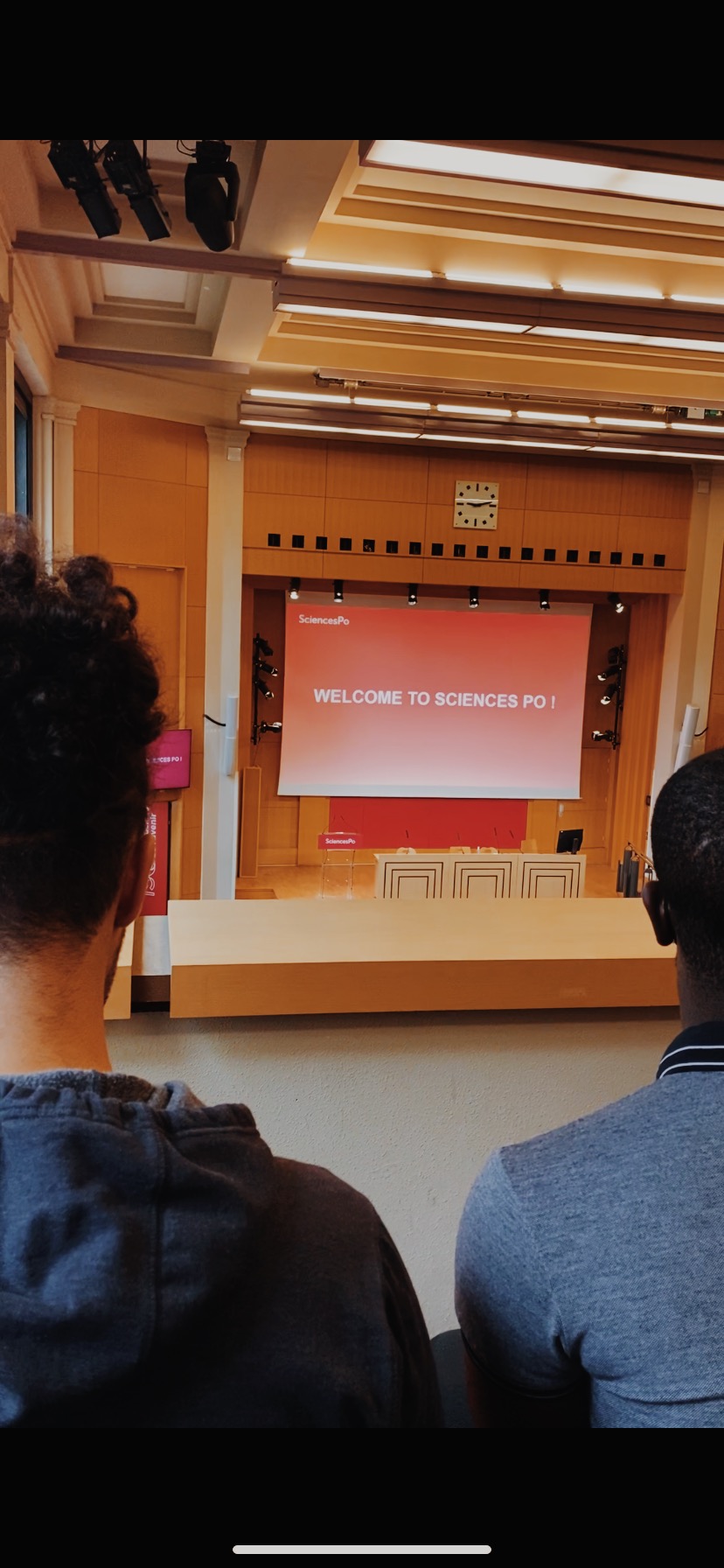
Welcome Week: a six-day orientation in the occident. Sciences Po styles students in red. Cliques pitter-patter, broken nails clitter-clatter. I chase ghosts.
Day One
If week one was my Sacred, week two was the Profane.
It starts, as all my sociologies start, with an old hallway and slivers of new selves. The Sciences Po foyer where 900 students are waiting before our first orientation session looks closer to a MUN than a meeting of vagabonds. Groups coagulate along the cuts of continents. Hi! I’m Sanjana, I say as I invade. The August breeze flies blazers onto bodies and pulls pants down to low-waist Bella Hadidisms. Transatlantic treaties are mirrored in loose troupes. Individual murmurs grow momentum and are elevated to anthems. Attempting to walk around is like swallowing a snowglobe and trying to watch the flakes fall without gagging. Why does everybody know each other already? How does one talk to people again? Can this hallowed chamber carry the Atlas-heavy weight of my expectations?
Back home, I had pictured university in Paris to be all flaneurs and fast philosophy, cigarettes between crumbling classes, and poetry in the corridors. (I now realise that I was picturing La Sorbonne.) Further, my first week mellowed in unconventional potential – I saw spectrums not white light. Sciences Po, on the other hand, is near Saint Germain. It rains in rays of silver, the sun drips in carats. Fashion maisons stand sterling and men in black suits make millions with each sidewalk crossed. The university is dead opposite YSL’s atelier, I gulp in guilt just for passing by its gilded door. I stagger through the school’s hallway, semi-secure in my sociality, but less secure in ideals: are there ideals here? Are there existential-moral-political crises abounding in the heads of tall blonde fast-talking Europeans? I fear, worse than anything, that I may never find out. Bon courage, I remind myself before pressure beats me to an unpersonable pulp. Shed your socialist pipedreams of 1920s Paris (for the moment), and try on a felted hat – a Fascinator if you will.
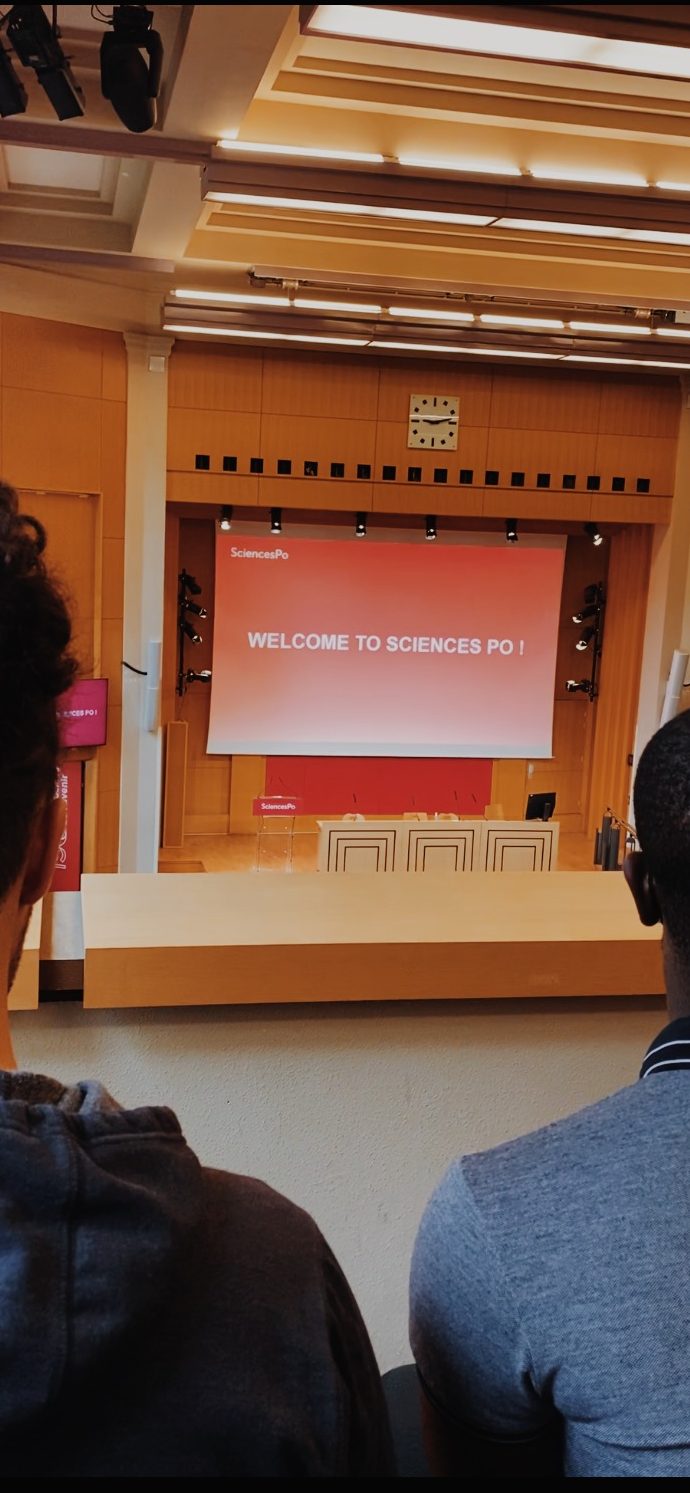
Orientation is always a game of striking the poker strait balance between earnestness and cool, which is to say: do we care about what we are a part of?
We are young, and reluctant to be wowed by the old. On exchange, students’ natural resistance to honouring tradition is strengthened by the temporary. It’s six months in Paris before it is a semester. Nonetheless, we have chosen to come for this orientation. Chosen our outfits and introductions with surgical precision. And we have chosen this city – nothing can fully mask the raw anticipation of studying abroad. At Sciences Po, this takes on new dawns. Assembly line of Europe’s greatest and most wanting politicians, alumni have walked on these marble walls to reach anti-gravity geopolitical positions. Elitism is etched into the sculptures of donors and alumni so generously splayed around the room. We are ushered into the auditorium by a welcome team of crimson students each equipped with the unbearable lightness needed to lift ten conversations at once.
Deep breath as I sit. My finger is shaking. I’ve been lucky enough to attend good schools before, but this feels bigger, more alive. Grand, and cutting-edge, immediate and imperial. In the 5-minutes where everyone rummages into seats, I talk to the girls next to me, grab their Instagrams, and dissect their dreams. They’re from Ukraine, Australia, and Japan. Behind everyone’s “Hi, I’m XX from —” hangs a huge cloud of half-correct cultural context, condensed through tweets and theory and TV. Over time, I wonder if these will change form or consolidate more clearly.
In the presentation, the chancellor of the university makes a joke about going outside to smoke a cigarette, and everyone who’s not from Europe talks about how hilarious that was for the next ten days. We get put into groups of 17 for the week, and the itinerary looks like Selena Gomez’ in the classic film Monte Carlo: we’re going get ID cards and see the Sacre Coeur, tell everybody a fun fact about ourselves, and trek to the Louvre, do bus tours, do sunset tours, go to parties, fan ourselves froid, and introduce ourselves to anybody within the one-kilometre radius of a Sciences Po event because, you never know, they could be my soulmate!
Day Two
Today: campus visit, ‘mysteries of Paris tour,’ and wine and cheese tasting. I meet the people in my group and map them in my head, points for culture, country, and cool. Everyone is liquidly kind, never overcommitting, ever always smoothening. Most of them are from the UK, and the others are from the US, Spain, Germany. Somehow, I get put into the same group as my friend from home with whom I am living – we try to pretend not to know each other when we first walk in, but that plan fails because whenever somebody talks to either of us they go – oh, there’s another girl from India here! And I have to be like yes, I have known her for 10 years. And the mystery collapses.
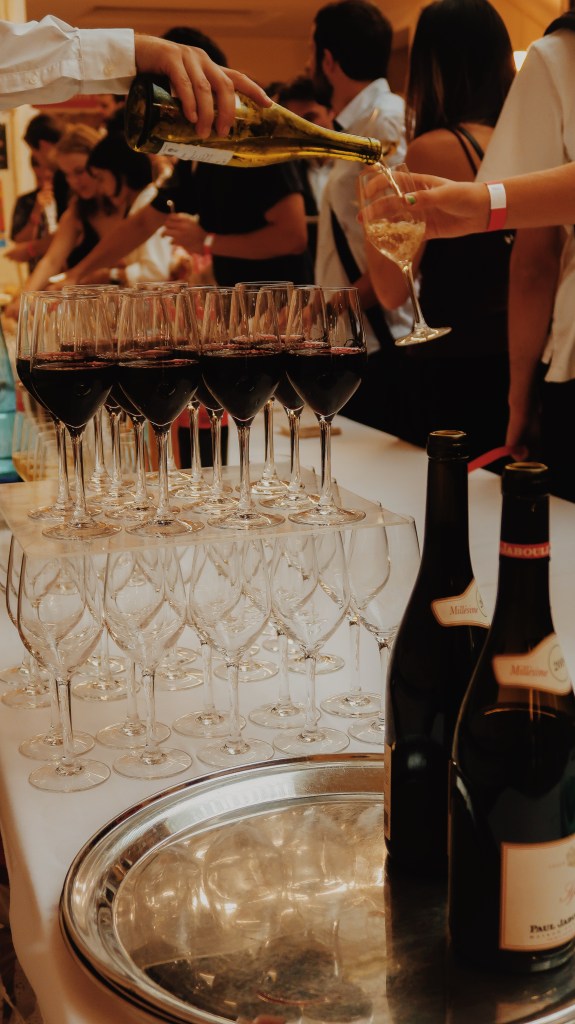
Rituals of interaction stratify us with schedules and obligations. Within these tight tours, contrived group activities, and tiresome requirements, fatigue and excitement buzz with equal power. Stories of party nights lush our garden picnics from enforced gatherings to psychiatric becomings, and I am at once star and shocked. We all wonder silently, where will we plant these fractious roots? What means more, aloofness or participation? And the wonderful thing about orientation, and its fluttering activities, is that there is no answer beyond delicacy. Delicacy in withholding intimacy while encouraging it. No answer beyond icebreaker games and linguistic slants – methods I’ve long loved and never mastered, in clumsiness, in asking, in wanting, and in believing. Truth, truth, lie. Kill, marry, die.
Day Three
I’m beginning to feel the folds of my neighbourhood. I can see directions in the fate lines of my palms. My new friends and I – how strange to say – make attachments in the girls’ bathroom of the bar. Find love in the lacunae of library carts. At the club, ABBA plays and I believe that Erasmus has unlocked the sublime; laundry day, and I struggle with the ardours of translation.
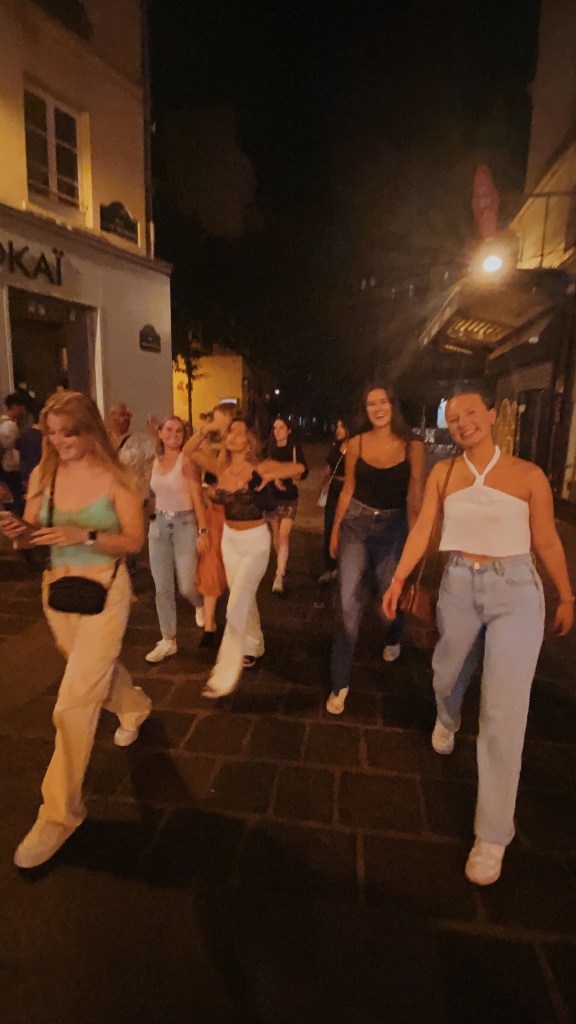
We are carefully building friendships in fragments and frames of reference. During this process, the creative in me yearns for honesty – plunging into everything all at once, unspooling my deepest thoughts onto a plate as we break bread. But the economist in me pleads for felicity. In waiting to give. Because what I love and hate about students is exactly the same: vulnerability, awkwardness, and a willingness to make any time into ash, banter, desperation, and into affection.
Day Four
It has become easy to meet new people, there are standard questions to be asked, and clever responses to show familiarity and cultural commonality ready as fries; where are you from, what are you studying, and of course, why Paris. (To which I have not yet levelled a convincing answer: an affected ‘paaaaris’ is all I have managed.) My exposure to America and the UK, or rather, my neocolonial submersion in them, has trained me in mirrorballing. During a group exercise, I say to a boy oh, you really came in clutch. And he says oh, you guys have clutch in India?
It is tempting, and perhaps too easy to pretend that a seamless globalized culture is all that I am. This is chameleon mimicry. It aches with critical race legacies that I sometimes feel pressing onto the nape of my neck. It is strange being the only brown woman in a room. I find myself talking about India in the liminal spaces of resisting stereotype while trying to retain political honesty. Because people from other parts of the world – particularly Spain, Germany, East Asia – they do not melt as easily into the slang of the extremely online Anglo Americas. They remain slightly removed from conversations rendered in TikTok audios, or references to Fleabag or the Arctic Monkeys or Target. I wish I felt more authority in my postcoloniality, I wish I were more sharp with my slanted selfhood. Instead, I see success in proving globalisation right – an aquatic identity untouched by the past, floating only in the now.
Day Five
I am here with a friend I went to high school with – we live together, and after a day of socialisation we debrief over card games. Definingly, there is tension: comfort is seen as a loss of experience and bravery, whilst the uncertain seems far too awkward and lonely to confront. She has hedged the stakes of my sociality, but at the same time increased them in overcompensation. I refuse, doggedly, to ensconce in the familiar.
But it is draining to broach so much novelty! Each outside conversation glistens, transparent and abstract, it lacks the flesh of home, the grit of time. I do not know these people, and in one talk I cannot pin their hair the right way. I will never know how their hometown felt on Fridays, or how their parents discipline their pets. These empty spaces of unease and disconnect yesterday were simply sparkling mysteries. Today, to fill loss, anxiety glides in. What do they think of me? What do they know of where I live? Was that kind of racist or just rude or both? And then, am I making the most of this moment – every moment all the time – I resent the long walk within the metro! Shouldn’t I be off falling in love somewhere? No, for I must wait in line to register for a student association.
Paris is being eclipsed by peers and quotidian struggles. No longer does it loom as an entity, untouched by people my age riddled with their ends and instruments and imperatives. No longer does it float, symbolic and archetypal, polysemic and precarious. It is now a city, and I now live in an apartment, where before it was a lost dream, and I was living on the chemtrails of catalysts.
Day Five
Drawn into a structured frame by Welcome Week, chance is fanning into a siloed point of a no-return; there are finite limits to the ceiling of the city.
Yesterday, those uneasy spaces in the others were cardiac stressors. Today, the answers I am beginning to get are somewhat…ordinary. People are people. Profane, finite. Regular, not radical. I, too, feel like I’m slowly falling from the highs of a daydream with a perfectly functional parachute. When I reach the ground, I am unchangeably myself again. Rushed clamourings. The whole group gets late to the Louvre because I was busy putting together a zeitgeist-shifting look. Shitty coffee. Rain runs, credit card failures. I waste money, I stain white shirts. Do these girls like me? God, how terrifying.
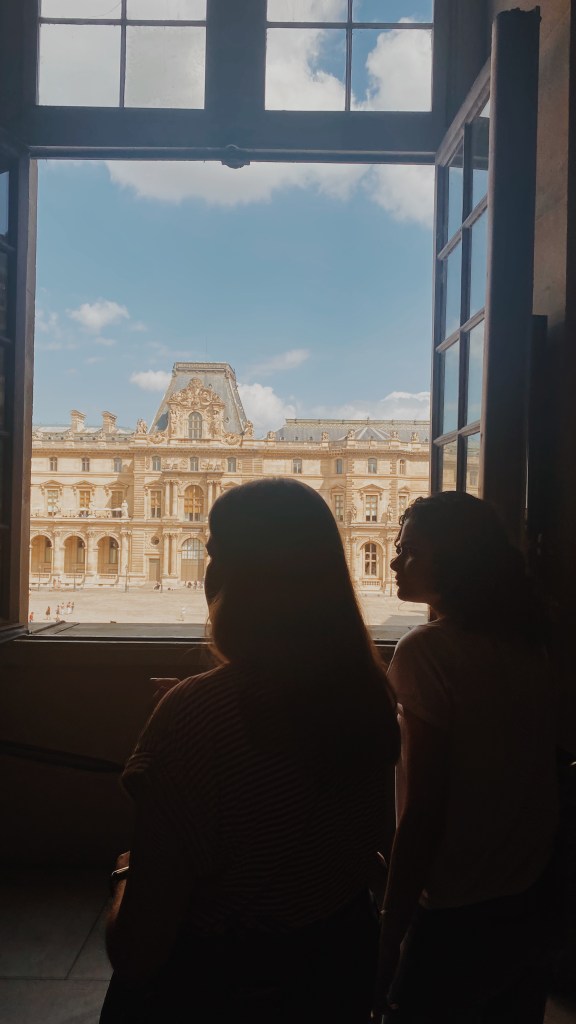
I go to a party with my friend from home, feeling foolish and unknown. The beachy club where it is being hosted is massive, and I’ve never heard these songs before. There are people from exchange here, I assume, but far more people who go to Sciences Po full-time. The aesthetic force of it all – chic French people not even trying to look cute, huddled around their closest friends, having the time of their lives in amber smiles – intimidates me into isolation. A couple of boys come over and talk to me, but beyond batted-eyelid-hellos, I struggle to keep myself on. We go from the dance floor to the bathroom to the bar to the smoking room with rhythm and restlessness. The overwhelming assault of sweat and fervour has tripped me up, the mechanical day weighs me down.
Rally! I tell myself. Your best friend could be waiting for you on the dance floor right now! So, we make strategies to be social, and mostly, this works. But something about all of this feels manufactured, embarrassing. At 2 am, hours before everyone else, we leave.
I go home and play cards with my roommate. And all the while, I fear irrelevance. I fear wastage. I fear intellectual anonymity, and cultural carelessness. There are philosophies tugging at my neurons. There are tragedies pulsing on my iOSised eyes. Blink. Breathe. Take a drag. If I don’t succumb to the profane, I will never find my way around the student services centre and the night buses. If I don’t succumb to the profane, though, I’ll be in Paris again. Can possibility still live here? Is it a fairer house than prose?
Day Six
In the heart of the Profane, we have an introductory ‘methodology’ class as part of the welcome week, and Sciences Po is drenched by voices for the first time. With my Beauvoir tucked beneath my New Yorker tote, and birdshit still fresh on my Sciences Po bookmark, I go to campus. The warm, sunbroken chatter of students clatters through the classrooms and buildings and gardens and staircases and cafeterias. From out of the floor-to-ceiling windows, grass and light flood in, panelled by new power and old politics. We discuss, (at this point I should be prohibited from using these two words) art and politics. An economics major from America argues that all art is utilitarian, and I graciously forgive him. There is a fireplace below a large mirror at the back of the class, abutted by a somehow not-at-all out-of-place charging point. I remember the French politicians that turned this place into a factory of the future, I remember the diplomats that lived in the cemeteries of the library. Brick beside a girl’s Goyard and a boy’s LL Bean, there is a sign above the screen << priere de ne pas fumer>> (please don’t smoke) and I think, in here? This needed to be said?
Back in a classroom, discussing ideas and inching towards each other’s heads, the generator in my guts whirs again. Something is beginning again. Later that evening, I climb to another garden where you can see the Eiffel Tower and Sacre Coeur simultaneously from a particular hilltop. I wish I could draw – it seems like such a rich skill to have in our visual world, such a rich skill in the moment (writing takes rewriting, photography flattens faces). I make friends with the group of skinny young adults sitting near me, very superficially, but on that all-important level of vibes.
Day Seven
On the last day of the welcome programme, our group is shuffled onto a bus tour. We slide onto each other as the bus turns from Arc de Triomphes to revolutionary cafés, moaning about the prison of organised activities. There is an enthusiastic tour guide, a big man, who perhaps if born a century ago might have found work writing communist pamphlets and telling stories over cider, but today must engage disaffected children in histories of a foreign land. He elocutes in pop culture references to keep us on our toes. I find myself the only one laughing at his jokes, and I cannot decide if it is out of pity or genuine historical humour that I find this funny.
We finally end at a garden by the Louvre, and there are girls from another group crying as they bid farewell to their team leader. I am stunned at their emotions, having attained little allegiance to anything but myself in this past week. The girls from my group decide to go get drinks afterwards. Exhaustion wanes us down to just three at the end – me, a girl from Australia, Madi, and one from the US, Audrey.
We sit by the Seine at an overpriced café – I order fries out of vegetarianism and miserliness – and drink pools of wine. Audrey smokes her first cigarette, coughing and chuckling. We talk about politics. The Australian Prime Minister apparently shat himself when he was 18. Audrey is shocked that Madi and I are well-acquainted with the nuances of her state – we tell her that it is not out of choice or interest, but mediatic coercion. More wine. The sun is setting on the Seine, lights begin to splash in the coarse, charcoal reflections of the water. Where next? We buy another bottle from a grocery store, and stumble down to the banks of the river.
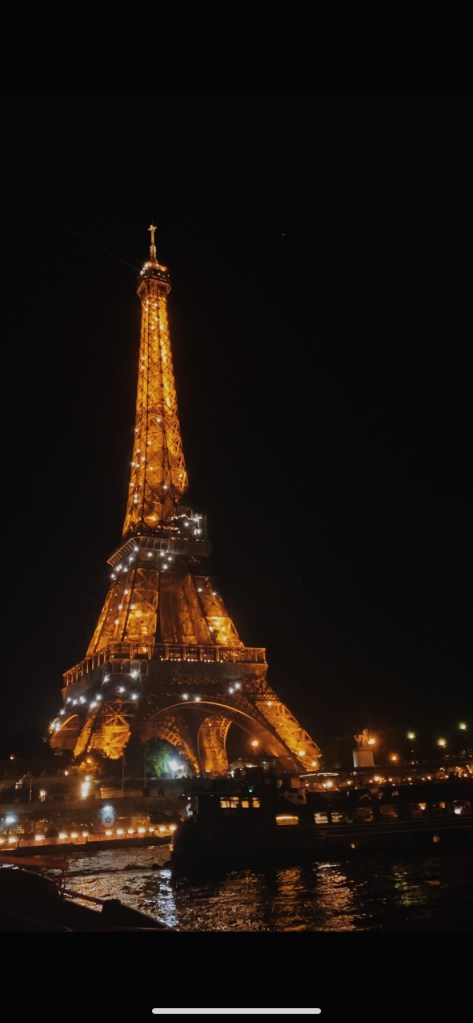
From here, we can see the Tower do a pirouette and shimmer, those glimmering moments cupped around each hour of the clock. I am buoyed by the rosé and the ritz, spelling out my bildungs roman through confessions about sex, society, and silliness. We are getting to know each other. We are sharing our insights, we are qualitative literature.
In the furore by the river, Audrey’s cigarette count has reached the double digits. Nicotine and wine mingle with the stench of the city. As one person talks about an ex-boyfriend, another takes a photo for an Instagram story. And in the re-arranging arranging of an area, the packet of cigarettes slides into the river. A greek tragedy!
We now have a new purpose. It seems as though we have chosen tonight to complete the first (of many) clichés in the city. We leave our riverine picnic and set off to find a Tabac open past midnight. As we lurch through streets and restaurants, nobody is willing to sell us cigs. People at a café offer us some for free, and we take those, spark them, and continue on for our own packet. Eventually, we realise we have already walked halfway to the Eiffel Tower. Commit. Chase.
We arrive with constellated eyes at the garden in darkness. The light of the tower softens one side of shadowy people, and here, everybody earns a golden rim to their visage. When we sit down, we are immediately offered cigarettes by – drumroll – Indians from Delhi! They are reluctant to believe I have lived in India all my life, and no amount of my apologies about my poor Hindi successfully prove my residency.
After many rounds of Never Have I Ever and swapped political positions, we decide to call it a night. We are spent, and we are shining. I go home, illuminated by contentment.
The week is dying, and I am happy. I see that the magic comes and it goes away. And it goes away and it comes. The steadiness of my experience comes from exactly this pendulum. That I have to do the profane with the posture and affectation of the sacred. Breaths of beingness bring pastfuture to a silent euphoria of presence – halting, heavenly. Cliques pitter patter, broken nails clitter clatter, there is a birdsong blowing my balloon lungs big. Dreams are never too far from my folded fingers. Possibility is in this, now, just around the corner, buried at the back of the metro, stewing in sewers, alive in air. It’s not that every second will be bliss, but that any second could be. Page one of Beauvoir’s She Came to Stay: <<and I am here, my heart is beating. Tonight, the theatre has a heart and it is beating.>>
 sanjana sheth
Leave a comment