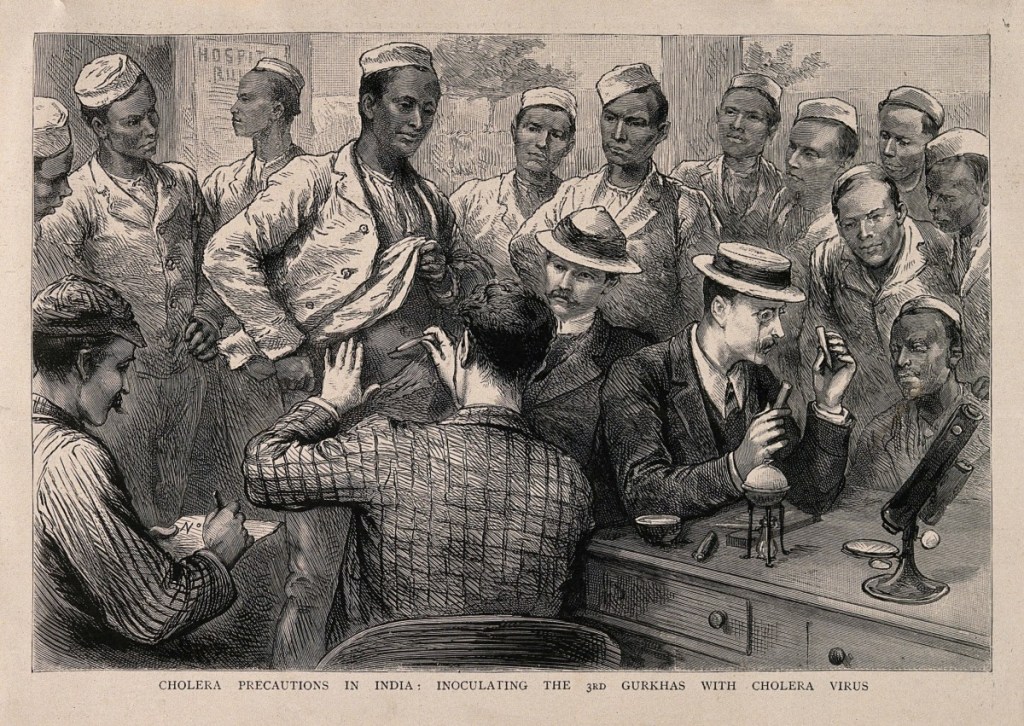
Bruno Latour argues that not only did colonial expansion dovetail with the establishment of public health in the African continent, but also that such a vast colonial expansion would have been impossible without the Pasteurian intervention. As he writes, “political politics fails, but politics by other means succeed superlatively” (142). Through the conquer of parasites and microbes, scientists were able to alter the biological firmament of society, thereby clearing the path for soldiers and the administration to possess political power. The combination of the climate, the lack of antecedent administered health (in the French sense), and the rapid scientific advancements achieved by the Pasteur Institut gave the colonial empire an unprecedented social and environmental potency to enact domination. For instance, Latour documents how sanitation-based segregation, particular forms of urban planning, alterations in quotidian dietary and natural habits were all exercises in colonization that were instrumentalised by the development of public health. These changes transformed the biopolitical playing field between races, by clinically undercutting the natives’ home-ground advantages.
Latour points to a dangerous affinity between large-scale health mandates and the systematic oppression enabled by such a penetrative, literally invasive state edifice. While evidently true for the colony, such skepticism of public health also illuminates the delicate position of science in today’s popular discourses. The right-wing resistance to vaccination, for instance, is justified by a conspiracy theory that it is a means for the government to take control, and therefore risking collective good health is a means of protest and dissent against state intervention. In such a position, science is vilified as an instrument of the ‘left-liberals’ who use it to naturalise oppressive and dangerous state power. While the logic behind such rhetoric is undoubtedly unscientific and deleterious to the general well-being of the world, the principle of wariness towards science and acknowledging its tenuous relationship with domination is not unfounded. Thus, once again, in the post-truth world we can see how the total liberal abdication to an objective, natural science opens up precarious sociological risks for vulnerable groups. At the same time, it is existentially necessary to use science as a tool to save lives, reduce health risks, and combat conspiracy theories. There is a need for a new epistemological position of science and public health, one that acknowledges its fluidity, while utilizing its medical benefits.
 sanjana sheth
Leave a comment