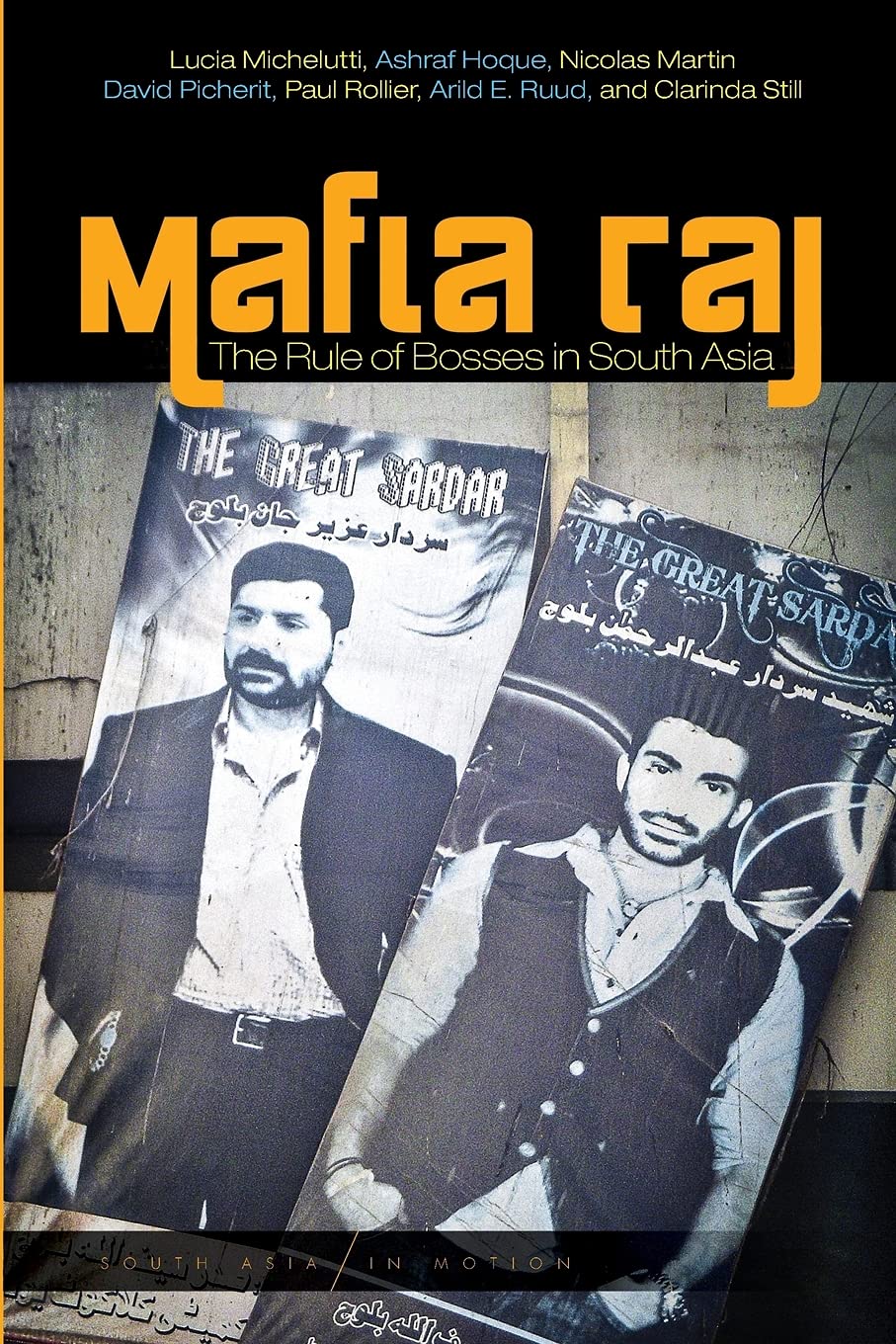
A Cross Review of Mafia Raj and Guns, Slums, and “Yellow Devils”
In Mafia Raj by Michelutti et al and Guns, Slums, and “Yellow Devils” by Laurent Gayer, they explore violence in postcolonial states and the strategies of power spanning political and economic institutions. The overarching theoretical inquiry is into how power operates, and the logic that maintains internecine conflicts in the public consciousness. Both texts subvert conventional instantiations of violence: Mafia Raj emphasises the centrality of the ‘boss’ figure to local domination; Guns, Slums, and “Yellow Devils” tracks how the vestiges of Karachi’s urban conflicts lie in economic causes, but eventually mutate to the more commonly perceived ethnically-motivated power struggles.
While reviews of literature locate these works as part of a larger sociological conversation, both texts tend to rely more heavily on conceptual neologisms born out of their unique ethnographic work. Mafia Raj evidently ruptures neat conceptual frameworks favoured by past researchers such as that of “the social type” of a charismatic leader or a vigilante, arguing conversely that these abstractions demand historically rooted case studies and other evidence to be accurate (10). Guns, Slums, and “Yellow Devils” shows how conflict theory is the best tool to understand violence in Karachi: it is a scarcity of resources and the competitive struggle arising out of that which triggers violence, exacerbated by the vitiating influence of ethnicity, religion, and political rivalry. He also discussed Feldman’s concept of “interface” and Picard’s “militia system” to make crucial links within his work (524; 529).
In Mafia Raj, Michelutti et al investigate what they call ‘the art of bossing’ (3) through the skeins of business, criminality, politics, and media. They demonstrate how these supposedly distinct spheres and professions welter to culminate in the mythical figure of the ‘boss.’ Variously termed as ‘goonda,’ ‘mafia don,’ ‘badmash,’ etc, Mafia Raj grounds this nomenclature in their real bosses; violence is a powerful tool for them but not the only one, they are often also politicians or businessmen but not exclusively, and they complicate conventional ideas of complicity for citizens, judicial organs, and other elected officials. Mafias are conceptualised as enterprises which monopolise control of a business and/or geographical area and also offer and enforce political impunity (4). The bosses of mafia are not merely interested in the accumulation of wealth, but also of power. Mafia Raj is theoretically occupied by the pursuit to map out how they perform “personal sovereignty” (8). They propose a theory of how power is done, rather than suggest power’s sources or show its dispersion. To build this argument, they look at concentrated power in the hands of the ‘boss figure,’ their networks of para-democratic support, and the mythologization of bosses which sustains their personally volatile yet cross-nationally standardised reign. Mafia Raj looks at seven sites located in “middle” Pakistan, India, and Bangladesh – neither urban nor rural poles – and focuses specifically on bosses at varying stages of their careers and levels of domination such as South India’s “the legend,” North India’s “Lady Dabang,” Bangladesh’s “The Rookie,” and Pakistan’s “the Adjudicators” (7). Situated in these postcolonial countries, Mafia Raj explores the violent tendencies of strategies of power, and how the fantasy of the vigilante, honourable yet fear-inspiring boss achieved tacit acceptance in the popular imagination of civilians through romanticised media representations of the same.
Guns, Slums, and “Yellow Devils” delves into the historical production of the crime-ridden, divided city of Karachi by detailing the fraught demographic dynamic between the Pathans, Sindhis, and Mohajirs. Laurent describes how the geopolitically optimal city devolved into a state of hyper fragmentation, secessionism, and even war, as seen between the Jihadists and the Mohajirs, constituted as MQM (514-5). He traces how illegal bastis on the outskirts of the federally-administered city spurred a disproportionate control of real estate to the Pathans, leaving the Mohajirs weakened, as Pathans also had a stronghold on the transportation systems (517). Economic distribution of these valued resources forced antipathy for the Pathans to the limelight; the violence turned ethnic, and caricatured cultural portrayals gained currency in the public imagination. The lynchpin for violence was the death of a Mohajir youth, following which the Mohajir community sought consolidation in the political party MQM. Subsequently, violence broke out on college campuses, streets, prompted police brutality, and bloodlust for arms. The incompatible ideological differences between the somewhat liberal and secular MQM and the Jihadists precipitated into the Mohajir demand for their own state.
Thick descriptions of research fields in both texts have come from the ethnographic methodology of observation, interviews, and aggregation of archival material. Laurent’s artful use of the interview yielded testimonies from a number of pivotal characters in his sprawling genealogy. Significantly, Michelutti et al relied on a collaborative approach to their ethnographies from the fieldwork stage, which allowed them to produce a “common ethnographic archive” (21). Their observations and insights were, at every stage, verified or challenged by their peers’ and resulted in a co-ordinated ontology of the art of bossing which did not run the risk of post-fieldwork manipulation to arrive at a generalisable logic. They employed dangerous but highly immersive participant observation – through shadowing the bosses, seeing them “offstage,” conducting interviews – in addition to statistical economic research into the black market, bribery, and regular commerce. Finally, they looked at newspapers, blogs, social media and crucially, crime novels and films of the mafia bent to ground their analyses in a rich contextual framework.
I found Mafia Raj to be a more rigorous and compelling chapter for two main reasons. First, it was able to show the limitations of conventional sociological categories of the ‘figure’ of even of ‘mafia’ without, as they put it, getting stupefied by the “seductions” of the bosses (25). In fact, in their ability to anatomise the workings of this seduction, they provide insight into the irrefutable appeal of populists like Trump and Modi – “the scalability of the logics of the art of bossing” (11). However, it is worth acknowledging that Laurent’s ambitious text sought to compress a large timeline into a dense study, while Mafia Raj has the luxury of space. Still, Laurent’s work did not have the granular credibility that came from the latter’s infrastructure of collaborative case studies, nor did it establish a frame for how this application of conflict theory could be generalised outside Karachi. Both texts point to a shared, riveting concern not just with – as Michelutti et al cite – “the anthropology of suffering,” rather, with the machinations and mythologies that inflict suffering in the first place (21).
Works Cited
Gayer, Laurent. (2007). “Guns, Slums, and “Yellow Devils”: A Genealogy of Urban Conflicts in Karachi, Pakistan”, Modern Asian Studies, 41, pp 515-544.
Introduction: Understanding the Rule of Bosses in South Asia, pp. 1 – 29 in Lucia Michelutti ed. (2018), Mafia Raj, Stanford University Press.
 sanjana sheth
Leave a comment