Reading Saito, Dowling, and Kant
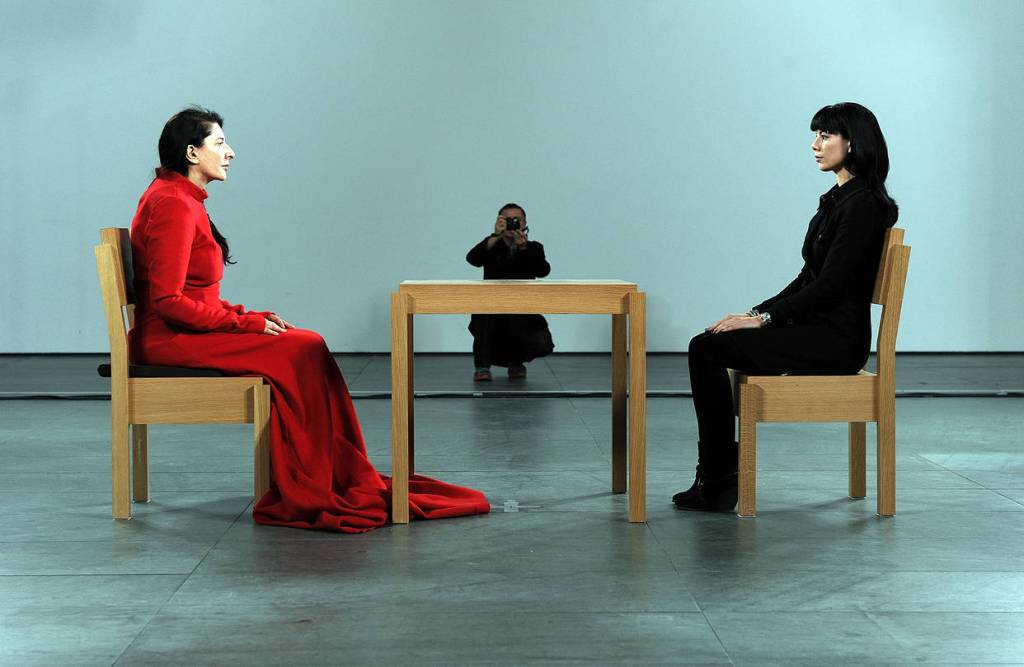
A person sits down in front of a woman in the MoMA’s atrium. The woman stares at the person intensely, scarcely blinking or moving. She gazes into a stranger’s eyes. Then, when their time is up, the person gets up, and another stranger sits before the woman, and the exercise is repeated. This was Marina Abramović’s famed ‘The Artist Is Present’ performance art piece, in which she ‘displayed’ her locked gaze to each enraptured visitor for eight hours a day, over six months, eventually reaching over 1,000 visitors.[1] On her journey with performance art she writes: “the first time I put my body in front of [an] audience, I understood: this is my media.”[2] Paul Blancas, a visitor who came to sit with her 21 times, said it was “a transforming experience—it’s luminous, it’s uplifting, it has many layers, but it always comes back to being present, breathing, maintaining eye contact.”[3]
Consider a modified situation, one perhaps everybody will have experienced: you are sitting on a chair with a parent, a friend, a lover, a co-worker, a professor. Maybe there has been conversation preceding this moment, maybe there will be conversation succeeding this moment. But for now, there is only sitting, and your eyes meet theirs speechlessly, in a look shared and sustained for many seconds or minutes. You are conscious of the dampness of the air, or the way light falls on their face, or of the background soundscape, or of the negative space opened up by the silence, and you are conscious of the staring. Taking for granted, for now, that the former is art, we may ask, is the latter is an aesthetic experience in its own right? Would the characterization of what makes it so, differ starkly from what might make Abramović’s work an aesthetic experience? Is such a universal, quotidian moment constitutive of some approximation of the sublime?
In this essay, I address these questions by interrogating Saito’s conception of ‘everyday aesthetics.’ Dowling provides a coherent critique of why ‘everyday aesthetics’ when evaluated further seem to borrow many of their criteria from conventional theories of the aesthetics of art. He introduces Kant’s work on the distinction between aesthetic judgements of the agreeable versus those of beauty, and upholds the categorization of experiences into theoretically dissimilar concepts of the pleasurable and the sublime. I accept Dowling’s responses to Saito, and his use of Kant to do so, but argue that Dowling does not go far enough. Like him, I reject the strong thesis that aesthetic experiences of the everyday can be paradigmatic for aesthetic theory. Moreover, I reject his weak thesis – “the concept of the aesthetic, at work in discussions of the value of art can be extended to include experiences from daily life.”[4] I argue that the weak thesis effectively has no theoretical stakes for a discussion of aesthetic experiences, being so hedged by truisms of any life that contains sensory experiences (which is to say, all lives). Kant’s account provides the infrastructure with which I scaffold this critique.
Saito’s Everyday Aesthetics: An Overview
Saito has argued that the recent art-centric approach to discussions of aesthetics has come at the cost of a wider appreciation of the aesthetic in our life. Art theory has replaced and conquered aesthetic theory, and if art is deemed the paradigmatic example of the aesthetic, we are missing out in our ability to attend to the everyday aesthetic. Unlike the gatekept art world, “[m]ost non‐art objects and activities concern our everyday experiences of eating, clothing, dwelling, cleaning, and dealing with natural elements. Unlike the institutionalized artworld, these are shared universally.”[5] In other words, the everyday aesthetic is accessible – it requires no glossary of art history terms, but only a sensory body engaged with its environment and conscientious with its sensory experiences. There are four characteristics of everyday aesthetics that Saito emphasizes.
- It is bodily: giving examples of Japanese traditions, Saito highlights the visceral nature of everyday aesthetics. The sense of a season changing, the feeling of humidity and the smell of rain are all minute conditions of the environment, usually deprioritized in the aesthetic experience. Instead of framing these conditions as deleterious or distracting, Saito welcomes them as delicate features that enhance the richness of everyday life, and diffuse the concept of the aesthetic into moments of otherwise mundanity.
- It is singular: the Japanese tea ceremony is often described using the phrase “ichigo ichie (one chance, one meeting).”[6] This facet of the everyday aesthetic challenges the Western valorization of permanence in the aesthetic experience. Something is valuable if it endures, with its relevance and restoration being sustained over centuries of civilization. This idea goes deep into the Western interaction with art, as Hippocrates immortalized very long ago, “life is short, and art is long.” Saito disrupts this theory. The ephemeral, fleeting nature of the everyday aesthetic is precisely what makes it so precious. The particular climatic conditions, the time of day, the arrangement of objects which happened to have worked in a given moment all contribute to the moment’s aesthetic value, and thus the aesthetic value is enlivened by its delicacy, and by its particularity. You can go back and visit the Mona Lisa again if you would life, but you cannot re-create a stack of books on a desk, bathing in sunlight, with dust caught in the light.
- It can be purposive, unlike art: Saito uses the example of a knife to dispute the claim of aesthetic theory that we must encounter the aesthetic object under contemplation as non-purposive and from a disinterested perspective. It does not matter ‘what it can do,’ and likely, it shouldn’t really do anything. Kant emphasizes that it should appear purposive without really having a purpose. Saito argues that the efficacy of the knife’s chopping can certainly be a part of the everyday aesthetic. In quotidian life, the amount of usefulness an object gives you can produce a powerful sense of appreciation for the object.
- It is able to theoretically account for judgement of an aesthetic nature that we make in other aspects of life (such as about a person’s character): Saito recognizes a human tendency to make judgements about the visual presentation of aspects of life such as someone’s sartorial choices, their house’s appearance, or even deciding what environmental cause to support based on saving appealing animals (pandas, turtles) over equally important but less appealing ones (inscects). The aesthetic, by Saito’s understanding, can be everywhere, influencing our decsions and perspectives of culture, ecology, and personality. It is worth expanding our understanding of the aesthetic experience if we are to make sense of the various ways it interacts with our day-to-day life.
Dowling’s Response: Strong, Weak, and Generous Theses
Dowling does not believe there is a need to dislocate the influence of art in our understanding of aesthetics. He shows that the critera that Saito builds for the everyday aesthetic are in fact chosen from conventional art-based theories of aesthetics. It is the values of imagination, sensory appeal, and momentary exultation that frame the notion of ‘everyday aesthetics,’ just like artworks. He rejects Saito’s strong thesis, wherein daily instances can be considered paradigmatic examples of aesthetic experiences. Instead, he argues for a weak thesis which is sensitive to the compatibility of aesthetic experiences with daily instances. In other words, our prevailing understanding and conceptualization of aesthetics can accommodate for everyday aesthetics without requiring much shuffling or modification. He rejects Saito’s thesis by maintaining a Kantian distinction between pleasure and beauty. Everyday aesthetic objects may be pleasurable, but it is theoretically dangerous to consider them exemplars, because that would be triviliasing the category of the aesthetic.
He writes: “While these experiences seem to have a pleasurable or enjoyable character, it is not clear what is achieved by appropriating the term ‘aesthetic’ here. The danger, I suggest, is that we motivate the ‘aesthetics of daily life’ intuition merely by equivocating between ‘aesthetic value’ and ‘pleasure.’”[7] He rightly points out that there is the threat of dilution involved when simple kinds of attention to sensory pleasure are construed as aesthetic experiences. In cases like this, there is nothing in the judgement or response outside of the fact of attention or recognition, which does not meet the basic requirements to constitute an aesthetic experience, which requires some critical significance to qualify. There is no rumination or meditation implicit in simply ‘living in the moment’ and ‘seeing the beauty in everyday.’ Without the requirement of criticality, depth, and longevity, Saito’s theoretical expansion empties out the aesthetic dimension of its full force.
Furthermore, he identifies that singling out the everyday and endowing it with greater significance is contradictory to Saito’s project. It is analytically incompatible to say both: ‘we must appreciate the aesthetic in the everyday,’ and ‘the way to appreciate the aesthetic in the everyday is to focus on it, and encounter it with the temperament of aesthetic contemplation.’ This elevates the everyday. Consider the ‘found object’ modern art. What makes it evocative and aesthetic is that it is from our everyday life, but decontextualized and repositioned not as a purposive part of the humdrum of life, but an aesthetic object in its own right.
Taking the Critique Forward: Kant and Dowling
It is worth briefly reconstructing Kant’s separation of judgements of the agreeable from judgements of beauty. This differentiation will help us understand what is at stake if we accept Saito’s proposition that the everyday can be aesthetic in new and compelling ways. Kant’s description of judgements of taste does not involve concepts, only pleasure and a movement of play. There is no panoply of concepts that are, through cognition, comprehended as discrete. Next, it is subjective in that they only rely on a person’s experience with the object – there is nothing else they can be tied down to like history or context. Further, judgements of taste are necessarily disinterested; it is not the utility or personal bias which can be considered judgement, there has to be a degree of externalization. The object must feel like it is purposive without actually having a purpose. Morality, perfection, and utility are not aesthetic criteria. Finally, judgements of taste must be universal. The spectator must do more than claim to find something beautiful and enjoy the pleasures of contemplation. They must also believe that their enjoyable engagement would be enjoyable universally. Kant requires that the observer expect or suggest that everybody might share in her judgement. Therefore, the judgement comes from one subjective person, but carries the weight of universal assent within it.
Contrasted with judgements of taste that deal in beauty, judgements of the agreeable, deal in sensory, visceral pleasures. There is no requirement for universal assent nor appeal, nor disinterested purposiveness without a real purpose. Prejudice and framing are likely intervening in such judgements, and thus judgements of the agreeable do not lay claim to generalization. They are immediately gratifying, but they do not inspire any deeper longevity or impression after their pleasurable contemplation has come to an end. With this framework in mind, I will now take forward Dowling’s critique of Saito through a Kantian lens, and offer my own.
Let us take up each the outlined facets of the everyday aesthetic.
- The Bodily
Saito’s urge that we consider bodily experiences a form of universal aesthetic is playing into the conception of the agreeable, not the sublime or beautiful. By emphasizing the visceral encounter one person has with their surroundings, it becomes theoretically impossible to accommodate that another person would feel the same way about the surroundings. In Kantian terms, it is theoretically impossible that they would even consider thinking about universal assent when the experience comes from its insularity, its embeddedness into one person’s everyday. Further, Saito acknowledges that sensitivity to surroundings is cultivated through the cultural specificities of said surroundings. This sensitivity is what allows the everyday to register as aesthetic, but this sensitivity comes from an interested and involved position.
- The Singular
Militating against the Western demand for permanence as a metric for aesthetic value, Saito celebrates the fleeting power of the everyday. However, once again, this lets the so-called aesthetic become more like a peak moment for one individual whose power depends on its brevity than an enduring experience. Why do paradigm examples of the aesthetic or the sublime rely on some temporal significance? I assert that there are two components: first, that the experience itself lasts reasonably long (at least a minute or five); second, that the experience leave a lasting impression. We have been told that everyday aesthetics require a special kind of attention to the regular; ‘attention’ connotes a sense that if you blink you might miss it. Second, being such a specific attention to a moment in time that takes place in the mundane, it is difficult to see why any long-term effect would be produced on the subject. Even if I stand at the edge of a cliff for one minute, it is far more likely to plunge me into some kind of meditations and leave an enduring afterimage in my mind. Thus, on both planes, singularity precludes depth.
- The Purposive
Saito claims that the object can be purposive, and what makes it aesthetic can include that very purposiveness. A knife that cuts well renders unto the user a new kind of aesthetic appreciation, the argument goes. But surely the usefulness of a thing should stand in stark contrast to its aesthetic value. Aesthetics must represent a dimension of contemplation and enjoyment unfettered by the material and rather machine-like world of utility and purposiveness. When the function of the object overwhelms its beauty, it is no longer an aesthetic experience, but some more base, more practical experience of efficiency that is taking place.
- The Everyday Judgement
It is a truism that sensory judgements influence our experiences with the world. What we find attractive in people, and the cues we use to make inferences about their lifestyle and identity are exercises in evaluating their appeal. But ‘appeal’ is often used synonymously with ‘aesthetic’ in common parlance. However, something being cute or compelling is not constitutive of the ‘aesthetic’ in any philosophical sense. Rather, it connotes the agreeable. To suggest that just because – say – colour theory influences both evaluation of an artwork and an outfit, that this influence renders the judgement aesthetic is a dangerous reach. Indeed, the key problem with Dowling’s weak thesis is that it suggests everyday aesthetics can be considered aesthetics because there are similar ways in which we talk about the two. He agrees that everyday aesthetics are not strong examples of the aesthetic, but because they both involve sensory appreciation, a moment of pleasure, and appealing imagery, that aesthetics can be extended to include the everyday.
If this were true, then everything would be a matter of aesthetics. By Saito’s depiction, driving a good car, if it went fast and we appreciated the speed, would be aesthetic. By Dowling’s weak thesis, the driving of the car – while not a paradigmatic example – is still an example nonetheless. It is difficult to see what the theoretical benefit of this can be. We can still talk about the sensory pleasure of cracking your neck or fixing your posture without affirming that these can be sublime or beautiful. That is to say, we can continue to use the vocabulary of the aesthetic without expanding the concept to absurdity.
Saito’s gripe seems to be that there has been an unfair Western prioritization of permanence, disinterest, and inaccessible art worlds. But neither in Kant, nor in this account, is there an allegation of inferiority launched on the everyday. It does contain pleasurable moments that we would do better to recognize and cherish. These are not, however, accounts of beauty nor the sublime.
Concluding the Everyday
Maria Abramović’s work is aesthetic not merely because people at the MoMA decided it was. There is something about isolating a human gaze, putting it on display, and creating an experience out of it that constitutes art. It is because of the protracted engagement with the idea of artist and subject, the intensity of the aesthetic experience, and the staging interaction as spectacle that we may call it beautiful. It is certainly an experience that could be pleasurable in the everyday as well, without the museum walls supporting it. However, by virtue of it being an everyday thing taking being in the space of the everyday, it is impossible to call it ‘aesthetic.’ To make this claim is not to set up a hierarchy where one is better than the other, but rather, to create a bifurcation that makes studying difference possible. Keeping the analytical categories of the agreeable and the beautiful discrete does not serve the Western hegemony of the artworld, it serves the spectator. It allows the spectator to take pleasure in their daily life without adding the conceptual requirements of depth or ruminative effects. Further, it also preserves the sublime. The sublime has the power to take us outside of our quotidian lives, filled with modernity’s effects and life’s bustle. Suspending the aesthetic outside of our day-to-day keeps that space sacred, and allows its power to not be diluted by the quicksand of the quotidian.
Works Cited
“Moma Learning.” MoMA, http://www.moma.org/learn/moma_learning/marina-abramovic-marina-abramovic-the-artist-is-present-2010/. Accessed 9 May 2023.
Christopher Dowling, The Aesthetics of Daily Life, The British Journal of Aesthetics, Volume 50, Issue 3, July 2010, Pages 225–242, https://doi.org/10.1093/aesthj/ayq021
Critique of the Power of Judgment (The Cambridge Edition of the Works of Immanuel Kant), Paul Guyer (ed.), Paul Guyer and Eric Matthews (trans), Cambridge: Cambridge University Press, 2000
Marina Abramović, quoted in “Marina Abramović: Early Years,” Marina Abramović Institute, http://www.mai-hudson.org/about-mai/.
Saito, Yuriko, Everyday Aesthetics (Oxford, 2007; online edn, Oxford Academic, 1 Jan. 2008), https://doi.org/10.1093/acprof:oso/9780199278350.001.0001, accessed 11 May 2023.
[1] MoMA, MoMA Learning.
[2] Abramović, Marina Abramović: Early Years.
[3] Paco Blancas tumblr, https://www.tumblr.com/search/paco%20blancas.
[4] Dowling, 241.
[5] Saito, 778.
[6] Saito, 779.
[7] Dowling, 226.
 sanjana sheth
Leave a comment