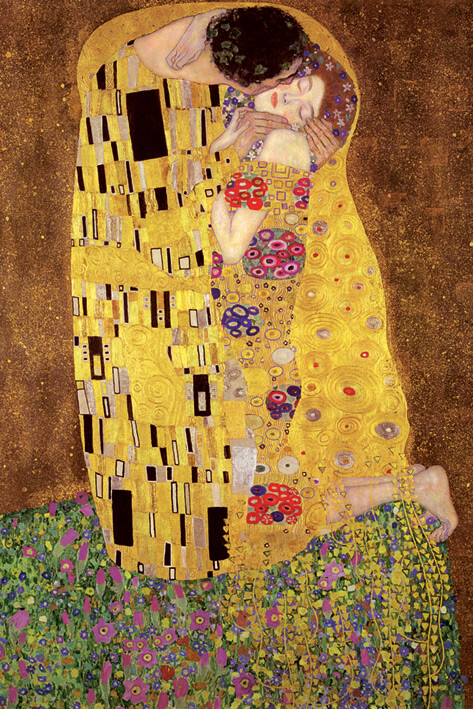
Gustav Klimt’s The Kiss depicts a pair of lovers engaged in an aureate embrace. Klimt’s artwork is adorned with different patterns, each intricate and dazzling, but certainly dissimilar – there are flowers, geometrical shapes, and human figures together constellating the work. The painting seems to capture Francis Hutcheson’s description of beauty as “unity amidst variety” as he details in the seminal Inquiry– The Kiss registers as beauty in its totality, despite (and because of) its disparate components with various textures and aesthetic elements.[1] This might lead to the conclusion that Hutchesonian view of beauty is plausible, that beauty is unity amidst variety can be immediately grasped. However, in this essay, I argue that although the principle of unity-amidst-variety is consistent with internal sense theory, it remains incompatible with most forms of relative beauty. I propose that this undermines Hutcheson’s whole project and suggests that his characterization of beauty is limited in its scope. Thus, while the unity-amidst-variety formula has merit as an aesthetic principle[2], beauty has more cognition and subjective space to it than Hutcheson’s view allows. To build this claim, I first reconstruct Hutcheson’s account of beauty as an internal sense, its relationship with pleasure, and the principle of unity-amidst-variety. Next, I suggest how the distinction between absolute and relative beauty puts pressure on this account, and finally, I conclude that it is difficult to argue for immediacy and no intellectual or cognitive work at play when discussing beauty, particularly relative beauty.
Beauty as an Internal Sense
Hutcheson asserts that we encounter, through our external senses, ‘ideas’ of objects.[3] ‘Idea’ is deployed in the Lockean tradition to mean a non-volitional, visceral, and immediate reaction to the primary qualities of an object – it is impossible to not perceive this information about colour, shape, and size.[4] He proceeds to distinguish internal senses from external senses, and then establishes beauty as an internal sense which can be compared to the pleasure of the external senses. External senses are grouped by the “general Idea of Sensation” and the “Powers of receiving those different Perceptions” are what differentiate senses from one another.[5] For instance, olfactory responses and gustatory responses are entirely dissimilar in the kind of sensation they bring about, but what is true of both is that they in fact do bring about sensations.
The internal sense of beauty differs from external senses because it is perceived as a sensation without exerting our external senses – they function independent of each other. External senses can give rise to pleasures concerned with simple ideas about the object.[6] The internal sense of beauty, on the other hand, is capable of apprehending a complex idea about the object. Namely, a complex idea of unity amidst variety, as will be shown later. Important here is that this internal sense of beauty operates in much the same way as our external senses of sight or sound – non-volitional and immediate. There is no ‘extra step’ of concatenating the simple ideas of external senses in the head into something more. The internal sense of beauty is sensible – that is, a response of sensation, and disinterested – unconcerned with cognitive estimates of the object’s purposiveness or previous vested interest in it.[7] The pleasure we obtain is a sensual pleasure in and of itself. Indeed, Hutcheson argues that “Our Desire of Beauty may be counter-ballanc’d by Rewards or Threatnings, but never our Sense of it,” which is to say that the desire to obtain or reject an object of beauty may well be mediated by other motivations and apperceptions, but the first-instance engagement is instantaneously and exclusively that of sense.[8] However, internal sense theory reduces encounters with objects to fleeting knee-jerk responses. While pleasurable, there is a loss of depth in this account. To expand on this claim, it is worth detailing the fulcrum of Hutcheson’s view of beauty.
Unity Amidst Variety
Hutcheson posits that the difference between an internal and external sense is in the complexity or simplicity of the idea it is capable of perceiving. In the case of beauty, the internal sense has the faculty to process immediately the form of a complex idea generated by an object. Hutcheson proposes that the complex idea is that of unity amidst variety: “But what we call Beautiful in Objects, to speak in the Mathematical Style, seems to be in a compound Ratio of Uniformity and Variety: so that where the Uniformity of Bodys is equal, the Beauty is as the Variety; and where the Variety is equal, the Beauty is as the Uniformity.”[9] This “compound Ratio,” is evinced in the comparatively greater beauty of an equilateral triangle than a scalene triangle (more uniformity). The square, however, has comparatively greater beauty than the equilateral triangle because not only does it have uniformity, but also it has more sides (variety).[10]
Importantly, it is not a recognition of unity-amidst-variety that is somehow cathecting pleasure into our experience with an object. There cannot be contextualised or intellectualized pleasure. Even without noting that there is unity-amidst-variety, the object can be sensed as beauteous. Hutcheson undertakes a study of the natural world to build his principle, elaborating with examples such as the plant and animal kingdom, where unity of species and shading creates uniformity and variety that is beautiful to humans.[11] Here, again, we do not have a say in what we choose to find beautiful, it is phenomenologically associated with our internal sense’s interaction with the object’s complex idea. Our external senses occasionally come into contact with objects that display unity-amidst-variety, and our internal sense of beauty immediately experiences this as pleasure, whether or not we have considered the existence of the uniformity or variety that make it such.
Absolute and Relative Beauty
Hutcheson first discusses objects of absolute beauty that are beautiful without referents – they stand on their own, displaying unity amidst variety through their formal composition. Nature, geometry, mathematics, harmonious compositions, and the universe all offer absolute beauty in their way. Relative beauty, on the other hand, is that which is seen in objects “commonly considered as imitations or resemblances of something else.”[12] This is representative beauty that allows its perceiver mimetic pleasures based on its ability to approximate a ‘real’ object.
Hutcheson is committed to the unity-amidst-variety principle even when discussing relative or comparative beauty: “ thro all other Works of Art, even to the meanest Utensil; the Beauty of every one of which we shall always find to have the same Foundation of Uniformity amidst Variety, without which they appear mean, irregular and deform’d.”[13] Even our literary preference for rounded, flawed characters instead of flat heroes is construed as an indication of a preference for variety coming together in unifying, choate terms.[14]
Three contentions with Hutcheson will be explored here. First, recognizing unity between an original and a duplication requires cognition. In contrast to the view provided by internal sense theory, it seems unlikely that a visceral reaction to the faithfulness of a representative work of art is totally devoid of thought. Furthermore, it is unclear how this relationship between the original and the representation can be tested by the unity-amidst-variety principle. Returning to The Kiss, one could suggest that despite the unrealistic painting style, its true mastery and beauty comes from its emotional richness, and its representation of a ‘relatable’ feeling that may not be immediately retrievable on first glance.
Second, relatedly, we can argue that in general, extended engagement with an object under aesthetic contemplation can be a source of the pleasure of beauty. Third, finally, that unity-amidst-variety works as a partial aesthetic theory, and cannot accommodate works of art, nor even all kinds of natural beauty. For instance, although there could be a case made that a calm open sea displays uniformity, it does not exhibit variety. Its beauty is perceived and augmented over time, through the movement of the waves. Several artworks are admired for their developing pleasure and not the sensory response – Picasso’s Les Demoiselles d’Avignon, Müch’s The Scream, or crucially, Yves Klien’s monochromatic blue paintings are fitting examples. Beauty is subjective for Hutcheson. That is to say, it does not exist in an object, disembodied from a person who is perceiving it. It is universal to all humans, but whatever the quality of the object that gives rise to the pleasure of beauty, it is necessarily a sensed idea like sight or sound.[15] However, this subjectivity is still subsumed under a larger universality amongst the human aesthetic response, and only the level of exposure and refinement of the subject could explain differences in aesthetic preferences. People’s subjectively varying responses to the ‘beauty’ in the aforementioned works once again problematizes Hutcheson’s faith in the enduring overarching principle of unity-amidst-variety; it seems far more likely that there are some objects of aesthetic contemplation to which humans have layered, diverging, and subjective responses to, not merely because of the presence or absence of unity-amidst-variety, but because of the interference of cognition and context.
Thus, while Hutchesonian beauty is impactful in its ability to capture the sensual pleasure of symmetry, intricacy, and geometry, it seems implausible when expanded to artworks, or longer timeframes of aesthetic experiences. Unity-amidst-variety succeeds as a principle of composition for some forms of absolute beauty, but cannot lay claim to a broader, more inclusive conception of beauty and the spectrum of aesthetic experiences.
Works Cited
Hutcheson, Francis. An Inquiry into the Original of Our Ideas of Beauty and Virtue (1726).
[1] Hutcheson, Inquiry, 65.
[2] The difference I am drawing here is between an aesthetic principle, that is, one method of recognizing and creating beauty in objects, as opposed to the defining aesthetic principle, that is, the sole predictor of beauty.
[3] Hutcheson, Inquiry, 19.
[4] Hutcheson, Inquiry, 19.
[5] Ibid, 19.
[6] Ibid, 21-22.
[7] Ibid, 26.
[8] Ibid, 26.
[9] Ibid, 29.
[10] Ibid, 29.
[11] Ibid, 31-33.
[12] Ibid, 27.
[13] Ibid, 41.
[14] Ibid, 43.
[15] Ibid, 63-6.
 sanjana sheth
Leave a comment