John Gardner’s Asymmetrical Interpretation of the Rule of Law
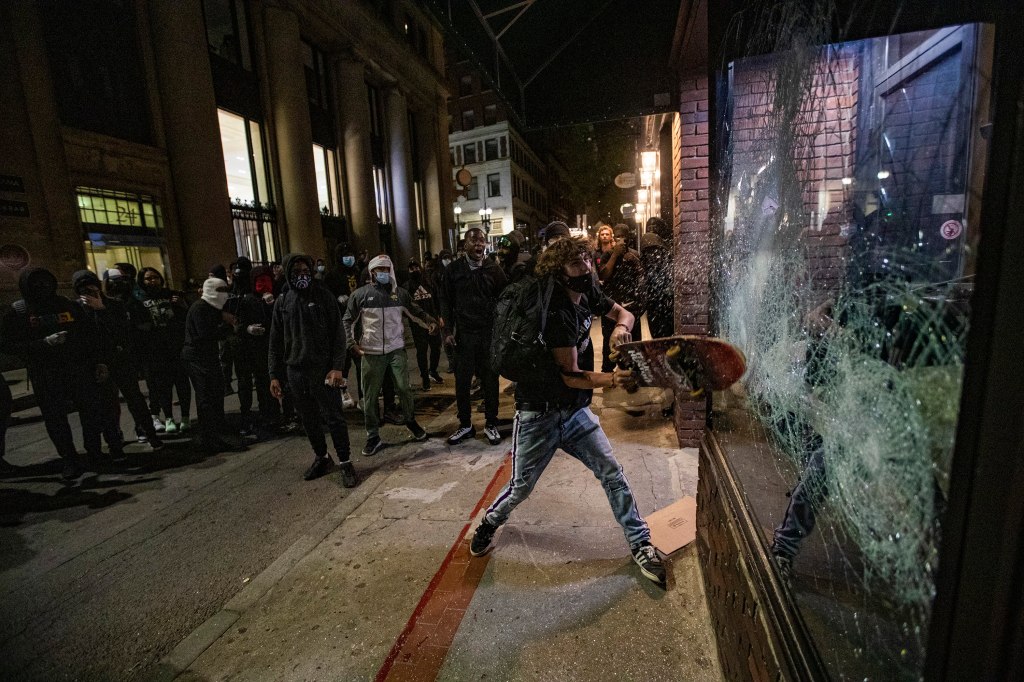
In the wake of George Floyd’s murder by two white police officers earlier this year, the sweeping ‘Black Lives Matter’ protests flared up into riots at several sites. Floyd was a black man facing arrest because of an allegedly fraudulent 20 dollar bill, and a police officer restrained an already-handcuffed Floyd by pressing their knee on his neck for nine and a half minutes until he died. Two recent New York Times op-eds described the violence, larceny, and destruction of property at the consequent protests as a morally justified pis aller: “looting is theft; it violates the law” but “the collapse of politics and governance leaves no other option” (Robin; Taylor). Under John Gardner’s nuanced and socially sensitive ‘asymmetrical interpretation’ of the rule of law, such defiance of law – when contextually qualified – is acceptable. Of course, the defaulters must face the consequences of their criminous behaviour, but it does not pose as great a threat to the rule of law as the police brutality which birthed the protests in the first place.
So, what is this ‘asymmetrical interpretation,’ and what does it mean for the ideal of the rule of law? In this paper, I hope to address precisely this question by closely reading John Gardner’s essay ‘The Twilight of Legality’ and a chapter from Law as a Leap of Faith, ‘The Supposed Formality of the Rule of Law’ before locating his theory among differing perspectives on the rule of law. Next, I will sketch out what I believe to be the implications of espousing an ‘asymmetrical interpretation’ of the rule of law. Finally, I conclude by discussing how Gardner’s work can be read in the present political context, its stakes, and whether or not I am persuaded by his approach.
Juridification and the Decline in Legality
Gardner’s ‘asymmetrical interpretation’ of the rule of law is, in many ways, a response to the increasing invasion of legislative regulations in every aspect of modern life. Counterintuitively, he explicates this proliferation of legal impositions as antithetical to legality. Gardner terms the contemporary phenomenon “juridification,” and sets forth two clear grounds upon which it has compromised the rule of law (2). First, the sheer breadth of laws pervading an individual’s daily life and routine renders ‘the law’ in its entirety, unknowable. It is impossible for a reasonable person, even one who has dedicated their life to studying the law, to learn and remember at every moment whether their actions have not been criminalised under some statute somewhere. Resultantly, the law can “unexpectedly ambush…those who are trying to conform to it,” which plagues the rule of law with unpredictability and impossible expectations of its citizens (Gardner 4).
Second, juridification’s unreasonable demands mean that the law cannot be enforced evenly. Every infraction cannot be penalised mainly because infractions themselves have become easier to commit, oftentimes unwittingly, and the prolific laws may simply be frivolous, absurd, or excessive. Hence, the law finds itself inconsistently enforced. However, said inconsistency is neither impartial nor aleatory. Selective enforcement operates with biases, fears and vested interests. For example, Gardner writes that, “big corporations with police-like security departments can enjoy cosy relations with the police that are denied to those who inconveniently protest against their corporate power” (5). Powerful groups can exploit the vastness of law to further their particular ends, while marginalised groups are disproportionately vulnerable to eccentric enforcement. It is easier for venality and ethically ambiguous factors to motivate prosecution because, in a juridified climate, citizens are turned into large moving targets acting within the omnipotent framework of ever-burgeoning laws. At this stage, it is apparent that juridification retards the capacity of a legal community for knowing and accordingly acting lawfully. Moreover, the expanded sphere of influence that is thus created necessitates the discretion of individual officials who are certainly not immune to persuasion, coercion, prejudice and expedience. This discretion is problematic since it, very crudely, is not fair – it defies several requirements of the rule of law such as impartial application, reliability and non-discrimination. In this age of juridification – where at the slightest “moral panic” reams of regulations are written – how can citizens ever follow the letter of the law (Gardner 3)? What recourse do they have register their dissent against the slew of legislation thrown at them? And most importantly, under these revised circumstances, does unlawfulness inescapably pierce the rule of law?
For Gardner, the ‘symmetrical’ approach to the rule of law propounded by who he pejoratively calls the “law and order types” regards the success of the rule of law to be directly and exclusively determined by the extent to which ordinary citizens adhere to the law (5). For these individuals, the rioting and looting seen in the Black Lives Matter protests are decisively condemned for they seriously jeapordise the rule of law. Protestors may take to destroying public buses, shattering a storefront or spray-painting a street sign – these are all deemed pointed affronts to the rule of law. They disrupt the ideal of order and lawfulness, and the sacralised contract that requires a legal community to be religiously law-abiding. The cruel and illegal force deployed by the police against the protesting masses through repressive weapons like water-cannons, tear gas and batons is legitimate inasmuch as it is chalked up merely as an illegal response to an incontrovertibly illegal act of rioting or vandalism. More than illegal, since the rioters have jeopardised the lawful peace, the unlawful response that is then inflicted is not only justified, it is sometimes painted as necessary or good for the rule of law.
The Asymmetrical Interpretation of the Rule of Law
Gardner repudiates the law and order types’ assumption that legality and abiding by the law is a decision made in an uncomplicated, equal world. To him, the equivalence between prosecutorial illegality and a private citizen’s is wholly unfounded. This false equivalence belies the structural and material foundations which intervene in how people are impacted by the law. When the public’s adherence to the law is used as a yardstick to ascertain extent to which we are under the rule of law, integral considerations of stratified inequality within law enforcement, state-sponsored violence, and inane, morally abhorrent or otherwise objectionable juridification are ignored just to sustain the status quo.
Gardner’s asymmetric approach is sharply cognisant of these considerations. In opposition to the law and order types, Gardner posits that officials of the law cannot deviate from the legal system that they themselves serve to protect and uphold. No matter how archaic or insipid a law, or how criminal a citizen is being, they have a moral responsibility as agents of the legal order to act in meticulous compliance with the law. This is because unlike private citizens, who “are the beneficiaries of the rule of law,” officers, “when in official capacity, are its functionaries” (Gardner 6). The asymmetric approach to the rule of law confers a greater imperative onto the police, judges, officials and other agents of the law than citizens because of a unique political relationship Gardner is implicitly characterising. This approach takes seriously the fact that the rule of law is but one ideal of political morality, it is far from the only or most significant one. Subsequently, its demands of a political community cannot include undying fealty to law and order, especially in the face of injustice. Moreover, where law and order types rationalise police brutality as collateral damage to their rule of law project, the asymmetric approach holds the police to a higher standard so that they satisfy their own stipulations, and face the repercussions for their crimes.
When a civilian recommends the wrong medicine to their friend with a headache either because said civilian was ignorant to the correct medicine or intentionally wanted to harm their friend because of a tiff they were in, it is not quite the same as if a practicing doctor prescribed addictive painkillers to me for a runny nose. It would be fair to accuse the civilian of stupidity or sociopathy, but not of medical malpractice. That is because the doctor knew better. The doctor’s function as a professional is to help patients get better. Disobeying the explicit recommendations of a medical professional is not without its consequences; the patient will suffer deteriorating health, poor quality of life and so on. However, if a patient disregarded their doctor’s orders for cutting out sugar or taking a vitamin, the doctor cannot, in response, perform a completely unnecessary surgery to conveniently solve the problem. Individual citizens benefit from a doctor’s orders, they may even choose when they would like to reject medical advice or offer some of their own, but they are not bound by the Hippocratic oath as medical professionals are. In a similar same vein, the moral obligation to uphold the law – whatever its contents – is asymmetrically applied to the functionaries of the rule of law. The costs of disobedience including incarceration, monetary compensation, or probation will follow. But like the ill- intentioned friend whose faulty recommendation is not medical malpractice, private infractions do not threaten the rule of law the way state-sponsored infractions do.
Juridifcation increases the general propensity to violate the law and it expands the discretionary powers of legal agents. Public officials are therefore positioned to act in contravention with the law either because they, quite plainly, are unfamiliar with its countless edicts, or because their discretionary powers fall prey to discriminatory forces. These are much greater, and indeed more pernicious systemic problems with the rule of law when compared with deliberate criminality. By making the law inaccessible and creating the possibility for malpractice, individuals are unable to accurately gauge the consequences of their actions and make informed decisions as citizens of a legal jurisdiction.
Gardner goes on to critique arbitration and “boilerplate take-it-or-leave-it” contracts for the parallel legal systems they create that are neither standardised, nor subject to the same scrutiny that a court’s ruling is (14). But they continue to enjoy the effect of ‘legality,’ without any of the mandatory reflexivity and checks and balances. In developing this line of analysis, Gardner describes the rule of law as being “a public good” (21). It is a public good because fulfilling its requirements of justice, clarity and equality will not always be the most expedient or profitable path. Yet, the rule of law and the justice it delivers has unique value unrelated to the singular interactions of a given crime. Therefore, the asymmetrical interpretation preserves the public good of the rule of law by elevating it beyond a tit-for-tat mechanism that seeks to blindly achieve order or resolution. Being a “legal practitioner” then, requires a “moral sensibility” that surpasses myopic adjudication on the individual instances of crime, a sensibility that must engage with larger power structures and dynamics in order to meaningfully respect the distinct ideal of the rule of law (22). In this school of thought, police brutality is unequivocally a greater miscarriage of the tenets of the rule of law than larceny or rioting because police brutality betrays the implicit burden of agents of law-enforcement to serve the rule of law as a public good. This interpretation is sees the power asymmetry between officialdom and civilians, and accordingly sees asymmetry in the way these two actors can engage with the rule of law.
Joseph Raz’s Vision of the Rule of Law
Raz’s formal conception of the rule of law insists on theoretically prescinding it from other political ideals such as equality, liberty, or democracy. He submits that “the rule of law is just one of the virtues a legal system may possess and by which it is to be judged” (Raz 211). His theory underlined the procedural framework of the rule of law to allow citizens to guard against the inherent threats to freedom cast by not being able to predict and steer behaviour. This liberal standpoint calls for laws that were stable, reliable, open, prospective and clear (213). Like Gardner, for Raz, the rule of law is impossible to achieve if its subjects are not aware of the laws themselves: “if the law is to be obeyed it must be capable of guiding the behaviour of its subjects” (214). Furthermore, one of his eight principles that guide his interpretation to the rule of law is that “[t]he discretion of the crime-preventing agencies should not be allowed to pervert the law. Not only the courts but also the actions of the police and the prosecuting authorities can subvert the law” (218). While Gardner would certainly agree with Raz here, Gardner’s asymmetrical interpretation pushes this strand of analysis much further by affirming the greater responsibility these crime-preventing agencies have in striving for the rule of law. However, Gardner explodes the separation of formal and substantive definitions of the rule of law, and would likely insist that Raz’s repeated emphasis on the rule of law somehow being both the tutelary of human dignity and yet far removed from any substantive aspects is contradictory and unsatisfying. How can a system grounded in human dignity and (limited) freedom claim to be compatible with evil and oppression?
Lon Fuller’s Morality of Law
Lon Fuller’s The Morality of Law was accused of being formal and legalistic. He lays down the 8 criteria which a legal system must fulfil to varying degrees in order to be considered a legal system at all. These desiderata are generality, in that there must be established rules, promulgated laws – laws are to be made publicly available, laws must be prospective, comprehensible, free of contradictions, should not require the impossible, stable, and finally, official action should be consistent with the declared rules of the legal system. In Law as a Leap of Faith, Gardner trounces Fuller’s critics by complicating the classification of formal/substantive. For instance, Gardner creates the hypothetical of a person suing the state for false imprisonment: “the imprisonment was unlawful if and only if the police did not follow the proper procedures for the arrest, detention, and questioning of a suspect” (Gardner 204) to show the intimate relationship between procedures and the substantive rights they are based on and give rise to. Fullerian rule of law is concertedly laying claim to a moral political ideal, and his desiderata promise not just effective law, but just law.
These ethical questions are profoundly feature in Gardner’s asymmetrical interpretation. Asymmetry is important because of the fraught state of legality and equality emerging out of the process of juridification and hegemonic discretionary power that cosies up with private actors and privileged groups. As all three thinkers agree, the rule of law must be thought of as just one facet of political morality. Still, Fuller and Gardner go further to argue that there is and must be a “moral sensibility” weighing in on legal decisions and their implementation by administrations and officials (Gardner 22).
The Implications of an Asymmetrical Interpretation
“If there is an assault on the rule of law, it will be found entirely in how officialdom responds to the rioting” (Gardner 213). So far we have anatomised the workings of an asymmetrical moral interpretation of the rule of law to showcase the need for holding those in power and appointed as soldiers of the law accountable for their infractions due to the greater threat they pose to the rule of law. What are the consequences of this standpoint for citizens and those disenfranchised by juridification’s discretionary power?
I believe that asymmetry creates a space for oppressed civilians to engage in proportionate violence against the state’s malfeasance or cruelty. Several rioters attributed their destruction of property in the George Floyd protests to be an act of resistance against a system that values property and corrupt institutions like the police over the lives of black people. By affirming that civilians have the recourse of criminality to express dissatisfaction with the law or government policies, I submit that the rule of law is strengthened as a reflexive ideal, capable of change and attuned to the social fabric of a legal community. Instead of treating law and order as the ultimate moral end of a state, asymmetry forces a law enforcement to abide by its precepts even when it is neither convenient nor favourable. However, while I do agree that Gardner’s asymmetry ought to be accepted as a moral and intellectual mainstay, I do not think the present political moment accommodates its principle. Violence, disobedience and rioting can be necessary to properly outrage at the state’s brutality, but it is these routes that often malign and undercut the narrative surrounding a movement of justice. Currently, it is not the state that is held to a higher moral standard, but the protesting masses – law and order types dominate media channels and occupy positions of power in society and in the government which is why they cling on to the juridified law that can be used as a political tool. At a protest site turned into violent riot, a white woman was seen spray painting a Starbucks store “BLACK LIVES MATTER” (Scher). A black woman recorded this on her phone with a voiceover stating, “This is not a black woman, I just want you to know that…we didn’t ask you to do that…Don’t spray stuff on here when they gonna blame black people for this,” she remarks. “They gonna blame that on us.”
The asymmetrical interpretation of the rule of law has immense potential to facilitate radical social change and to create a culture of respect for due process, civility, and procedural integrity for agents of the law. As law enforcement has sunk into the discriminatory and the impossible, perhaps the best shot we have at the rule of law is through activism, mobilisation and agitation. There will be repercussions for these crimes – both in terms of optics like the Starbucks vandal and other legal consequences – but hopefully, the cause is worthy, the state is compelled to respect its obligations, and injustices are corrected.
Works Cited
Fuller, Lon, ‘A Reply to Professors Cohen and Dworkin’, Villanova Law Review 10(4) (1965): 660.
Gardner, John. Law as a Leap of Faith: Essays on Law in General. Oxford Univ. Press, 2012.
Robin. “What Kind of Society Values Property Over Black Lives?” The New York Times, The New York Times, 18 June 2020, http://www.nytimes.com/2020/06/18/opinion/george-floyd-protests-looting.html.
Scher, Isaac. “’They Gonna Blame That on Us’: Videos Show White Protesters Smashing Windows and Defacing Stores as Black Protesters Tell Them They’re Endangering Black Lives.” Insider, Insider, 2 June 2020, http://www.insider.com/white-protesters-deface-and-destroy-property-endangering-black- protesters-2020-6.
Taylor, Keeanga-yamahtta. “Of Course There Are Protests. The State Is Failing Black People.” The New York Times, The New York Times, 29 May 2020, http://www.nytimes.com/2020/05/29/opinion/george- floyd-minneapolis.html.
 sanjana sheth
Leave a reply to Dhruv Erry Cancel reply